
 E-Paper



BJP’s sole Muslim candidate a university gold medallist from Kondhwa
Kondhwa is a Muslim-dominated and socially diverse pocket of south Pune, and has traditionally been considered difficult terrain for the BJP

 Prefer HTon Google


In a move that has drawn attention amid the party’s limited representation of the Muslim community in the 2026 civic polls, the Bharatiya Janata Party (BJP) has fielded 28-year-old Noor Fatima Hussain Khan from Kondhwa ward number 19 in the Pune Municipal Corporation (PMC) elections.
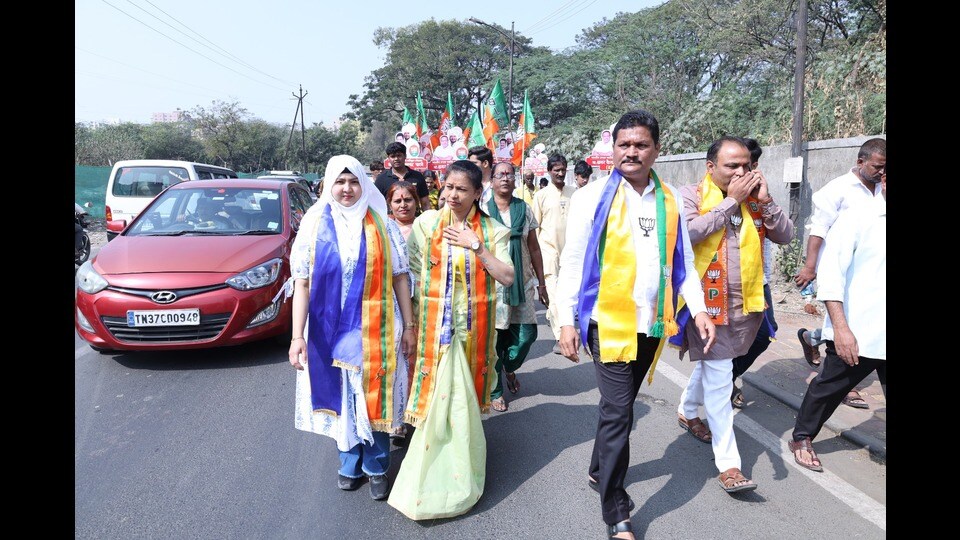
Kondhwa is a Muslim-dominated and socially diverse pocket of south Pune, and has traditionally been considered difficult terrain for the BJP. Khan, who holds a B Com from Savitribai Phule Pune University (SPPU), is a university gold medallist who passed with first class-distinction. She is the BJP’s lone candidate in the ward, and is facing a three-cornered contest against Nanda Lonkar (Nationalist Congress Party/NCP), Taslem Hasan Shaikh (Congress), and Mubina Ahmed Khan (Maharashtra Navnirman Sena/MNS).
Her candidature is significant in the broader context of the BJP’s Muslim representation in the municipal elections. Across Maharashtra, the party has fielded only a small number of Muslim candidates — one each in Pune and Nagpur, four in Malegaon, five in Thane and four in the Jalna Municipal Corporation. By contrast, the BJP hasn’t fielded a single Muslim candidate in its first list for the Brihanmumbai Municipal Corporation (BMC) elections.
Muslims constitute around 11 to 12% of Maharashtra’s population, with a sizeable concentration in urban and semi-urban areas. These include Marathi-speaking Muslim communities in cities such as Mumbai, Pune, and Nagpur; and North Indian migrant populations in towns such as Malegaon, Jalna and Sambhajinagar.
Political observers say that the decision to field Khan from Kondhwa reflects a calibrated attempt by the BJP to project a governance- and education-oriented candidate in a minority-dominated urban constituency, rather than relying solely on identity-based mobilisation.
Outlining her priorities, Khan said that her campaign is centred on education, healthcare, safety and urban infrastructure. “My first priority is to establish a college in Kondhwa so that local students, especially girls, do not have to travel long distances for higher education. The area also needs a Pune Metro link, a multi-speciality hospital and better implementation of government schemes for women and youth employment,” she said.
She also flagged the need for a police chowky in the Mitha Nagar area to address security concerns, particularly for women. “Women’s safety, scholarships for poor and meritorious students, and skill-based opportunities for youth will be among my top priorities. I also want to start coaching centres for IAS and IPS aspirants so that talent from Kondhwa can reach higher levels of public service,” Khan said.
Civic amenities such as public gardens, sports facilities and community spaces are also part of her agenda. Traffic congestion, a long-standing issue in Kondhwa, has been identified as a key concern. “Better planning, parking management and coordination with traffic police are essential. The area cannot grow without fixing mobility,” she said.
In an inclusive political message, Khan said she has received encouraging feedback from residents across communities. “There should be no division. People from all communities are responding positively. I am motivated and confident,” she said.
Khan comes from a politically active family. Her father, Hussain Khan, has been associated with civic and community issues for over 16 years. He said her decision to join the BJP was based on the belief that access to power is necessary to bring about visible change. “When the Centre, the state and the Pune Municipal Corporation are run by the BJP, it becomes easier to implement schemes and bring funds to the ward. That is why she chose this platform,” he said.
He added that his daughter’s entry into politics is not symbolic. “She wants to deliver — for women, for the youth and for every resident of Kondhwa who deserves better education, healthcare and safer streets,” he said.


