
 E-Paper



Compensation not paid to kin in 63% of sewer & septic tank deaths across Maha
30 such deaths recorded in sewers and septic tanks across Maharashtra in the past five years from 2017 to 2021, of which the kin of only 11 deceased have received government compensation while that of the remaining 19 deceased continue to await compensation

 Prefer HTon Google


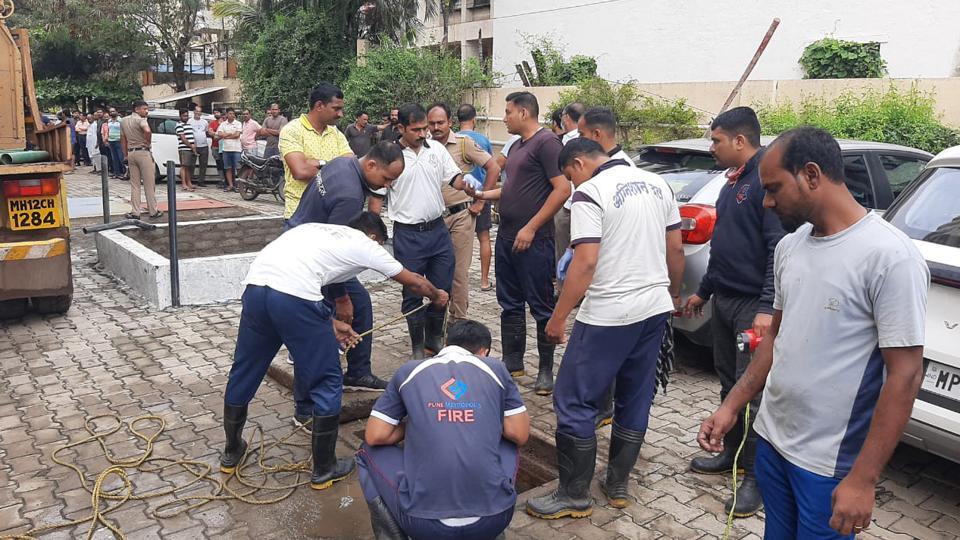
Following the death due to suspected suffocation of two persons while cleaning a sewage chamber at a private manufacturing plant of a multinational company (MNC) in Ranjangaon industrial estate, Pune, last Friday, it has now come to light that there have been at least 30 such deaths recorded in sewers and septic tanks across Maharashtra in the past five years from 2017 to 2021, of which the kin of only 11 deceased have received government compensation while that of the remaining 19 deceased continue to await compensation.
The data maintained by the ministry of social justice and empowerment further states that in 2017, five such deaths were recorded of which the kin of only one deceased received compensation. In 2018, there were six deaths of which the kin of only two deceased got compensation. In 2019, there were 15 deaths of which the kin of only eight deceased got compensation. In 2020, there were four deaths with the kin of none of the deceased receiving compensation. In 2021, there were no deaths reported while cleaning sewers and septic tanks in the state.
Ramdas Athawale, minister for social justice and empowerment, said, “A compensation of Rs10 lakh is being given to the families of those who died while cleaning sewers/septic tanks. The process of distribution of compensation is going on and soon, we will complete it. In addition to that, we have also decided to implement ‘zero fatalities’ in sanitation work across India.’’
Athawale further said that the government has formulated a scheme, ‘National Action Plan for Mechanised Sanitation Ecosystem’ or NAMASTE which aims to achieve ‘zero fatalities’ in sanitation work across India by having skilled workers carry out sanitation work among others. Additionally, for safe and sustainable sanitation, the ministry of housing and urban affairs has also prescribed standard operating procedures (SOPs) for safe cleaning of sewers and septic tanks in November 2018. Under NAMASTE, it has been decided that no sanitation workers should come in direct contact with human faeces and that all sanitation workers should have access to alternative livelihoods.
Athawale also clarified that there is no report of the number of people currently engaged in manual scavenging as defined under the ‘Prohibition of Employment as Manual Scavengers and their Rehabilitation Act’. As far as Maharashtra is concerned, 6,325 such have been identified by the government. Whereas, the state has recorded a total 41 sewer deaths between 1993 and 2022.
National Action Plan for Mechanised Sanitation Ecosystem (NAMASTE)
The project aims to achieve the following outcomes:
1 Zero fatalities in sanitation work in India
2 All sanitation work to be performed by skilled workers
3 No sanitation workers to come in direct contact with human faecal matter
4 Sanitation workers to be collectivised into SHGs and empowered to run sanitation enterprises
5 All sewer and septic tanks sanitation workers (SSWs) to have access to alternative livelihoods
6 Strengthened supervisory and monitoring system at national, state and ULB levels to ensure enforcement and monitoring of safe sanitation work
7 Increased awareness among sanitation service seekers (individual and institutional) to seek services from registered and skilled sanitation workers


