
 E-Paper



Education solutions for the e-classroom
Proctur serves the organised as well as unorganised educational institutes throughout the country including schools, tuitions, and coaching centres


Eduspace Technologies, founded by Delhi-based engineer Nishant Agarwal, has developed “Proctur”, a platform providing technologically-backed educational solutions and focusing primarily on mass digitisation in education. Incepted in November 2016, Proctur serves the organised as well as unorganised educational institutes throughout the country including schools, tuitions, and coaching centres.
Agarwal comes from a middle-class Delhi family. He did his BE in Instrumentation and Control from Netaji Subhas Institute of Technology at New Delhi in 2004, and then worked at Infosys Technologies, Bengaluru, for a year after his graduation. He joined Fidelity Investments in Gurgaon as an analyst programmer and then switched to Citibank Japan as a senior technical consultant, where he worked for five years. After nine years of work experience with mostly large multinational companies in the financial domain, where Agarwal developed and managed products for consumers, he decided to do his MBA. In 2014, he got his MBA degree from IE Business School, Madrid, Spain.
First “failure”
Coming back from Spain and armed with his core expertise in handling management, business strategy, product management, innovation, digital marketing, and analytics, Agarwal launched his first venture Legalink. Explaining the concept, Agarwal said, “It was an email drafting service for the small and medium sized businesses in Japan. My previous work experience at Japan had prompted me to start this venture with my lawyer friend. However, that did not turn out well and I took an exit after two years of running the start-up.”
How Proctur was born
After the exit, Agarwal was exploring opportunities. Says Agarwal, “I used to observe my sister, faculty at a coaching institute. She carried around many books and managed a myriad of tasks manually every day. In the evening, she used to call parents and inform them about their child’s attendance and marks. I realised that technology usage in the coaching classes segment is very low and that segment is in a very nascent stage.”
“I did some research and thought why not digitise the coaching classes. The idea of Proctur was conceived to address the pain points of traditional coaching institutes and students. I was also concerned about the growth of students in this vicinity as they were being deprived of the benefits that come with the implementation of technology in the education sector. During my travels through the country, I realised that it was quite worrisome that a majority of the population did not have access to quality education. In fact, some areas had no access to education at all. I deeply thought about different ways in which I could help both the teachers and the students,” he stated.
First step – A simple interactive platform
Says Agarwal, “Initially, we developed a simple platform where tutors of coaching classes can interact with parents easily, via SMS and other communication channels, using mobile apps. We did not have any tech background. I had a strong product background and experience. So, we hired some freelance developers to develop the product. I was guiding them and it took four to six months to launch the initial version. Meanwhile, we had already started getting some clients. Hunny Tutorial in Delhi was the first coaching class which became our client. We were just walking around on a Sunday afternoon and trying to visit some coaching classes. At that time nobody was using software and our product was also “half-cooked”. Still, he believed in us and appreciates us even today.”
Says Nitin Agrawal, who was the first employee, “I was hired for a sales role in Proctur. I was pretty shy, but took it as an opportunity and started my journey with Proctur. Later I moved to client servicing team as an executive and started interacting with the clients. Interacting with the tech team and improving the product life cycle, Proctur has helped me grow. Currently, I am product manager and looking after the overall product development.”
As the venture started to grow, the company realised that the problem they were trying to solve was much bigger than it seemed at first glance.
Says Nishant Agarwal, “We needed to address all components of the education system – including students, educators, and parents to get the desired results. We also found that it was necessary to address the educational needs as well as the non-educational needs of the students, simultaneously. From the very beginning, Proctur focused on affordability, so that the majority of the population can benefit from the venture. This is where the school segment came into the picture. All of this culminated in the creation of two verticals, catering to the vast unorganized sector of educational institutes as well as the organized sector comprising the schools.”
Agarwal has been into this space for close to five years now. He says, “We now provide a unique offering of a combination of ERP and learning management system (LMS). We help coaching classes and schools to digitise their operational part like fees, attendance, exams, etc. At the same time, they are able to sell their courses online using our platform. They are able to conduct live classes, share videos with the students, online assignments, online tests, etc. We provide complete end-to-end ‘blended learning solution’ as we call it.”
Shifting to Pune
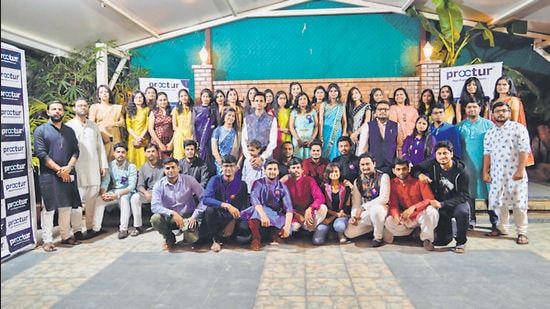
The private coaching classes industry is evolving. Agarwal said, “Online educators have offline presence for sure, but there is no as such exclusive online education provider in India. Considering this fact, we thought it is better to move to a city wherein it is easy to get resources and where it is easy to access new and young minds. We decided to move to Pune which is known to be an education hub of India and a tech hub as well, probably after Bengaluru.”
“Earlier we had a team strength of 40 employees in November 2020. Within a few months of shifting, we have onboarded more than hundred coaching classes from in and around Pune. Now we have doubled our team size to almost 90 members,” he added.
Pandemic accelerated changes
On the effects of Covid-19 pandemic and consequent lockdown, Agarwal says, “We always believed in ‘blended learning’. We had developed the solution of live classes, online tests solutions much before pandemic happened. Due to Covid-19, we have gone at least two to three years ahead of time. The pace at which people are adapting to our solutions, we were expecting that to happen in the next couple of years. It was good to have earlier, but now it is a must-have.”
“With the uncertainty of face-to-face teaching, coaching classes have now become confident of using online software’s. They don’t even ask for a demo and directly go for the purchase. This is a big change in mindset. Also, another visible change is that the product usage has gone very high now. Earlier, institutes were using only 30 to 50 per cent of features that were provided, but now they use almost 80 to 90 per cent of them. Before Covid-19 outbreak, most classes functioned offline and hence scheduling, attendance and sharing exam marks was important task for them besides the fees collection. After Covid-19, online fees collection is most in-demand feature followed by online teaching, live platforms, video sharing and online tests,” Agarwal explained.
“We have started an office in Noida in April to cater to the northern region clients. We are also hiring for offline sales team. Presently, the entire team is remote-working due to lockdowns and Covid-19 outbreak, the lead generation is done using online marketing tools and advertisements on Facebook, Google, etc. Demo is arranged through mobile or laptop for the prospective clients. They are provided with training on using different features and motivated to use them all,” he added.
Future plans
Says Agarwal, “We are a bootstrapped start-up. Our vision is to automate and help streamline management of educational institutes by providing app-based interfaces to key stakeholders in the education industry. We don’t want to be only a software sales company. Our mission is to build a service platform for enhancing student learning and bringing innovation to the rapidly progressing field of education. We are generating a user base on which we can start offering our value-added services. So, it won’t be B2B company but it will be B2B2C. So far we did not go for any institutional investor but now we are looking to raise funds.”


