
 E-Paper



Let ‘healing touch’ also reflect in your conduct: Rajnath to young docs at KGMU convocation
India setting new benchmarks in medical research and developing indigenous solutions to global health challenges through gene therapy and nuclear medicine, says defence minister

 Prefer HTon Google


LUCKNOW A doctor’s true identity is shaped not merely by medical knowledge, but by compassion, empathy and ethical conduct, defence minister Rajnath Singh said on Monday as he urged medical graduates to ensure that their “healing touch” is reflected as much in their behaviour as in the medicines they prescribe.
Cautioning against the impact of ‘white coat syndrome’, a condition in which patients become anxious in the presence of doctors, he said patients remember a doctor’s warmth and reassuring words long after treatment is over and emphasised that trust should replace fear often associated with the syndrome.
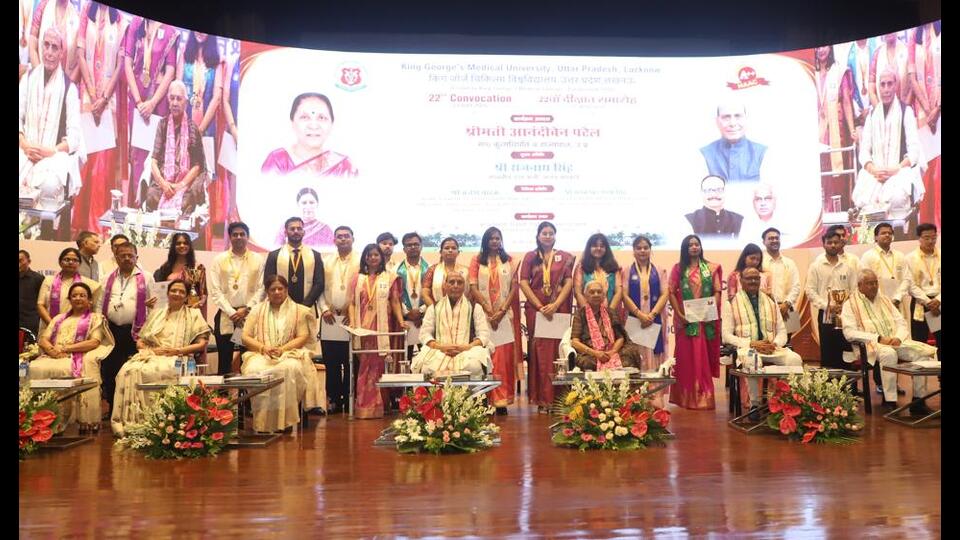
“A patient’s diagnosis is often hidden in what they say. Doctors must listen patiently and treat every patient with dignity and equality,” he said addressing the 22nd convocation of King George’s Medical University (KGMU).
Artificial Intelligence is bringing rapid progress in medical sciences but it cannot replace human compassion, Singh said, urging budding doctors to work with empathy towards patients and their families.
The minister said new technologies such as artificial intelligence, synthetic biology, gene editing and precision medicine are transforming both the direction and the landscape of healthcare.
The defence minister asserted that India is setting new benchmarks in medical research and developing indigenous solutions to global health challenges through gene therapy and nuclear medicine.
“Today, India’s health system has emerged as more self-reliant, accessible, affordable, modern and people-centric as compared to earlier times. Today, India is developing indigenous solutions to global health challenges through gene therapy, nuclear medicine and other modern technologies,” Singh said.
The Lok Sabha MP from Lucknow said the country’s scientists have successfully demonstrated an indigenous gene therapy to treat haemophilia and scientists at an institute in Pune have developed a nanomedicine for breast cancer.
Singh also underlined the importance of preventive healthcare, advising doctors to practise yoga and meditation themselves before recommending healthy lifestyles to others.
He also called for greater research on women’s health, wider awareness about organ donation and greater adoption of advanced medical technologies, including gene therapy, CAR-T cell therapy and nano-drug-based treatment for breast cancer.
“We have developed the world’s most affordable CAR-T cell therapy. Treatment that was previously limited to only a few developed nations and the wealthy is now becoming available in India at a very low cost,” he said.
CAR-T, or Chimeric Antigen Receptor T-cell, therapy is a highly personalised immunotherapy that reprogrammes a patient’s own immune cells to hunt down and destroy cancer cells. It is primarily used to treat specific blood cancers such as leukaemia and lymphoma and is widely recognised as a life-saving living drug.
“India’s health sector has witnessed unprecedented transformation over the last 12 years. Under the leadership of Prime Minister Narendra Modi, our government’s goal has not merely been to provide medical treatment, but to build a healthcare system that is accessible, affordable and quality-driven,” Singh said.
The minister termed organ donation as the “biggest gift” to humanity.
“Unfortunately, even today, there are many misconceptions and hesitations in society regarding organ donation,” he said and added that doctors play the most crucial role in dispelling them.
Singh claimed that under the leadership of chief minister Yogi Adityanath, healthcare services in Uttar Pradesh have seen significant improvement over the past nine years. Before 2017, there were only 17 medical colleges in the state, which have now increased to 81, he added.
Governor stresses rural service, orders hostel inquiry
Governor Anandiben Patel urged newly graduated doctors to serve in rural areas for at least two to three years and continue learning throughout their professional careers.
She also appealed to private hospitals to provide free or subsidised treatment to economically weaker patients and noted that more than 90 crore people across the country have been issued Unique Medical Record IDs under the Digital Health Mission.
Following an inspection of nearly 90 buildings on the university campus, the governor directed KGMU authorities to improve cleanliness, stretcher availability, food quality and security arrangements.
Her inspection of 18 hostels accommodating more than 500 students revealed expired spices in the kitchens of two hostels, prompting orders for an inquiry. She also instructed the university to install washing machines, improve quality of hostel meals, ensure better nutrition by serving paneer and noted that non-vegetarian food was being prepared in three hostels.
To strengthen campus security, Patel announced that KGMU would expand its CCTV surveillance network from the existing 600 cameras by installing another 2,500 cameras across the campus.
Healthcare key to UP’s growth: Pathak
Deputy chief minister Brajesh Pathak said UP’s rapid development must be accompanied by stronger healthcare services.
“Papers can wait, treatment cannot,” he said, urging doctors to regard every patient as equal to God and ensure that nobody is denied timely medical care.
Minister of state Mankeshwar Sharan Singh spoke about KGMU’s historical legacy, saying the institution was built on land donated by the Maharaja of Balrampur and that his ancestors had contributed ₹3 lakh towards its construction while the total project cost at the time was ₹10.75 lakh.
KGMU highlights expansion, research and affordable healthcare
Vice-chancellor Prof Soniya Nityanand outlined the university’s recent achievements, stating that KGMU has performed nearly 190 subsidised robotic surgeries and expanded its Level-1 Trauma Centre with 20 additional casualty beds and 10 ventilator beds.
She said medicines, implants and consumables are being provided at 45-70% below market prices through the Hospital Revolving Fund.
The university has successfully completed 46 liver, 19 kidney and 18 bone marrow transplants and is preparing to launch lung transplant services. Around 60 postgraduate seats have been added during the past three years while recruitment is underway for 325 non-teaching posts. Nearly 80 faculty members and 550 non-teaching employees have also been promoted.
Nityanand said work is progressing on a second trauma centre, a round-the-clock Integrated Diagnostic Centre, an orthopaedic super-speciality block, a new surgical block and an organ transplant complex.
She also highlighted KGMU’s growing international and research collaborations, including an MoU with the University of Manitoba in Canada and AI-based healthcare research projects with All India Institute of Medical Sciences, New Delhi, and the IITs.
Deepti Sharma scripts history with 19 medals
The convocation’s biggest honour went to Deepti Sharma of the 2021-26 batch, who became only the seventh student in KGMU’s history to win both the prestigious Hewett Gold Medal and the Chancellor’s Gold Medal simultaneously.
She received a total of 19 medals, including the University Honours Gold Medal and the Provincial Medical Services Association Gold Medal.
Crediting her achievement to the support of her family, teachers and friends, Sharma said she studies three to four hours daily and hopes to pursue postgraduate studies in dermatology or gynaecology.
Abhilasha Ghosh secured 13 medals, while 20 students —11 men and nine women — received a total of 54 medals during the ceremony.
Degrees conferred on over 1,700 students
A total of 1,701 students, including 975 men and 726 women, received degrees at the convocation. Among them, 515 were from the KGMU campus while 1,186 graduated from 11 affiliated medical colleges and seven nursing colleges.
Former head of the neurology department Dr RK Garg received the Lifetime Achievement Award.
Nidhi Singh was awarded the Dr RML Mehrotra Memorial Gold Medal in the Scheduled Caste category while Aniket Chandra Saxena received major academic honours. Sakshi Tripathi received the Padma Shri Dr Sabyasachi Sarkar Gold Medal in nursing and Dr Shalini Singh and Dr Aritra Saha were recognised for the best postgraduate thesis. Nikhil Verma won the Buckley Cup while Divyanshi Singh was named Best Female Athlete.
Dr M Srinivas was conferred the honorary Doctor of Science (DSc) degree in recognition of his contributions to medical administration and health policy.
Prof Rishi Sethi, prof and head of the department of cardiology at KGMU, was awarded the Governor’s Gold Medal for outstanding faculty on Monday. He was selected by the university’s selection committee for his contributions to medical education, research, student mentorship, institutional development and community service.
‘Hriday Sanjeevani’
The university also launched the ‘Hriday Sanjeevani’ basic life support training programme, inaugurated a bedside CT scan service and a new Central Information Centre and released a book authored by former orthopaedics HoD Dr GK Singh. Several doctors and healthcare professionals, including the Trauma Centre team, were felicitated for their contributions to patient care and medical services.


