
 E-Paper



Global Village Idiot: In search of political ownership for Pune’s development objectives
With all the planning and budgetary allocations from the state and Centre, someone will decide to execute civic projects in a non-intrusive manner. Else, we will continue to live in a dusty polluted congested town even as a smarter city struggles to shape up in the background


It’s April today. So, theoretically, one could understand temperatures close to 40 degrees Celsius. But earlier this week (and all of last week) was March, and temperatures close to 38 degrees in March automatically made me wonder if we would reach 50 by May. Yesterday in particular was scorching.
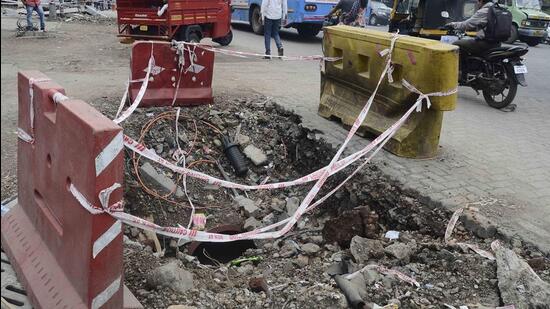
Forecasts for the next eight days show Pune in the 38-41 range. So, it’s going to get hotter and hotter. Which wouldn’t be so bad if we didn’t have road diggings and cable and pipe installations and other kinds of ad hoc road disruption work going on around Baner and Balewadi.
To be honest, Baner is an exciting place to live in, except when it isn’t. Like now. And to be fair there’s been a good bit of development in and around Baner the past few years. But as soon as a project is complete and we look forward to better traffic flow, fresher air, some new project starts.
This area also has a good number of construction sites, which add material particles, dust, dirt, grime and an energetic volume of other unhealthy elements to these suburbs (including noise). And with metro work likely to commence soon on the Balewadi High Street stretch, we can look forward to an indeterminately long period of traffic congestion, noise and general pollution in these parts leading to health, and safety hazards. Yay.
The past few months, roads have been dug up for laying of cables, pipes, for concrete work, for installation of lamp posts, dividers. And how the work happens is a study in inefficiency and inconvenience. They dig up one side of the road, but not entirely, they leave one stretch alone in the middle or the end. Then they get cables and leave it there for a few days. Then they lay cables for weeks. Then they start the covering up. And some months later, they are done. Parts of the approach to our lane is still a disorganised collection of broken pavement tiles, mud and assorted rubble. That’s their idea of done. The entire road is never done at a stretch. As a result, there is work happening most months.
The contractors and teams are all part of the secret service. If you ask them what work they are doing, nobody knows. Supervisors are rarely at these site. So, I can’t even ascertain if they are civil workers on a government approved project or a telecom company digging up for laying their infrastructure (in which case also they should provide ID cards when queried) or a miscreant or fraudster. There are never any official supervisors nor any boards put up with reference to government approval numbers or some official reason. The notable (and welcome) exception is the metro work. They have clearly demarcated everything and signs are up stating purpose.
I often wonder why there is so much randomness in civic and infrastructure work - is there no planning involved anywhere?
I was brought up in Mumbai and have now spent half my life in Pune and half in Mumbai. Further, I come from the hospitality industry, and have been travelling for work around the globe for about 15 years now. I love privacy, want safety and security in the vicinity of my residence and family, but also want an environment that is social, diverse, and hospitable. Which is probably what most people want. What kind of a world is safe, secure and hospitable? Is it possible to be open without entertaining diversity? Is it possible to be knowledgeable without inviting debate? Is it possible to be hospitable without being social at the same time? Is it possible to have a smart sustainable city without development pains?
I look at all the Smart City features in Aundh and I think they look great, but as many of my rickshaw and cab driver friends asked: how is it smart to reduce an already congested motorway for pretty wide pavements that end up lined by hawkers when no one is looking?
There is a lot to learn from cities like Hong Kong and Singapore and Orlando and Dubai - residential areas, shopping areas, hospitality areas, commercial areas, business areas are well demarcated. Even commercial and hospitality areas within residential societies are clearly defined and managed such that residents have peace and quiet and also the opportunity to be social or enjoy a tipple without infringing upon other’s privacy. Laws and boundaries are clear and maintained and administered with efficiency as well. I have been in Hong Kong for long weeks and months several times and one doesn’t even realise there is construction happening next door till the building just appears one day. The construction site is usually completely cordoned and buildings are covered (even those being redeveloped) such that there is hardly any debris or particles intruding upon the surrounding areas. I don’t remember seeing normal life disrupted during infrastructure or construction projects on any of those visits.
I guess this is where town-planning and professional project execution have a vital role to play. Town planning at the local government level can be a fairly straight forward concept - the local government takes a decision based on what’s good for the city, keeping in mind the necessary checks and balances and current global trends and best practices.
But all those cities are administered societies, administered by laws and rules and that means the individuals have to subscribe to and submit to the laws for the agreed development of everyone.
But ours is a democracy, and a different kind at that. We debate, dissent and oppose all decisions at all levels, as do our leaders and our institutions. Further, ours is the kind of democracy where decisions (and authority) related to city development are distributed across central, state and local governments. And with three (or more depending on political alliances at every level) different sets of powers involved in various decisions, Pune is staring at a dismal pace of development and a lot of political posturing on development, usually just before elections.
Till even a decade ago, Baner was a rural, agrarian society. In the past 5 years, it’s been on a development roadmap as an urban suburb and in the past two years it’s moved up rapidly onto a cosmopolitan hub roadmap.
But on the city infrastructure front, it’s a different story and there is a reason for that story because the city does not have a political owner. No power seems interested in developing Pune as a truly world class metropolis, most political leaders have to focus on their own core cities (Mumbai, Nagpur, Baramati) and Pune gets overlooked. The new international airport project saga is a good example.
The past week there has been a lot of activity with many different leaders talking about the new airport and other development projects in Pune. My guess is that election is coming up. I am hoping that with all the planning and budgetary allocations from the state and Centre, someone will decide to execute civic projects in a non-intrusive manner. Else, we will continue to live in a dusty polluted congested town even as a smarter city struggles to shape up in the background.
Mukherjee, author, learning-tech designer and management consultant, is founder of Mountain Walker and chief strategy advisor, Peak Pacific. He can be reached @ thebengali@icloud.com


