A team of scientists from the National Centre for Radio Astrophysics (NCRA) Pune - using the GMRT High Resolution Southern Sky (GHRSS) survey – has discovered two new slow pulsars from the same data that was checked previously for pulsars. The team was able to discover the new pulsars from the same data owing to a superior new algorithm designed to discover pulsars equally efficiently with all ranges of periods and widths.
The team - led by a Ph.D. student from NCRA, Shubham Singh, along with scientists from the NCRA; the University of Manchester, UK; National Naval Laboratory, USA; and West Virginia University, USA – has recently published the new technique for efficiently searching for pulsars with the new discovery in the Astrophysical Journal, July 2022.
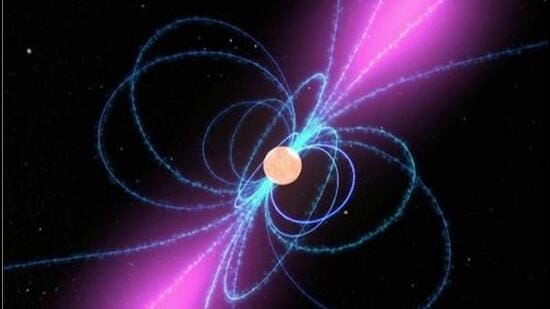
Singh said, “Certain massive stars burn their nuclear fuel and eventually collapse in violent explosions called supernova. A compact city-sized object called neutron stars remains close to the centre of the explosion remnant. Neutron stars are extremely dense and harbour the strongest magnetic fields found in the universe. They rotate rapidly and are able to extract energy from their rotation to form beams of radiation. When these beams sweep past the observer, a sequence of regular pulses is seen and hence, they are named pulsars (see figure 1 for an artist’s impression of pulsars). Over time, the pulsar slows down due to the loss of rotational energy and its rotational period becomes longer. It is predicted that if the period is extremely long, then the pulsar can no longer radiate and moves to the so-called pulsar graveyard, which is a range of pulsar periods and magnetic field strengths that are not enough to sustain the radiation process.”
“However, the discovery of long-period pulsars like J2144-3933, with a rotation period of 8.5s, challenged the emission theories as it is in the pulsar graveyard and still emitting in radio frequencies. Thus, an efficient search for pulsars near this stellar graveyard can constrain the theoretical model explaining the cessation of radio emission. However, one of the major reasons behind the lack of long-period pulsars needed to probe the emission conditions near the graveyard is the bias introduced by conventional pulsar search methods. The conventional search method is highly susceptible to excess noise at longer timescales, introduced by the slow variations in telescope system gain and radio frequency interferences from terrestrial radio sources enshrouding the population of long-period pulsars,” Singh said.
{{/usCountry}}“However, the discovery of long-period pulsars like J2144-3933, with a rotation period of 8.5s, challenged the emission theories as it is in the pulsar graveyard and still emitting in radio frequencies. Thus, an efficient search for pulsars near this stellar graveyard can constrain the theoretical model explaining the cessation of radio emission. However, one of the major reasons behind the lack of long-period pulsars needed to probe the emission conditions near the graveyard is the bias introduced by conventional pulsar search methods. The conventional search method is highly susceptible to excess noise at longer timescales, introduced by the slow variations in telescope system gain and radio frequency interferences from terrestrial radio sources enshrouding the population of long-period pulsars,” Singh said.
{{/usCountry}}Scientists at the NCRA are conducting the GHRSS survey since 2014 and have discovered 31 neutron stars so far, which happens to be the highest number to be found per sky area so far. However, the existing pulsar population from the GHRSS and other ongoing surveys with telescopes around the world is lacking long-period pulsars due to the underlying search algorithm which looks for signals in the pulsar spin frequency domain. In this work, aided by new technological advancement, the team applied an alternative search algorithm to look for periodic signals from pulsars in the time domain with optimal mitigation of contributions from instrumental variation and terrestrial interferences. With simulated data and real GHRSS survey data, the team showed that the new search method is performing significantly better than the conventional search technique, especially for long-period pulsars.