
 E-Paper



Leopard driven out of residential area after seven-hour overnight operation in Shirur
The sighting was reported around 11.30 pm near a house in Joshewadi, following which the Shirur Forest Division immediately mobilised multiple teams

 Prefer HTon Google


A late-night leopard sighting in Joshewadi village of Shirur taluka triggered a tense overnight operation by the Forest Department, which lasted nearly seven hours in a densely populated residential area with narrow lanes and closely packed houses.
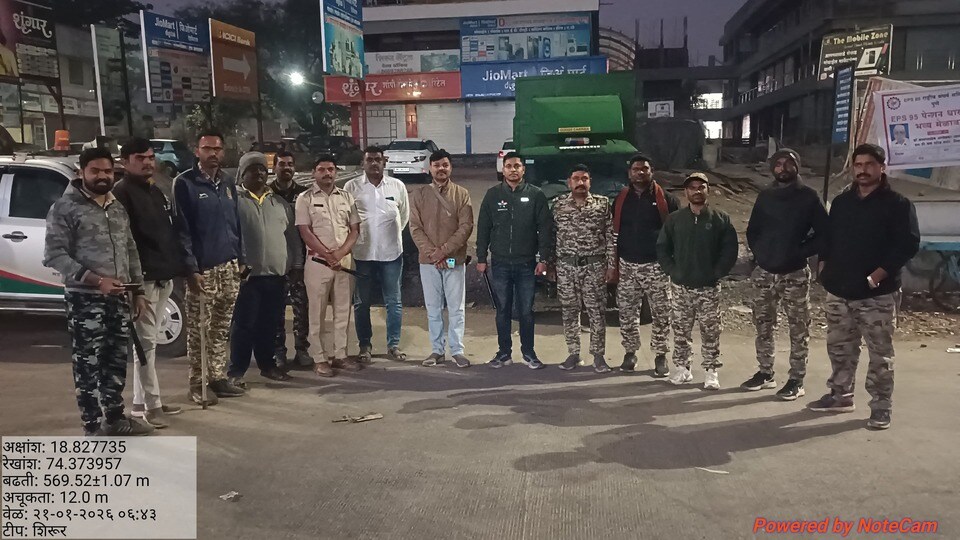
The sighting was reported around 11.30 pm near a house in Joshewadi, following which the Shirur Forest Division immediately mobilised multiple teams. Officials said the biggest challenge was the locality’s layout, crowded habitation, poor visibility and tight bylanes, making it extremely difficult to locate, track or tranquillise the animal without risking human safety.
Despite these constraints, forest personnel conducted a coordinated ground search through the night, closely monitoring movement patterns and attempting to guide the leopard away from residential pockets instead of forcing a capture. After sustained efforts, the animal was finally located and safely driven towards the nearby river belt by around 6 am on Wednesday, averting a potential human–wildlife conflict.
The operation was led by Nilkanth Gawhane, range forest officer (RFO), Shirur, along with forest guards Ganesh Zhirpe and Jalindar Sanap. They were supported by other range staff, base camp members and a veterinary team from the Manikdoh Leopard Rescue Centre.
Speaking on precautionary measures, RFO Gawhane said one cage was immediately installed in the Panjarpol area, while two additional cages and trap cameras were installed the following day. Drone surveillance will also be carried out to monitor the leopard’s movement and assess the possibility of its return.
Shirur tehsil has witnessed a rise in human–leopard conflict in recent years. Between April and December 2025, at least five of the six reported human fatalities caused by leopard attacks in the district occurred in Shirur. Forest officials have captured at least 50 leopards from the tehsil since October 2025, and the operation is ongoing.
Gawhane said that while incidents of human–leopard conflict have reduced to some extent, reports of cattle attacks continue to be received daily. “The problem has not been completely resolved, but increased vigilance has led to some improvement,” he said.
The Forest Department has urged residents to remain alert and cooperate with officials. Citizens have been advised to immediately report sightings, avoid venturing out late at night, ensure children are not left unattended after dark, and keep exterior lights switched on.


