
 E-Paper



Meet Pune’s ‘traffic warriors’, honoured for reporting maximum violations
Pune commissioner of police Amitesh Kumar on Thursday felicitated five Pune residents for reporting highest number of traffic violations through the Pune Traffic Police (PTP) mobile application


Pune: In a strong example of citizen-led policing, five Pune residents were felicitated on Thursday by Pune commissioner of police Amitesh Kumar for reporting the highest number of traffic violations through the Pune Traffic Police (PTP) mobile application. These citizens, through consistent efforts, alerted police of traffic violations and followed it up till many of the violators paid fine.
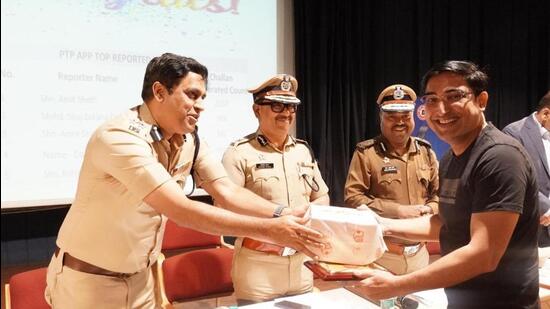
Their recognition by the commissioner and other senior officials was part of National Road Safety Month, being observed from January 1 to January 31, 2026.
The awardees — Amit Sheth, Siraj Dokdiya, Amrit Sharma, Rohit Chavan and one citizen who chose to remain anonymous — have collectively submitted thousands of verified reports, leading to the issuance of several thousand challans.
Traffic officials described the five as the department’s “extended eyes on the road”, helping enforce discipline at a scale otherwise difficult to achieve with existing manpower.
Additional commissioner of police (traffic) Manoj Patil said what set these citizens apart was not just the volume of reports, but their consistency, accuracy and intent. “From illegal parking and signal jumping to dangerous driving and lane violations, they meticulously documented offences and submitted them through the PTP app, often during peak traffic hours,” he said.
Amit Sheth, who topped the list, reported over 2,600 violations, resulting in more than 2,100 challans. Siraj Dokdiya followed by reporting 1,249 violations leading to 994 challans, while Amrit Sharma reported 1,110 violations, resulting in 982 challans. The anonymous awardee submitted 800 reports, and Rohit Chavan filed 729 reports, each contributing significantly to enforcement action.
“These citizens didn’t just report violations; they followed up, ensured accuracy and remained committed to road safety,” Patil added.
During the felicitation ceremony, Kumar praised the awardees for demonstrating responsible citizenship and said technology-driven platforms like the PTP app are most effective when citizens actively participate. “Traffic discipline cannot be enforced by the police alone. When alert citizens come forward and use lawful digital platforms to report violations, it creates deterrence and saves lives,” he said, while presenting cash awards and certificates.
The initiative was carried out in collaboration with the Pune Platform for Collaborative Response (PPCR), which works closely with the traffic police on issues such as traffic management, road safety, pollution and public awareness.
As part of National Road Safety Month, the Pune traffic department has rolled out several initiatives, including awareness drives, enforcement campaigns and citizen engagement programmes, to ensure smoother and safer traffic movement across the city.
Traffic officials said the success of the PTP app and the contribution of these five citizens could serve as a model for other cities. “When citizens choose not to ignore violations, roads become safer for everyone,” Kumar said.
‘Warrior speak’
Amrit Sharma, a graduate engineer who moved to Pune in July and currently teaches at a coaching institute on FC Road, said his journey as a road safety volunteer began with a simple incident. “When I tried to park my two-wheeler in a designated parking lot, I found four-wheelers occupying the entire space. That pushed me to observe traffic behaviour more closely,” he said.
Sharma began reporting violations such as triple-seat riding, mobile phone use while driving, misuse of fancy number plates and vehicles with illegal tinted glasses. His focus later shifted to Hinjewadi and adjoining areas, where he repeatedly observed heavy vehicles — particularly dumpers and ready-mix concrete (RMC) trucks — being involved in serious, often fatal accidents.
“I reported several hundred such vehicles through the app, which resulted in challans,” he said, but added that enforcement remained a challenge. “There is a visible reluctance to act strictly against heavy vehicles. Fines remain unpaid for long periods and recovery is poor. These vehicles continue to operate despite repeated violations.”
According to Sharma, reducing road fatalities will not be possible without stricter regulation of heavy vehicles. “Drivers are largely indifferent to fines. What is needed is proactive recovery and, where necessary, impounding of vehicles,” he said.
Amit Sheth, who reported the highest number of violations, said most offenders fall in the 18–32 age group. “Many use number plates deliberately designed to be unreadable, making vehicles virtually untraceable,” he said, adding that such motorists are frequently involved in signal jumping and aggressive driving.
“The only effective deterrent is a real financial hit through heavy fines. Habitual violators’ vehicles should be impounded for at least six months,” Sheth said.
Rohit Chavan, a computer science graduate from PICT, said he began reporting violations after confronting a car driver travelling on the wrong side. “I want roads to be safer, accidents to reduce and fatalities to come down,” he said.
Referring to Kothrud, Chavan said shopping mall areas are particularly prone to violations, especially on weekends. “Double parking and violations of P1 and P2 parking rules are common on Saturdays and Sundays. Reporting these offences motivated me to continue,” he added.


