
 E-Paper



Modi Lipi sees revival due to Maratha reservation issue
With the state government making it mandatory for members of the Maratha community to submit records for their inclusion in the Kunbi category to avail the benefits of reservation, old documents such as land and revenue records, temple registers and archival papers written in the Modi script have become crucial evidence

 Prefer HTon Google


The recent agitation for Maratha quota and subsequent administrative processes around Maratha reservation have had an unlikely fallout namely, revival of interest in the ancient Modi Lipi which was once the royal script during the reign of the Peshwas.
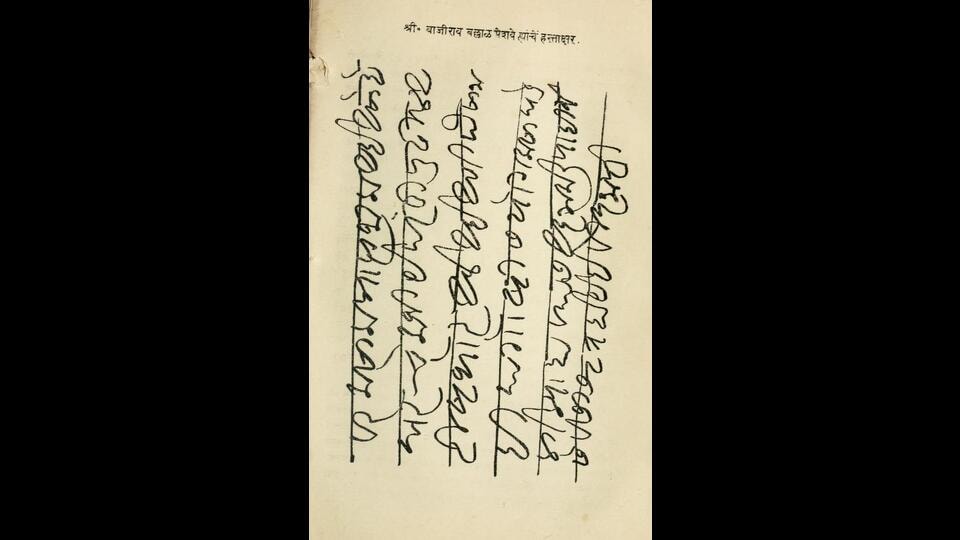
With the state government making it mandatory for members of the Maratha community to submit records for their inclusion in the Kunbi category to avail the benefits of reservation, old documents such as land and revenue records, temple registers and archival papers written in the Modi script have become crucial evidence. The state government has further clarified that only documents dating back before 1950 will be considered valid, inducing a scramble among Maratha families across Maharashtra that are now busy rummaging through ancestral trunks for (worn out) land purchase deeds, temple donation records and manuscripts of all manner, not to mention inundating tehsildar offices to rifle through piles of archival documents in the hope of finding (any) evidence. Many are even demanding that the records be digitised to facilitate easy searching and prevent further wear and tear of the already crumbling documents.
The other thing is that the Modi script has a legacy of over 700 years, and was widely used across Maharashtra for administrative communication and record-keeping apart from being the official script of the Maratha empire during the Peshwa period. Pune alone is estimated to preserve over 5 crore Modi script documents in its state archives. After independence however, Modi was gradually phased out and finally removed from academic syllabi in the 1950s, making it largely obsolete for the younger generation. With the Maratha reservation issue back in the spotlight, the Modi script too is back in focus, making those with expertise in the script indispensable in the reservation verification process.
Sakharam Khandare, a farmer from Satara district, said, “I recently found an old land record from my grandfather’s time written in Modi Lipi. This document can prove our Kunbi lineage and help us avail the benefits of Maratha reservation. But I cannot read a single word of it. I have been visiting tehsildar offices and searching for experts who can translate it but there are so few Modi Lipi scholars available that the charges are very high. Still, this document is my only hope so I am ready to spend whatever it takes. The government should provide certified Modi Lipi translators in every district, otherwise thousands of families like mine will be running from pillar to post without success.”
Furthermore, decoding Modi script documents is not easy – dusty files, fragile paper, blurred ink, and complex ligatures often pose significant challenges. But the current situation has pushed up demand for Modi script experts from Mumbai to Pune to Chhatrapati Sambhajinagar to the extent that families that can afford such services are going all out to get their records read and transcribed. At the same time, Modi experts have cautioned that even after locating the documents, finding definitive proof of the Kunbi identity in them is not guaranteed.
Modi script expert Raj Memane said, “There is tremendous demand across the state for transcription of Modi script documents, particularly from tehsildar offices of each taluka where most of these records are stored. However, the number of skilled Modi Lipi experts is very limited. At present, transcription of Modi documents is a specialised service and on average, it costs around ₹500 per page in the market. This clearly shows the value as well as the scarcity of expertise in this field.”
For many families, the lack of readily available Modi script experts has become a major obstacle. Sunil Jadhav, a resident of rural Pune, said, “After the state government issued a Government Resolution (GR) on the Maratha community reservation, I realised how important the Modi Lipi has become for thousands of families like mine. I want to learn transcription work so that I can help people in my community retrieve old documents and also as a means of livelihood. The demand is huge but the experts are so few that ordinary families are struggling to get their records read. If training facilities are made easily available, many of us are willing to step forward and fill this gap.”
Professor Babasaheb Dudhbhate, coordinator of the Modi Lipi department at the Savitribai Phule Pune University (SPPU), said, “The Modi script is witnessing a revival due to the Maratha reservation issue. We have been working to trace relevant records from the archives, and there has been a sharp rise in people enrolling for workshops to learn the Modi script. So far, between 400 and 500 students have been trained through our department.”
With reservation claims hinging on centuries-old records, the Modi script—once on the verge of extinction—is now witnessing a revival, not out of nostalgia but necessity.


