
 E-Paper



Monday Musings: A hill replaced by a garden or park is lost for ever
The hills in Pune - be it Taljai, Chaturshrungi hill, Vetal tekdi or Hanuman tekdi, - should be retained as hills are an extended part of forests. Turning them into a garden or park may make them aesthetically beautiful, but it will take away their soul and ecological sanctity


PUNE Around 10 years ago, when the Pune Municipal Corporation (PMC) and forest department put up a proposal to construct an open air amphitheatre and bird watching post near the quarry at Vetal Tekdi, it met with a stiff resistance. Those opposing the proposal were citizens from Deccan and nearby areas, and regular tekdi goers. The proposal could not move forward.
Since then many such proposals were moved to artificially develop Pune’s hills, with some of them getting cleared, and the others bringing locals at loggerheads with the civic administration.
The latest getting the attention – and opposition – is the Development Plan for Taljai hills. Located in the southern part of Pune, Taljai hill has a rich biodiversity, wildlife and is one of the biggest that the city has.
The proposed development plan that involves beautification of the hill has attracted opposition from residents who say the move has posed a great danger to the ecology of the hill, located in Sahakarnagar, and visited by morning and evening-goers in large numbers.
The hills in Pune - be it Taljai, Chaturshrungi hill, Vetal tekdi or Hanuman tekdi, - should be retained as hills are an extended part of forests. Turning them into gardens may make them aesthetically beautiful, but it will take away their soul and ecological sanctity.
Already the PMC has constructed a stadium on five acres of Taljai hill. The project worth ₹120 crore also includes seven theme-based gardens such as Nakshatra, bamboo, local species (Ran Mewa), another cricket stadium for women, gymnasium, study room and solar panel covered parking lot on 120 acres of area. The project was originally proposed around two years ago when locals along with some politicos opposed it. The issue has resurfaced now as a detailed project report has been submitted to PMC standing committee, whose nod will facilitate work at the hill.
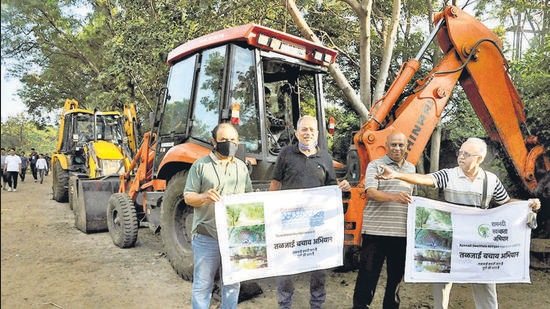
To oppose the project, locals carried out signature campaign. The signature campaign carried out by locals under the banner of Taljai Bachav Abhiyan received a good response on Sunday, an indication that a large number of people, for whom PMC is claiming to be developing the hill, are not happy with the proposal. The locals want the hill to be retained as a hill, as an additional development work will further increase human activity and would frighten the birds. The project will no doubt attract more crowd, noise and litter in the area, that has already seen large number of vehicles every day. Besides crowding, the project threatens soil erosion too.
Already, the PMC and state administration has failed to save hills surrounding Pune, which is surrounded by the Katraj ghats on the southern side and Dive ghat on its east. Most areas on hills at Katraj are dotted with unauthorised construction of hutments. The PMC, forest department or district administration neither have the machinery nor the funds to stop the mushrooming of illegal constructions. The 978 hectares of land on the hills around Pune which constitute the biodiversity park (BDP) zone of Pune, is considered to serve as the lungs for the city. The state government has entrusted PMC to retain the greenery on these hills by implementing a Bio-Diversity Park (BDP), even as the civic body is finding it difficult.
The city has already lost hill after hill in the construction boom over the last few decades. Pune’s topography stands defined by the majesty of the Sahyadri hills around it. The politicians and bureaucrats along with people have taken them granted as they witness various activities. If we do not protect whatever is left, the future generations won’t forgive us.


