
 E-Paper



Monday Musings: Can low-emission zones make Pune breathe easier?
The contrast is stark. A car registered before the year 2000 can emit pollution equivalent to about 11 modern BS-6 cars, while an old truck can pollute as much as 14 modern trucks. Seen in that light, the idea of restricting older vehicles from entering the most congested parts of the city is not entirely unreasonable.

 Prefer HTon Google


Cities rarely change with dramatic announcements. More often, they shift quietly — through policies that at first sound technical but slowly reshape daily life.
One such idea now being discussed in the city is the creation of a Low Emission Zone (LEZ) in the Shivajinagar and Peth areas of central Pune. A meeting in this regard was held at the district collectorate on March 13, and Hindustan Times published a comprehensive report on it. The meeting was steered by PMC chief Naval Kishore Ram, a key driving force behind several key initiatives in the city, along with district collector Jitendra Dudi and city engineer Aniruddha Pawaskar.
The proposal, still under discussion among the Pune Municipal Corporation (PMC) authorities, district administration officials, and transport planners, suggests restricting highly polluting vehicles from entering the area unless they pay a pollution charge.
At first glance, this may sound like yet another bureaucratic experiment. But if implemented seriously, it could mark a significant moment in how Pune begins to deal with a problem it has long preferred to ignore — air pollution caused by vehicles.
For decades, Pune has comforted itself with the belief that it is not as polluted as Delhi or Mumbai. The city likes to think of itself as breezy, green and relatively breathable. Yet the numbers tell a different story.
Study shows that nearly 46% of PM2.5 pollution in the Pune metropolitan region comes from vehicles. These microscopic particles are among the most dangerous pollutants because they can penetrate deep into the lungs and bloodstream.
At the same time, another survey in 2023 found that nearly 70% of vehicles in Pune and Pimpri-Chinchwad still run on Bharat Stage-4 or older engine technology. India has already moved to Bharat Stage-6 emission standards, which significantly reduce particulate emissions.
The contrast is stark. A car registered before the year 2000 can emit pollution equivalent to about eleven modern BS-6 cars, while an old truck can pollute as much as fourteen modern trucks.
Seen in that light, the idea of restricting older vehicles from entering the most congested parts of the city is not entirely unreasonable.
Shivajinagar and the peth areas are perhaps the most logical places to start such an experiment.
These neighbourhoods are not just administrative or commercial hubs. They are also some of Pune’s oldest and densest urban spaces, where narrow roads, heavy traffic and constant construction have already stretched the city’s infrastructure.
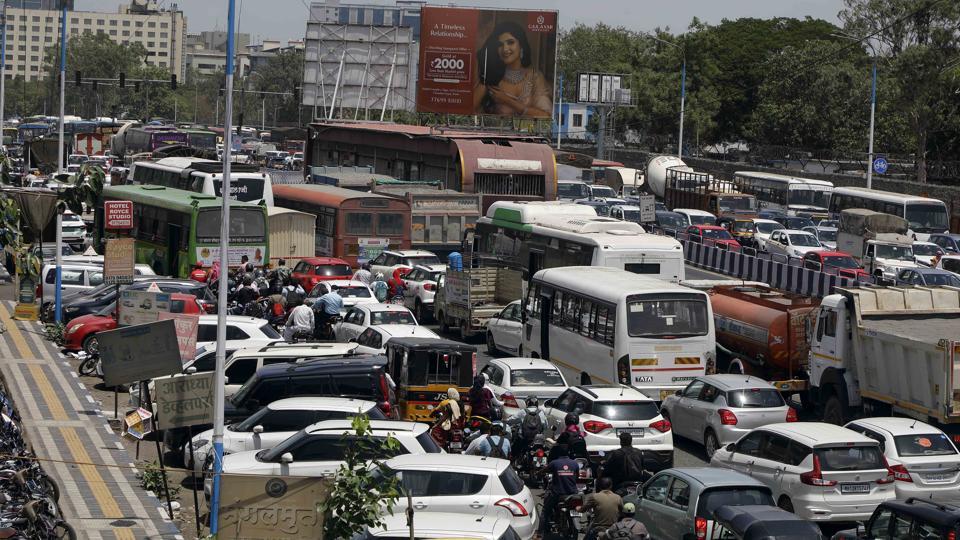
Walk through the area on a weekday afternoon, and you will notice a familiar pattern: buses inching forward, motorcycles squeezing into impossible gaps, autorickshaws darting across intersections and cars patiently idling in traffic.
All of it adds up to one invisible but persistent by-product — exhaust fumes.
A LEZ attempts to change this equation. In simple terms, it works on a straightforward principle: the more polluting a vehicle is, the more difficult or expensive it becomes for it to enter a designated area.
Cities across Europe have adopted this approach over the past two decades, sometimes charging older vehicles hefty fees or banning them entirely.
The idea is not merely punitive. It also encourages behavioural change — pushing people towards cleaner vehicles, public transport or simply fewer trips into already crowded city centres.
But whether such a model will work in Pune is an entirely different question.
Urban policies in India often falter not because the idea is flawed, but because implementation becomes complicated.
For one, Pune’s vehicle population has exploded over the past two decades. The city now has more vehicles than people in many neighbourhoods, thanks largely to the dominance of two-wheelers.
Restricting entry for certain vehicles could therefore raise uncomfortable questions. Who will be exempted? How will the rules apply to delivery vehicles, autos, taxis and small businesses operating in the area?
Then there is the question of enforcement. Officials have suggested that the system could operate through cameras that identify vehicles entering the zone and charge them automatically.
That sounds efficient on paper. But Punekars know from experience that technology often meets its toughest challenge not in design but in daily traffic.
And yet, despite these doubts, the proposal may still represent an important shift in thinking.
For years, the conversation around Pune’s transport problems has revolved around building more roads, flyovers and bridges. The assumption was simple: more infrastructure would reduce congestion.
Reality has shown otherwise. Every new road eventually fills up with more vehicles.
The LEZ idea suggests a different approach — managing demand rather than endlessly expanding supply.
Interestingly, the discussions around the LEZ proposal have also included other complementary measures: making footpaths more walkable, strengthening public transport, increasing bus services and encouraging alternative mobility options.
Those ideas may ultimately matter more than the pollution charges themselves.
After all, restricting vehicles works only if people have viable alternatives.
For now, the proposal remains at the discussion stage. Whether it eventually becomes policy will depend on political will, public acceptance and administrative persistence — three ingredients that urban reforms often struggle to combine.
Still, the mere fact that Pune’s administrators are thinking about LEZ suggests a small but significant realisation: that the city’s air cannot be treated as an unlimited resource.


