
 E-Paper



No more illicit liquor, tribal women from Solapur, switch to furnished cloths as an alternative source of income
Solapur rural police through ‘Operation Parivartan’ have successfully rehabilitated 714 tribal families


In an unprecedented example of the police having gone beyond the call of duty to help transform a community, the Solapur rural police through ‘Operation Parivartan’ have successfully rehabilitated 714 tribal families - earlier involved in the illicit liquor brewing business - by providing them with alternative means of livelihood.
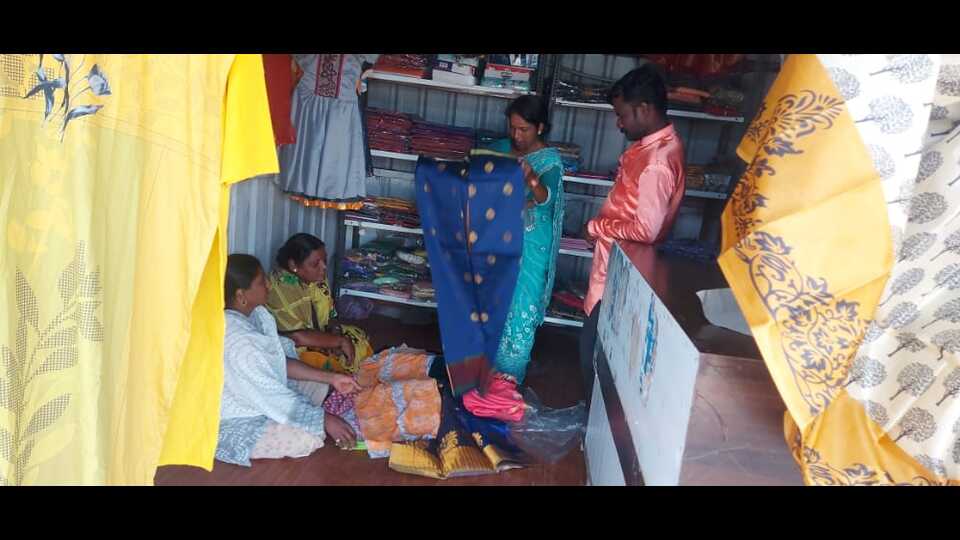
These 714 families based out of Solapur were involved in the illicit brewing, sale and distribution of liquor, a tradition passed down generations for the past 150 years. Instead of simply filing FIRs against these people, the Solapur rural police went a step ahead and helped them shift to alternative livelihoods, including grocery, tea shops, food joints, unskilled/semi-skilled/skilled labour, agriculture and animal husbandry. So much so. that today, around 215 women of this tribal (Banjara) community from Solapur district are actively involved in the manufacture of products such as embroidered sarees, blouses, jackets, kurtas, dupattas and jewellery. What’s more, their products were recently introduced on e-commerce websites under the brand name, ‘Gormati Art’.
Solapur rural SP Tejaswi Satpute has played a major role in this transformation.
The Solapur rural police launched ‘Operation Parivartan’ in August 2021 as part of an integrated approach to solving the problem of illicit liquor permanently. The people involved in the production, sale and distribution of liquor were motivated to change their business and start a new one and were provided financial assistance to stand on their own feet. For a while however, it was seen that two to three days after an illicit liquor manufacturing unit was raided, the people would return to the same business as they were confident that the officers would not raid the premises again at least for a month. Against this backdrop, SP Satpute ordered that all such illegal units be raided twice a week and that they be destroyed along with the raw material. It was these frequent raids that ultimately broke the back of the illicit liquor business.
PI Ankush Mane who adopted Kamti village said, “Because of the frequent raids, illicit liquor producers incurred heavy losses as we destroyed everything, including the vessels and raw materials. Also, we registered cases as non-bailable offences. Later, we arrested many big operators in the illicit liquor trade, which indirectly put pressure on the smaller players.”
Whereas Satpute said that they realised that the raids alone would not solve the problem so they took untiring efforts to change the mindset of the people, and got them to gradually shift to alternate livelihoods. The data (family background, monthly income, education and skills) of the members of at least 586 families involved in the production, sale and distribution of illicit liquor was collected based on which, a counselling strategy was devised. Around 3,000 counselling sessions were conducted wherein the members of these families were motivated to pursue alternative livelihoods in the presence of people from all walks of life. The Solapur rural police even approached several institutes to train the women of the tribal community.
Training in stitching was imparted to 41 women with the help of Udyog Mahamandal through MITCON. Of the 41, 30 decided to make sewing their profession. Industrial sewing machines were made available to them through loans under the ‘lead bank scheme’. Companies such as ‘Apex Garments’ and ‘Jay Garments’ came forward to place the initial orders. Today, these women, who used to manufacture illicit liquor, are busy manufacturing shirts, school uniforms, aprons and several other products, and have proudly named their small unit as ‘Parivartan Udyog Samuh’.
In separate training sessions (40 sessions of two hours’ each) conducted in various villages/tandas, around 300 women were trained and motivated to manufacture products such as embroidered sarees, blouses, jackets, kurtis, dupattas, cushion work, jewellery, decorative items, wall hangings, etc. The capital required for the raw material was made available through a government scheme called ‘Umed’.
Maya Yadav, who previously owned an illicit liquor manufacturing unit with a manufacturing capacity of 100 litre at Kumbhari village, is now content manufacturing clothes. ‘’Because of the frequent raids, I incurred heavy financial losses. I was frustrated but Mane saheb helped me raise money for my new business. Now I am living happily with my family,” said Yadav, who earns ₹20,000 to ₹22,000 monthly through a perfectly legal occupation.
Another woman, Kamala Shinde, who used to sell illicit liquor along with her husband, is now sewing for a living while her husband has put up a ‘vada-pav’ stall in Valsang village for which, the Vidharbha-Kokan Gramin bank even gave him a loan. “’It was difficult for us to quit the traditional liquor business but because of the police, we moved ahead in life and are now earning legally for our family,’’ said Kamala.
For Satpute, ‘Operation Parivartan’ is an ongoing initiative. While the police have rehabilitated 714 families, the process of identifying more such families will never end, she says.


