
 E-Paper



Only two PMPML buses caught fire this year from 27 in last five years
While no commuters were seriously injured in these accidents, according to the PMPML, they have led to concerns among passengers


Efforts to prevent buses from catching fire have borne fruit with relatively few accidents reported this year as compared to the last five years, according to data shared by the Pune Mahanagar Parivahan Mahamandal Limited (PMPML) on Friday.
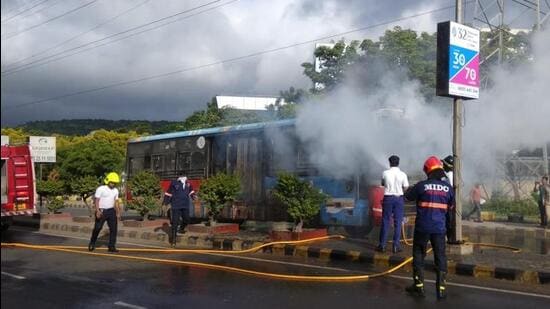
Between 2017 and 2022, at least 27 buses caught fire in major and minor incidents. There were seven such incidents in 2017 and 2018 while the number rose to nine in 2019 only to plunge to zero in 2020 owing to pandemic-induced transport restrictions. By 2021 and 2022 (January to December 9), only two such accidents were reported, one of them involving a charred bus. The vehicle was taken for maintenance and made suitable for travel again. Among the 27 buses that caught fire, 16 were PMPML buses while 11 had been rented out to private contractors by the public transport body.
While no commuters were seriously injured in these accidents, according to the PMPML, they have led to concerns among passengers. So much so that the PMPML previously installed firefighting systems in at least 1,100 buses, with the mechanism capable of extinguishing sparks in the engines. Ramesh Chavan, chief mechanical engineer, PMPML, said, “A look at the buses with and without these firefighting systems will give us an idea about the manufacturing and functioning issues that need to be addressed.”
“Sometimes when oil spreads on the engine and if there is a pipe that leaks in a running bus, fumes near the engine raise the temperature beyond 700 degrees Celsius leading to a spark which in turn can cause fire. Collision sparks and AC compressor-induced sparks have majorly contributed to the fires in most of the cases reported,” Chavan said.
The PMPML bus accidents have majorly been reported in high-speed corridors such as highways and places where there is high collision of traffic. Engines that are persistently adjusted in accordance with pollution norms may sometimes be unadaptable to the ecosystem of the bus, obstructing smooth running and causing these incidents, officials said.
“We have periodic maintenance. We ask the bus manufacturers to investigate the reasons for the accident and let us know if there is a mistake in the bus. We check if there has been any negligence in the regular mechanic schedule, and if we have a record of the mechanic taking care of that bus - we take action accordingly,” Chavan explained. The Chandani chowk incident was a major one and led to the PMPML taking stringent measures to ensure that there was no repeat. “A fire audit is to be conducted by PMC officials in PMPML workshops and units. Buses will also be inspected and revamped to meet the criteria for quality and efficiency. An agency will be delegated to carry on the investigation for improvement in performance,” Chavan said.


