
 E-Paper



Residents oppose clearing of forest land at Warje Malwadi
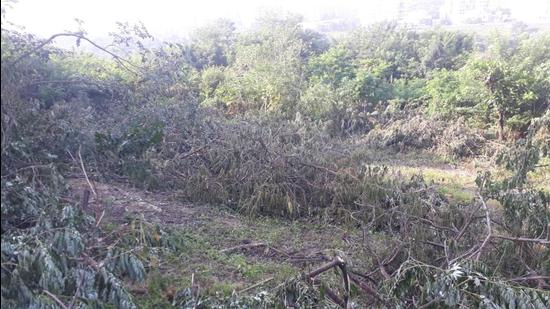
The work for Sanjeevan Udyan, urban forest, has begun full-fledged after the inauguration in August 2021, by clearing of the trees on the 35-acre hill near Dukkar Khind, Warje Malwadi


The work for Sanjeevan Udyan, urban forest, has begun full-fledged after the inauguration in August 2021, by clearing of the trees on the 35-acre hill near Dukkar Khind, Warje Malwadi. But according to locals, the clearing of trees will affect the avifauna in the area.
Arnav Gandhe, a BE Comp student of Msc biodiversity, Garware College, said, “Sanjeevan Udyan has been planned within an area of pre-existing woodland spread across 35 acres. This woodland and the Mahatma tekdi (hill) plateau together are home to more than 115 species of avifauna recorded for the last seven years. It is also home to more than ten species of mammalian fauna, and many amphibians and reptiles which would certainly face a severe habitat loss due to such culling”
“Moreover this culling of trees has been started on the onset of winter which is the prime period for winter migrations of avifaunal diversity observed in Pune. Similar to other the hills of Pune Mahatma tekdi is also used as a halt by these migrants, which would hazard their populations,” he said.
Gandhe said, “When such a huge project is planned the necessary project impact assessment including the biodiversity assessment is a must.”
This is the second such urban forest in Warje after Smriti Van, another urban forest, being jointly developed by the state government, union forest ministry, and a local non-government organisation (NGO).
According to the forest department, Sanjeevan Udyan will also be known as ‘oxygen park’ where landscaping, beautification, pollution control and planting of medicinal herbs and plants will be given top priority.
Rahul Patil, deputy conservator of forests for the Pune region, said that the forest department will offer all support, including trees to be planted on a 35-acre land parcel.
He also clarified, “Only deciduous species are being cleared. Earlier in that area, since it was barren, only Gliricidia trees were planted and according to the Maharashtra forest documents, we are allowed to clear two hectares (5 acres ) of Gliricidia in the urban area. We will be planting more indigenous trees in its place to create a better urban forest.”
According to Gandhe, “Winter followed by Summer is another threat to the mass plantation of native species as due low water table and severe heat, the planted trees would get affected. Even if they are watered by PMC tankers, the guarantee of such regular care remains a question.”


