
 E-Paper



Smooth traffic system running at busy chowks in Pune gets bylanes chocked
The Adaptive Traffic Management System (ATMS) implemented in Pune under the 'Smart City' initiative has helped reduce traffic congestion on main roads, but has worsened traffic on side roads. Residents have reported longer waiting times at signals and increased traffic jams. The PMC is working to address the issue and improve the system. The ATMS is being implemented in three phases, with the entire project expected to be completed by the end of June at a cost of ₹171 crores.


While the Adaptive Traffic Management System (ATMS) implemented by the Pune Municipal Corporation (PMC) at 100 major chowks and roads under the ‘Smart City’ initiative seems to have helped contain traffic congestion on the main roads, it appears to have worsened the traffic situation on the side roads connecting/connected to these main roads.
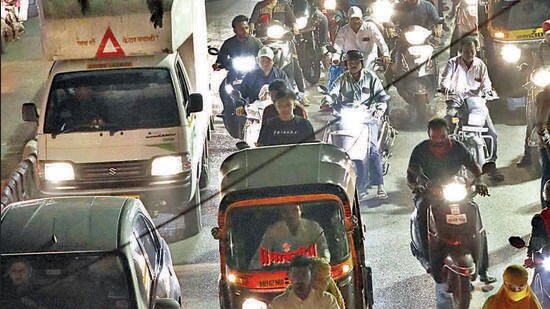
The ATMS works on the principles of intelligent traffic management under which, smart signals capture real-time data and continuously monitor the traffic flow, pedestrian activity and other essential factors on the road so as to adjust timings.
The major components of the ATMS are: adaptive traffic controllers at the junction signals, traffic sensors, variable message sign boards, and integration with the command control centre. The control system has a video wall to monitor sensors and cameras across the city. While the ATMS has had a positive impact on traffic on the main streets, it has ended up increasing traffic congestion on the side roads or causing congestion where none existed before.
Sameer Shaikh, a resident of Viman Nagar, said, “At Hyatt Chowk on Ahmednagar Road near Vadgaon Sheri, there are two side roads connected to Ahmednagar Road: one is from Wadgaonsheri and the other is from Viman Nagar.
The timing of signals at these two side roads has reduced from 25 to 15 seconds which is not enough for the traffic to pass. Therefore, there are huge traffic jams on the Viman Nagar and Vadgaon Sheri side roads.”
Dattatraya Palve from Sukhsagar Nagar, said, “Earlier, vehicles going to Swargate and Sahakarnagar from Bibwewadi did not get stuck in traffic at Pushpamangalam (Maniksheth Dugad) Chowk. But now, after they set up the new traffic signal system (ATMS) on Satara Road, vehicles from Bibwewadi to Satara Road get stuck every morning.”
Vikas Dhakane, additional municipal commissioner of the PMC, said, “We had called a meeting of ‘Smart City’ officials to resolve the problem of traffic jams on side roads and provide enough time to pedestrians to cross the roads. They have assured us that they will solve the problem as early as possible.”
One of the senior officials said that during a recent meeting attended by senior ‘Smart City’ officials, representatives of the company responsible for ATMS were questioned regarding the observed flaws of the system.
However, their responses failed to address several crucial queries.
Shrinivas Kandul, additional city engineer of the PMC electrical department, said, “As per the ‘Smart City’ plan, the ATMS’s implementation solely focused on the traffic of the main roads without considering the side roads which connect the main roads.
The contractor company officials asserted that the upcoming installation of the ATMS on the side roads would resolve the traffic predicament on the side roads as well.
As per the PMC’s instructions, ATMS is going to set a timing of 15 to 20 seconds for pedestrians to cross roads. Right now, pedestrians get only five to seven seconds for crossing roads which is not enough.”
“The Pune ‘Smart City’ is implementing a system in three phases. The first two phases comprising 75 signals have been completed and now, the remaining work is going on,” Kandul said.
One of the Pune Smart City Development Corporation Limited (PSCDCL) officials who is part of the ATMS, said, “The main purpose of ATMS is to synchronise signals and increase the speed of vehicles. Right now, ATMS is collecting the data of traffic on the main roads and adjusting the timing of signals. It has not considered the side roads connected to the main roads.
Now, the system will collect the data of the side roads and analyse it.
The system is new in the country. It will take around three months to collect and analyse and synchronise signals based on traffic flow.”
Chief knowledge officer (CKO) Dinesh Virkar did not pick up calls when we tried to contact him for further details of the ATMS.
In 2017, the then chief executive officer (CEO) of PSCDCL, Kunal Kumar, had proposed the ATMS for the Pune and Pimpri-Chinchwad municipal corporations at a cost of ₹320 crores.
However, it did not work out and PSCDCL then decided to introduce the system in Pune city alone. After around six years, PSCDCL has finally completed the first phase covering 30 signals. The second and third (last) phases of the project will cover 46 and 49 signals, respectively. The PSCDCL has set a deadline of the end of June to complete the entire project, the estimated cost of which is ₹171 crores.


