
 E-Paper



Startup Mantra: Waste is money, say founders of Scrapdeal
Jayesh Pakhale founded "Scrapdeal" after struggling to dispose of scrap during college, turning it into a successful waste management business.

 Prefer HTon Google


Perhaps it is the learning at engineering schools that sometimes sows small seeds of entrepreneurial thinking. Jayesh Pakhale was at the end of his mechanical engineering course at Sinhagad College and had to prepare to leave his hostel room. “When I was in the final year of my graduation, I found myself with a surplus of old college journals, books, and newspapers that I needed to dispose of. I set out to find a local “kabadiwala” in the market who could come to my place and collect all the scrap material at a fair price. Unfortunately, I was unable to find one. They all required me to transport the heavy 100kg+ material to their shop, which simply wasn’t feasible.”
That made him think. How did senior citizens, and working professionals manage to disburse their waste? Surely this simple job must be quite a task for them. He set about to do some research on the subject. Says Jayesh, “As luck would have it, I had an uncle who already had a shop in Pune related to this line of work. He was generous enough to share valuable information and contact numbers of various vendors. This became the basic foundation for my new business venture “Scrapdeal” which was registered in 2021.”
Initial steps
Fired by his experience, Jayesh worked out a method that he thought would work. “I felt that people should be able to simply request for scrap collection and the material be it books, plastic, metal, e-waste, even clothes, anything at all should be collected at their doorstep. There should be a proper weighing scale and payment should be made immediately. The rates should be made known to all beforehand.”
He wanted to offer his customers a more convenient solution. Taking a cue from the online food delivery apps Jayesh felt that the same service should be extended to scrap collection. So he needed an app. Says Jayesh, “But I was a mechanical engineering student and had no idea about app development, so I approached some friends with computer and IT engineering expertise and asked them if they would build me one. They were kind enough to lend a hand in creating a basic Android application for my scrap business. This app was eventually launched on January 10, 2019, during the final semester of my graduation.”
Challenges ahead
Now Jayesh had to get customers who would request scrap collection. The first thing he did was reach out to his college network by sharing the app link in his college WhatsApp groups. He also distributed pamphlets in areas near the college. Says Jayesh, “The response from fellow students and friends was a truly fulfilling experience.” But, getting orders was only one part of the job. Now Jayesh had to deliver the service. “I started this business with ₹1,000 which was part of my pocket money and borrowed some money from my older brother Chetan. I used my two-wheeler and borrowed a weighing machine from my uncle. I carried two big sacks and drove myself to the locations from where the requests came. I weighed the scrap and my pocket money was used to make immediate payment.”
As soon as he had finished paying for his purchase he’d segregate his waste material at his rented flat and take it to the wholesaler. He’d sell off his scrap and then go for the next round of collection. In the early days, he would collect around 500 kg of material. “I would buy it, segregate it myself and then sell it to the wholesaler. I would buy it at around ₹7 or ₹8 and sell it at two to two and a half times at the wholesaler.” And so his purchasing power increased with every round of collection. All was chugging along till Covid hit the city. “That was a seriously dark time for me. To keep some money coming in I even started a tea stall at Sinhgad Road. In those days my business was struggling to stay afloat, so I turned to my family for help and support. Fortunately, my cousins, Vaibhav Pakhale and Ganesh Pakhale were interested in joining the company. In 2021 together we invested ₹1 lakh equally and converted my proprietorship firm to a partnership firm.” In time, Covid abated and their partnership firm started its journey on the growth path.
Making progress
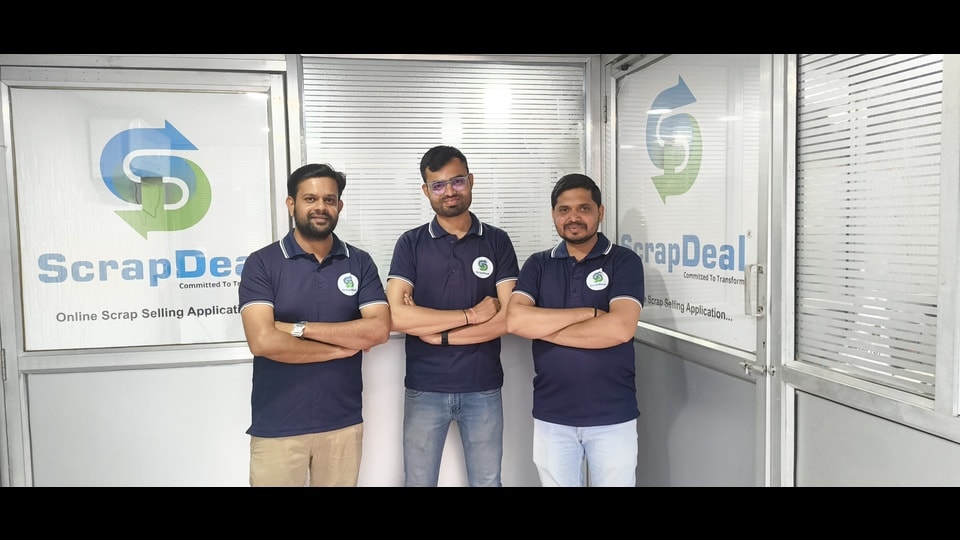
From collecting 500 kgs of scrap per month individually to now more than 100 tonnes has been quite a journey. The three founders have divided the work amongst themselves. Says Jayesh, “Vaibhav manages the finances, Ganesh is involved in the operations and I look after the marketing and technical end.” Of course, now they do not do the collection themselves. They have hired 30+ people who are trained in the process of doorstep collection and segregation. The process involves collecting various types of scrap materials and then carefully categorizing them. Once sorted, the segregated materials are sold to authorized recyclers at market rates. Says Ganesh, “Each category of material is directed to specific recyclers, depending on the type. It’s important to note that each vendor operates on a different credit cycle and has specific policies. Additionally, the rates for all materials are subject to fluctuations based on daily, weekly, or monthly market conditions.” The market rate depends on various factors.
Says Ganesh, “Government policies, demand-supply all impact the rate we get from wholesalers. For example, the government has mandated that companies have to use a minimum of 30% recycled plastic. This means the demand for items like Pet bottles increases”
Funding
Scrapdeal has rented out a 4,000 sq ft warehouse space where their scarp is segregated for sale. They pay a rent of ₹1 lakh per month and along with salaries operate on a 60-70% gross margin. Says Vaibhav, “Our operating cost is about 30% and we have an ROI (Return on Investment) of 15-20% EBITDA (Earnings Before Interest, Taxes, Depreciation, and Amortization). ScrapDeal is totally self-funded and with their own working capital is now generating a ₹2crore+ revenue profitably.
Competition
“Only a few companies are operating in the same segment as ours. Notable among them are thekabadiwala.com, scrapuncle.com and scrapbazar.in. These companies offer their services in various cities like Delhi, Ahmedabad, Bhopal, Indore, and Lucknow. However, none of them
currently provide services in Pune, or the next serviceable city, Mumbai, which gives us an additional advantage in these untapped markets. While there are numerous other management companies, none of them operate in the B2C segment, which presents a vast and relatively unexplored market for us to tap into,” says Jayesh.
Jayesh is confident that it is their efficient execution that is a differentiating factor. Says he, “We ensure timely waste collection, maintain a user-friendly app, provide exceptional customer
service, and offer a distinct value proposition. By focusing on streamlined processes, we simply outpace the competition.”
Future plans
Scrapdeal aims to set up dedicated recycling units in major metropolitan areas such as Mumbai and Bengaluru and expand into more new markets. “Our ultimate ambition is to emerge as the most trusted partner and industry leader in the waste management sector. We hope that more and more gets recycled leading to zero untreated waste,” he says.


