
 E-Paper



Statewide coastal audit launched as ghost nets threaten marine ecology
Zones will be surveyed for ecological sensitivity, species diversity, fishing intensity, and prevalence of ghost gear to identify the areas most at risk from entanglement and overfishing, enabling the development of focused and sustainable regulatory solutions involving local communities


In a bid to tackle the mounting crisis posed by ghost nets – lost, abandoned or discarded fishing gear that continues to harm marine life long after being discarded in the ocean – the Maharashtra Department of Fisheries this week submitted to the National Green Tribunal (NGT) a comprehensive action plan to assess and monitor 300 marine zones along the state’s coastline spread across Maharashtra’s key coastal districts such as Sindhudurg, Ratnagiri, Raigad, Mumbai and Palghar.
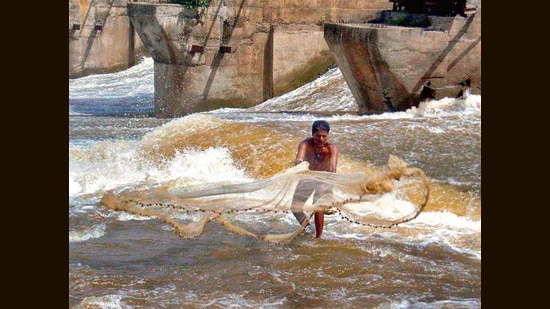
The said zones will be surveyed for ecological sensitivity, species diversity, fishing intensity, and prevalence of ghost gear to identify the areas most at risk from entanglement and overfishing, enabling the development of focused and sustainable regulatory solutions involving local communities.
The plan has been submitted as part of ongoing litigation initiated by the NGT which earlier took suo moto cognisance of a media report highlighting the dangers of ghost nets in Indian waters and directed the fisheries department to outline the measures being taken to mitigate marine pollution cause0d by ghost nets and similar such fishing debris and to provide a detailed roadmap for the future.
Responding to the NGT’s directive, the fisheries department has detailed its collaboration with national research institutions on two innovation-driven projects sanctioned earlier this year by the National Fisheries Development Board (NFDB), Hyderabad. The total sanctioned cost for the projects is ₹67.10 lakh for a period of one year. The first project, implemented by the ICAR-Central Institute of Fisheries Technology (ICAR-CIFT), Kochi, focuses on upcycling abandoned fishing gear and plastic debris into useful textile and geotextile materials. As part of this initiative, over 250 trawl operations have been conducted off the Kochi coast to recover marine litter and study its potential for reuse and recycling.
The second project, being carried out by the ICAR-Central Institute of Fisheries Education (ICAR-CIFE), Mumbai, is dedicated to addressing the ghost gear problem specifically along the Maharashtra coast. The project aims to survey 300 fishermen across various coastal districts to gather data on the distribution, density, and impact of ghost nets. In addition, the project will work to identify hotspots, assess ecological consequences, and implement solutions for removal and recycling of ghost gear, with active participation from local fishers, divers, and other stakeholders.
Ghost nets are widely recognised as one of the most dangerous forms of marine plastic pollution. Originating from both commercial and local fishing activities, these nets are often lost during storms, intentionally discarded, or accidentally released into the sea. Constructed primarily from synthetic fibres like nylon, they do not decompose and can remain in marine environments for several decades. During that time, they continue to trap fish, turtles, marine mammals, and other sea creatures, leading to extensive and often invisible damage to biodiversity.
Ketankumar Ramteke, senior scientist at CIFE, Mumbai, who is also leading the project, said that the initiative began three months ago and will run for a full year. “We are identifying coastal areas where ghost nets are reported in large numbers. These locations will be declared as ecological hotspots. The study will help us develop targeted solutions to tackle this serious threat to marine life,” he said.
Experts say that the long-term damage caused by ghost gear often goes unnoticed due to the underwater nature of its impact. Entangled animals may suffer injuries, drown, or die from exhaustion or starvation. Coral reefs, already under stress from climate change, are also vulnerable to damage from these nets as they get dragged along the seabed.


