
 E-Paper



Sutradhara’s tales: Pune rises from ashes as young Shivaji enters the scene
Under Queen Jijabai’s governance and Dadoji Kondadeo’s supervision, Shivaji Maharaj started gaining experience in statecraft and governance. These fertile grounds became the first cradle of the Maratha kingdom as a young Shivaji Raje walked his first steps on “Punyabhumi”

 Prefer HTon Google


Shivaji Maharaj’s father, Shahaji Raje, fought the battle of a lone wolf. He dreamed of autonomy and an independent kingdom. His aspiration for independence and the contrasting political situation put him at the centre of conflict in western Deccan.
In spite of his loyal service at the Mughal court, an important part of his jahagir was handed over to Fattekhan, the son of Malik Ambar, by the Mughals.
Pune, his home jahagir was ransacked by Adilshahi sardars mercilessly. This left Shahaji Raje disillusioned. As he left the Mughal service to return to Nizamshahi, Nizamshahi was breathing its last.
And yet, with sheer grit, Shahaji Raje protected Nizamshahi’s underage heir to the throne, against the joint forces of the Mughals and Adilshahi.
He made Pemgiri near Sangamne his capital and continued to defend Nizamshahi for the next four years.
Around the end of 1636, Nizamshahi rule ended after a bitter struggle and territory was distributed between the Mughals and Adilshahi. Shahaji Raje returned to Adilshahi and was awarded his original jahagir of Pune, Supe and Chakan pargana by Mohammad Adilshah II.
However, as retribution of his actions, he was appointed to conduct the Karnataka campaign along with Adilshahi sardar, Ranadulla Khan, this far from his jahagir.
As he could not administrate Pune, Shahaji Raje appointed his trusted official Dadoji Konddeo to accompany his elder wife Queen Jijabai and second son, Shivaji Raje, to govern Pune. In addition, Dadoji Konddeo was the Adilshahi subhedar of fort Sinhagad. A cavalry of 1,000 soldiers, was appointed for their assistance.
Pune was in no condition to be inhabited in 1637, so Queen Jijabai and Shivaji Raje sought temporary residence at Kasba Khed (Shivapur) near Pune, at Bapuji Mudgal Narhekar Deshpande’s wada.
Dadoji Konddeo was assigned the responsibility of training a young Shivaji in statecraft and military prowess.
To resurrect Kasba Pune and the entire Mawal region was no easy task. People believed that the land was infested by ghosts and demons and were reluctant to inhabit it. Queen Jijabai and Dadoji Konddeo decided to conduct an auspicious ritual to purify the land.
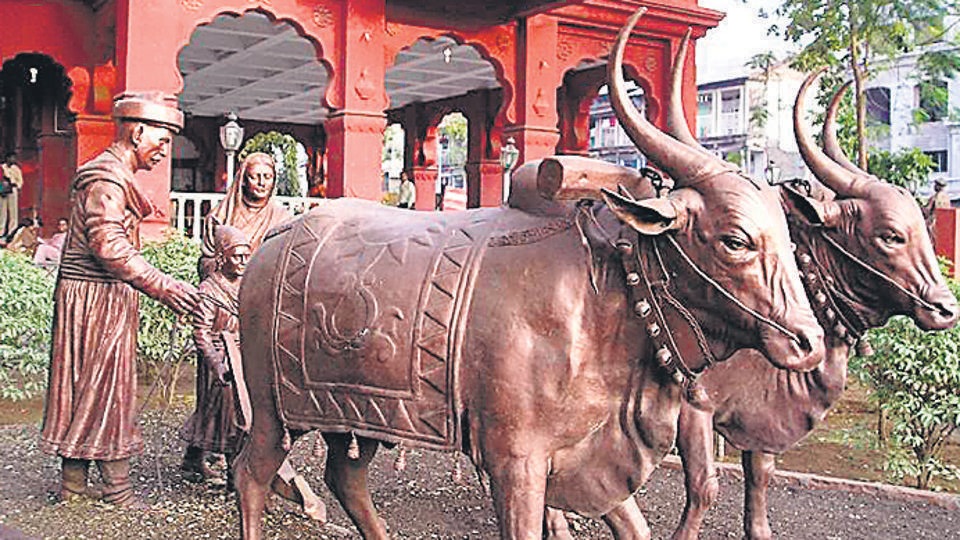
As per prescriptions of the shashtra, a king should sanctify polluted land by tilling it with a gold-tipped plough, yoking healthy bullocks with gold- tipped horns. This symbolic gesture was conducted to bring fertility and productivity back to the land.
When this ritual was conducted by Queen Jijabai and Shivaji Maharaj, jahagirdars of Pune, under the guidance of Dadoji Konddeo, it instilled great confidence in the minds of the public. This meant that the Bhosale family would personally protect the locals and guard their land and interests.
The Patils, Deshmukhs, Kulkarnis and village workers, assured of their safety, were brought back to Pune,.
They were given the responsibility of agricultural development. Special offers were made to farmers and farm workers to cultivate the land. Agriculture taxes were exempted for five years. Dadoji Konddeo adopted Malik Ambar’s taxation model in a staggered manner, to be executed over three years. The entire land had to be inspected and was classified according to productivity. Eventually, one-fourth taxes were levied on agricultural produce. Several fruit orchards were promoted. Loans and discounts were offered to expedite redevelopment of the land.
The “gav pandhar” or residential settlements, were newly laid down as per community preferences.
The resettlement of Pune would not be possible without assured sources of water. Expansion of Pune as a city (and most medieval towns), has always been a function of water. In order to ensure guaranteed irrigated supply for newly cultivated lands, a dam was built on the old Ambil Odha (stream) which flowed from the south of Pune to the centre, to meet the Mutha river.
A dam was built in a ‘C’ shape near Parvati and named “Seri-Parvatiche Dharan”. The dam was primarily for irrigation purposes and it submerged a large area extending from Sanas ground to the present-day Parvati water works. The remnants of the dam wall can still be seen over Ambil Odha today.
Before construction of the dam, the Ambil stream was used by the Mahar community to wash animal hides which polluted the clean water. In order to avoid this, the community was awarded a separate space to process animal hides on the western side of Pune at the time. They were also awarded a space to the northeast of Pune behind Kalbhairav temple (present day Maharwada).
The old temple of Ganesha, between Shitole wada and Honap Deshpande wada at Kasba peth, was in a terrible state when Queen Jijabai took charge of Pune. It had suffered great damage after the Adilshahi attack on Pune. Vinayak Bhat Thakar, who was in charge of the Ganesha temple during the Nizamshahi, performed the daily service discreetly, not to invite undue attention.
Queen Jijabai ordered Dadoji Konddeo to rebuild the Kasba Ganpati temple and reinstated daily worship with great fanfare. The archival documents of the Thakar family inform us of annual grants given by Queen Jijabai.
She also reinstated the Tambdi Jogeshwari temple near “Kale wavar”, at the present-day Appa Balwant chowk. The Bendre family was given a grant for the same.
Kasba Ganpati and Tambdi Jogeshwari, along with Nava Kalbhairav, were recognised as the three main Gram devatas of Pune city.
Dadoji Kondadeo ensured that the wildlife menace was reduced around the settlement by declaring awards for the hunting of wolves and wild boar. He was also responsible for establishing a peth in the village of Pashan, named after Jijabai, as Jijapur.
Under Queen Jijabai’s governance and Dadoji Kondadeo’s supervision, Shivaji Maharaj started gaining experience in statecraft and governance. Queen Jijabai actively oversaw the judiciary functions of the pargana. Pune was finally resurrected from the ashes. These fertile grounds became the first cradle of the Maratha kingdom as a young Shivaji Raje walked his first steps on “Punyabhumi”.


