
 E-Paper



Sutradhara’s Tales: Recipe of a Peth by Pune’s Shete-Mahajans
Pune along with Pimpri-Chinchwad is the largest city in Maharashtra and ranks as one of the seventh most populated city in India. With a total area of 518 sqkm it has surpassed even Mumbai.


The recent statistics show that Pune along with Pimpri-Chinchwad is the largest city in Maharashtra and ranks as one of the seventh most populated city in India. With a total area of 518 sqkm it has surpassed even Mumbai.
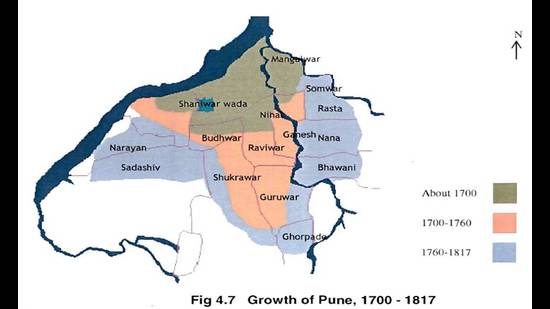
This march of expansion in case of Pune had picked up the pace way back in 18th century itself! Today we witness agencies such as Pune Municipal Corporation (PMC) and town planning department facilitating, administering and governing the growth of the city through development control (DC) rules and laws.
Unlike north Indian societies, traditional Maharashtrian society lacked a well-defined occupation group of traders such as Baniyas. In traditional Marathi village, there existed Vaishya Vani community which would be involved in retail selling of household goods and so on. The weekly bazaars use to be held at a central village or town where people bought sold and exchanged commodities. During time of Deccan sultanates, one witnesses a migration of Bohra community from Surat to Deccan in search of trading opportunity who later had settled in parts of Pune, too.
But, these communities and their occupational function did not directly contribute to assist in systematic urban planning and development of the city.
As the political importance of Pune was on a rise due to residence of Peshwas in Pune, inflow of various communities in search of livelihood opportunity had increased. The new communities could not be speedily and organically assimilated in small town structure consisting of Patils, Kulkarnis, Deshmukhs and Deshpandes. The trade and industry was also to be encouraged and fostered.
Thus, the government, in this case, the Peshwas, took the responsibility of setting up newer parts of Pune in orderly fashion, through agencies of community called “Shete-Mahajans”. Shete-Mahajans often belonged to upper class community, mostly Brahmins, who were well off and often functioned as money lenders, too. Their economic status served as a financial guarantee, thus, making them a preferred choice.
Records or “Rumals” from Peshwa archives give us accounts of watan contracts of the peths that was signed between the government and the “Shete-Mahajan” individual. The assignment was hereditary in nature and the contract was called “watan patra” of the peth.
One such document from Tulshibaugwale Daftar states that the Watan patra of Rasta peth is hereby renewed and given to Anandrao Bhikaji /Sadashivrao, son of Mahadap Shete of Pune, whose father was given position of Shete. He was, thus, directed to make the Peth prosperous and on the fulfilment of agreement for ten years, he shall exercise the prescriptive rights of the office.
He is to exert his right to bring in merchants and professionals for settlements in demarcated wards as per their occupational requirements. He is to discharge his duties loyally and to best of his abilities.
Similar document can be found granting the rights to Firangoji Khande to establish a peth to west of Ganesh peth beyond Nagzhari, north of Bhawani peth and to south of Ratha peth. He was to being the new families of merchants and artisans to establish the peth and was granted a hereditary right.
The boundaries of new peths wee meticulously set and described in “watanpatra” which reflected a concern for orderly development.
The peth was a complex of residential places, shops and artisan manufactories. This was intercepted with public spaces such as temples and shrines, gardens and parks, orchards, bakhal (open grounds around buildings and workshops), public water tanks or hauds, kattas and paars (public platforms) and police post called chawadi.
Artisan communities such as Tambats (coppersmiths) from Raigad and Brud from Karnataka and Andhra region settled in Pune during these times. Even, the ascetics such as Giri Gosavis from Rajasthan who worked as traders and money lenders are seen settling in math at Somwar peth and building temples such as Trishund Ganesh in Pune.
Parts of residential houses in medieval Pune houses many times doubled as workshops and shops for artisans such as tambats, potters, shikalgars and buruds. Thus, the streetscape and width of the roads were arranged so as to provide for these customised requirements for each artisan groups. The sale of product such as pottery or delivering the service such as tailoring service was done along the roadside openings of the houses. In some cases, meandered streets were planned to make provision for corner spaces which does not lead to grid like arrangements one sees in modern town planning.
It is pertinent to note that, as an effect, many artisans are clubbed as per individual occupation and caste in medieval Pune as against class-based housing. Thus, these complexes of work and home were arranged on both sides of the roads referred to as Ali, Bol or Galli in Marathi. Based on the particular artisans’ occupation or products, they are named as Burud Ali (bamboo weavers), Tambat Ali (Coppersmiths), or Sugandhi Ali (fragrant perfumes) and Cholkhun Ali (khun blouse cloth).
As the lanes were built for pedestrian and bullock cart traffic, they were narrower and closely placed than modern lanes, in character. The scale of the architecture of the peths was low, often not more than two storeys. The peths were almost self-sufficient units of administration except for the watch and ward, which was under the town Kotwal.
The peth was, thus, understood to be organised for a specific purpose, to initiate and foster economic activities and trade through exchange of commodities or production through the artisan trades. The Shete–Mahajan was responsible for general upkeep maintenance and repairs of public services and facilities in a peth.
In exchange of these services, Shete-Mahajans were entitled to impose and collect certain contributions from peth dwellers. The documents list 35 different articles that Shete could collect from grocers, vendors of wood, tobacconists, fishmongers, oil mongers, weavers, manufacturers of charcoal and lime, carders, shepherds, tailors, thatchers and other professionals. Prescribed amount and quantity of products were to be paid to Shete and he was entitled to receive traditional gifts on stated holidays and festivals.
The redevelopment of old declining peth, too, was entrusted to Shete–Mahajans. However, the decision to initiate such development as well as right to transfer the office from person or family to other remained solely reserved with government. Such transfers would take place if work was found unsatisfactory because of inefficiency, complaints of high handedness from residents’ or excessive extraction.
Various taxes such as gharpatti- house tax, Gulal- patti- a tax for celebration of certain festivals such as Holi and Jhende patti- professional tax were to be paid by the occupants of houses in the peth. The tax income of particular would also include the fines collected in case of civil disputes and punishments.
The taxes for a peth were collected by another official named “kamavisdar” who served under “mamlatadar”, the main officer of revenue administration. The remuneration paid to the kamavisdar differed from one area to another. The general principle seems to have been to give the kamavisdar four per cent of the money advanced by him, through the rule does not seem to have been followed uniformly. Kamavaisdar was, thus, allowed to collect a stated number of taxes from professions in the peth in return for his agreement to pay a predetermined amount of money in advance every year to the government.
This urban system of town planning led to development of eighteen peths which contributed making Pune a prominent trade centre till the end of Peshwa era. With backing of strong political presence, a now forgotten community of Shete-Mahajans were successful in developing the urban Pune of 18th century CE.
Saili Palande-Datar is an indologist, environmentalist, history researcher and farmer. She can be reached @ sailikdatar@gmail.com


