A second chance for 27 Assam residents declared foreigners
Many of the declared foreigners cited illness, poverty, illiteracy or confusion about the legal process as reasons for not appearing before the foreign tribunal
Updated on: Jul 27, 2026, 06:27:47 IST
By Biswa Kalyan Purkayastha, Silchar
Prefer HTon Google
Share via
Copy link
The Detention of Noor Jahan and Abdul Jebbar
Sixty-year-old Noor Jahan from Assam’s Morigaon spent seven years in a foreigners’ detention centre after a Foreigners Tribunal (FT) declared her an illegal foreigner in an ex-parte (one-sided) order in 2011. Her husband, Abdul Jebbar, 75, was declared a foreigner by the same quasi-judicial tribunal in 2012.
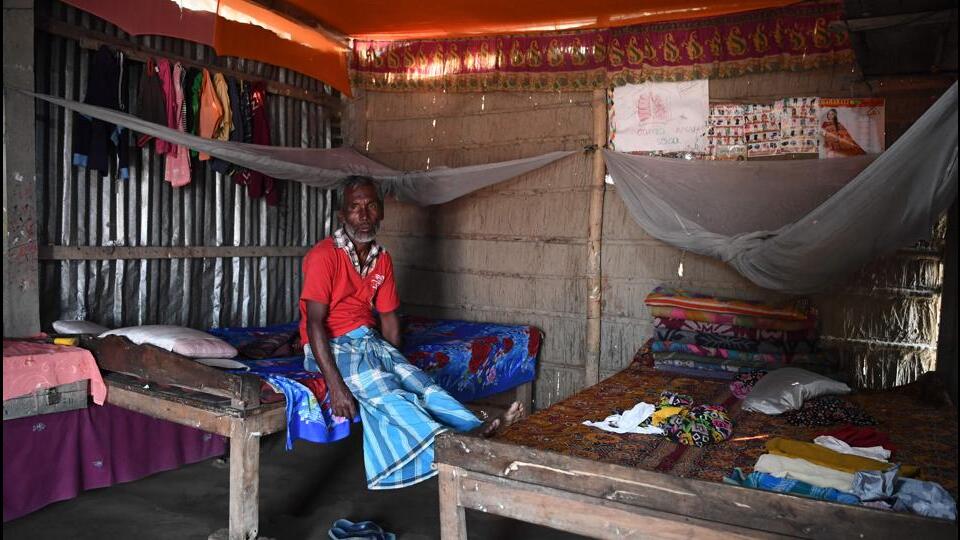
Habib-ur-Rehman, who was released from a detention centre, rests in his home in Barpeta village of Assam. (AFP File)
Arrested in 2013, the elderly couple walked out only in 2020 during the Covid-19 lockdown after the Supreme Court (SC) ordered the release of long-term detainees on conditional bail.
The family is modest. Noor Jahan is a housewife, and Abdul Jebbar served as a cleric at a mosque in Tezpur until his arrest in 2013. The family lives in a small house.
But their challenge to their detention –– first in front of the Gauhati high court in 2013 which was dismissed four months later and then before the Supreme Court in 2017 –– became part of a historic apex court order last week involving 27 Assam residents declared foreigners through similar proceedings.
“I cannot forget the night when we were almost dragged by the police. We were among many families, and they [the police] were treating us like we were not humans but some domestic cows,” Noor Jahan said.
She said family members tried to show their documents to police officers but the officers refused to check. “My father’s name appeared in the 1951 National Register of Citizens (NRC), he had voted as an Indian multiple times before 1966, and we have all the documents. We tried to show those, but nobody listened to us,” she added.
The FT notice was issued in early 2009, and the couple appeared twice before the tribunal. However, due to a miscommunication with their lawyer, they did not receive updates about subsequent hearing dates, according to Noor Jahan’s sons. They were declared foreigners in mid-2012 and, around seven months later, on March 26, 2013, filed a writ petition before the Gauhati high court.
In 2016, they approached advocate Milan Laskar, who represented them before the Supreme Court.
Laskar confirmed that Noor Jahan’s father Abdul Khalek’s name appeared in the NRC 1951 draft and that she had the document in her possession.
“As per the records, she accepted the FT notice and appeared once or twice but later discontinued. They were declared foreigners in an ex-parte order,” he said.
Her son, Umar Faruk, said they spent more than ₹12 lakh on the legal process. “The process in the high court and Supreme Court was highly expensive, and we had to sell our land, cows, and whatever valuables we had,” he said.
“We are five brothers, and two of us were minors when our parents were arrested. They left their studies and joined work so that we could arrange the lawyers’ fees. After 13 years, we finally have a chance to show our documents,” he said.
The Supreme Court judgment
Last week, a top court bench of justices Vikram Nath and Sandeep Mehta held that even when a person fails to appear before a foreigners tribunal, citizenship cannot be determined through a mechanical or purely technical process. The court remanded all 27 cases to the respective tribunals for fresh adjudication and directed that no coercive action be taken against the appellants until the proceedings conclude.
The judgment did not declare any of the appellants Indian citizens. Instead, it stressed that citizenship disputes, given their grave consequences, must be decided through a process that satisfies constitutional standards of fairness.
“A person proceeded against before a foreigners tribunal may ultimately fail to establish Indian citizenship, but the process by which such determination is made must still satisfy the constitutional requirements of fairness, reasonableness and non-arbitrariness,” the court observed.
Assam citizenship timelines
Under the Assam Accord, those who entered Assam before January 1, 1966, are recognised as Indian citizens. Those who arrived between January 1, 1966, and March 24, 1971, can remain in the state after registering as foreigners and become eligible for citizenship after 10 years, without voting rights during that period. Those entering on or after March 25, 1971, are treated as illegal immigrants and are liable to detection and deportation.
In 2018, the NRC was carried out in line with the Assam Accord, using March 24, 1971, as the cut-off date for inclusion. As part of the exercise, applicants had to establish a “family tree” by proving a legitimate link with their ancestors using pre-1971 documents.
The 27 appeals before the Supreme Court shared one common feature: Each person had been declared a foreigner after ex-parte proceedings. First, the border police referred the cases to the FTs in the respective districts. The FTs then issued notices asking the individuals to appear on a specific date. Many appeared initially but did not continue, while many others did not even receive the notices.
According to advocate Sishir Dey, a former member of a FT in Assam’s Sribhumi district, if a person misses three consecutive hearing dates, the tribunal has the authority to issue an ex-parte order.
Laskar represented five of these 27 cases, and said that one of them had proof of living in Assam before March 25, 1971.
Ajiuddin, 60, was served an order of the FT in 2010, another ex-parte order.
The farmer was asked to register his name in the Morigaon Foreigners Regional Registration Office (FRRO) by the FT in 2011 but didn’t do so.
According to Laskar, Ajiuddin was directed to register with the FRRO within 90 days of the FT’s order. However, due to health issues, he approached the office after more than 180 days. The FRRO refused to register him because he had missed the deadline. He then approached the tribunal seeking a fresh date to complete the registration, but the plea was rejected.
“He later moved the high court, but nothing changed, and he kept living in that uncertainty until the SC finally allowed him to appeal before the FT again,” Laskar said.
“According to the FT, he missed multiple hearings, but on the ground, he was not aware of it; he didn’t receive the FT notice. The first notice he received was an FT order which was based on a direct reference by the police,” Laskar added.
Many appellants said they never received tribunal notices properly. But as per the FT records, they initially appeared but missed dates later.
Most petitioners financially poor
Activist Mansur Ahmed from Tezpur said that many petitioners were daily wage labourers. “They leave their work to appear on these dates, and most of the time, the absence of FT members or the public prosecutor delays the process,” he said.
“The absence is contempt of court which is punishable, but it should not cost an Indian their citizenship,” Ahmed added. His organisation, Progressive Society, has been working for people fighting for citizenship in many parts of Assam.
Many of the declared foreigners cited illness, poverty, illiteracy, or confusion about the legal process as reasons for not appearing before the FT on scheduled dates. Several argued that minor spelling differences, typographical mistakes, or inconsistencies in decades-old electoral records and legacy documents eventually became the basis for their being declared foreigners.
Among those who approached the apex court were Sabitri Dey, Ajbahar Ali, Md Akbar Ali, Abeda Khatun, and Anowara Khatun. Their petitions argued that hyper-technical discrepancies in historical records had overshadowed the substantive evidence supporting their citizenship claims.
How the tribunal cases unfolded
In Sabitri Dey’s case, the FT declared her and her family foreigners after none of them appeared or filed a written statement. The Gauhati high court later upheld the decision, largely on the ground that they had not participated in the proceedings.
Md Akbar Ali’s brother appeared before the tribunal and informed it that Akbar Ali was seriously ill and therefore unable to attend. Despite the explanation, the tribunal proceeded ex-parte and ultimately declared him a foreigner.
Samiran Nessa initially appeared before the tribunal and sought additional time but later remained absent, resulting in another ex-parte declaration. Abeda Khatun filed a written statement but failed to produce evidence despite being granted opportunities, leading to a similar outcome.
The apex court observed that while ex-parte proceedings are legally permissible, they do not relieve tribunals of their obligation to independently assess the available material before arriving at a conclusion.
“An ex parte proceeding may dispense with the participation of the absent party, but it does not dispense with objective consideration and meaningful adjudication by the tribunal,” the bench said.
Activist Kamal Chakraborty said that while ex-parte was a legal procedure, its execution in most cases was unjust. “In many cases, the police pasted the notice on trees or shops; the person in question didn’t even know that they were asked to appear,” he told HT.
Invoking the doctrine of audi alteram partem, the principle that every person must have an opportunity to be heard, the court described it as one of the foundational rules of natural justice and “a rule of fair play in action.”
For Noor Jahan and Abdul Jebbar, the legal battle that began more than a decade ago is far from over. But after years spent inside a detention centre, repeated court appearances, and a prolonged struggle to establish their identity, they now have something they say they never truly had before — a chance to be heard.
“I am hopeful that we will be able to prove our citizenship in the court (FT),” Noor Jahan said. “At least, we’ll die as Indians.”
Get Latest News, breaking headlines, and top India News, and today real-time updates from across the nation. Stay informed on politics, government policies, crime, Today Weather, and major developments on Hindustan Times
Home/India News/A Second Chance For 27 Assam Residents Declared Foreigners

 E-Paper