
 E-Paper



Taste of Life: Even a greenhorn can do ‘Poonah’ painting for home decoration
Historical archaeology reveals the fascinating connection between Nauvoo, Illinois, and Poonah pottery from Staffordshire, England, popularized by Mintons in the 19th century.

 Prefer HTon Google


The dynamics between food and culture, food and environment, and shifts in foodways over time are of particular interest to researchers. Historical archaeology, the archaeology of the modern world, AD 1400 to present, provides exemplary insights into various aspects of food culture making the recognition of the recent past a legitimate subject of research.
The development of historical archaeology in the USA coincided with an exciting excavation by Jean Carl Harrington, the “father of historical archaeology in America”, in the 1960s during which an unlikely connection of Poonah with Staffordshire in England and Nauvoo in Illinois was found. “Excavating Nauvoo: The Mormons and the Rise of Historical Archaeology in America” by Benjamin C Pykles provides a fascinating report of the excavation.
Harrington led the archaeology programme of Nauvoo Restoration, Inc. (NRI), a nonprofit corporation sponsored by the Church of Jesus Christ of Latter-day Saints to authentically restore the city of Nauvoo, Illinois, as it was during the Mormon period of the 1840s. For several years, Harrington, his wife, and other archaeologists spent their summers in Nauvoo, excavating no fewer than five historic sites, including the massive excavation of the Mormon Temple.
One of the important aspects of the project was excavation of the lot on which Brigham Young’s house stood. NRI had selected this site for early restoration not only because Young was “one of the best known personalities of Nauvoo”, but also because “the house was in serious need of stabilisation if it was to be kept standing.” Moreover, the site was of interpretive interest to both NRI and the Church because of Young’s role in leading the westward Mormon migration of 1846–47.
The excavation at this site was carried out by Clyde Dollar, a historian turned archaeologist, whom Harrington had invited. He found a large number of artefacts, including construction material, personal effects like marbles, porcelain doll parts, cloth, buttons, and household items that included oil lamp chimneys, drinking glasses, forks, pots, and bone-handled knives.
The excavation of a small stone foundation by Dollar proved to be of particular interest. The stone foundation turned out to be a large stone-lined shaft (a privy vault), more than seven feet deep, filled with “building debris, junk, and household garbage of all types”. In the lower levels of this vault, he discovered several pottery fragments of previously unknown blue transferware. Some of these fragments had a distinctive sunburst stamp that enclosed the words “Poonah/J”.
While Dollar could not trace the source of the pottery at that time, it was revealed later that it was part of a collection known as the “Poonah pottery”.
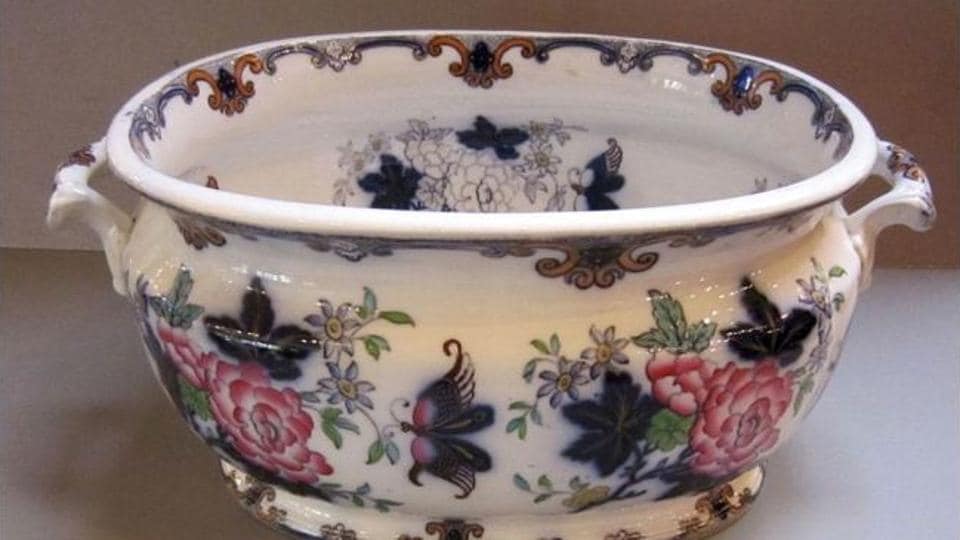
The “Poonah pottery” adorned the “Poonah pattern” that was derived from the “Poonah painting” style. The Federal-period taste for silk embroideries of baskets of fruit or flowers gave way to a technique known as Theorem painting or Poonah painting in the late eighteenth century.
Poonah painting most likely originated in Poona and was also known as Oriental painting or Formula painting.
It was better adapted to fruits, birds, and butterflies than to landscapes and heads. Typically rendered in watercolour on velvet, this style was also suitable for painting on wood, silk, paper, silk, satin, crepe etc.
Poonah painting was considered “very effective” for home decoration, and it could be done by anyone, even if they did not know how to draw or design. The materials required were a set of brushes and paints, a bottle of copal varnish, some sheets of cartridge paper, one sheet each of transfer and tracing paper, a lead pencil, a pair of sharp scissors with fine points, and a piece of velvet or cloth on which one was going to paint.
Poonah painting was a kind of stencilling. Poonah paper was rather thick and semi-transparent. Out of this were cut the shapes of leaves, petals of flowers, vases and such. The paper was laid on wood or cloth to be ornamented, and colour was applied to the cut-out spaces with a stiff brush cut flat at the end. The apertures were moved about till a perfect flower had been formed. Poonah work enabled a lady to ornament her dress or embellish her rooms and furniture.
Even though few thought the style to be at once “superb and nouvelle” and many considered it to be amateur and “not of high character”, the style and pattern - vases with flowers - was very popular in the nineteenth century India and Europe.
However, Mintons, Europe’s leading ceramic factory during the Victorian era, used the distinct “Poonah pattern” to decorate its pottery, and by doing so elevated the status of the Poonah painting.
Established in 1793 in Stoke-on-Trent in Staffordshire, Mintons dabbled in several manufacturing and decorative techniques. As well as pottery vessels and sculptures, the firm was a leading manufacturer of tiles and other architectural ceramics, producing work for both the Houses of Parliament in London and the United States Capitol.
Mintons introduced the “Poonah pattern” on its pottery in 1843. The design typically featured a vase with flowers of different colours. This pottery was specifically designed for the European and American markets.
Several other manufacturers rode on the wave of popularity and brought out crockery - cups, saucers, kettles, tureens, pots, ladles, spoons, jugs, bowls - featuring the “Poonah pattern”. Many of them later incorporated motifs that were not typically used in Poonah painting.
The pottery found by Dollar at Nauvoo was the “Poonah pottery” most probably manufactured by Mintons. He exuberantly declared, “not even the Smithsonian Institution can claim to have the quantity, quality, or style spectrum of early nineteenth century ceramics as the ceramic artifacts discovered at the Brigham Young site this past summer!”
Although Dollar was enthusiastic that these ceramic fragments “added what might be an original and very interesting ceramic pattern to our knowledge of early nineteenth century ceramics”, later research proved unfruitful in identifying the precise age of the Poonah pottery.
The Poonah pottery from Nauvoo was handed over to the Mintons Archives housed at the Stoke-on-Trent Archives in the 1990s.
I contacted the Stoke-on-Trent Archives to find out about the designer of the pattern and the variations in the design, but they do not have any such information.
Earthenware with “Poonah pattern” still keeps surfacing during auctions of antiques in Europe and the US.
Chinmay Damle is a research scientist and food enthusiast. He writes here on Pune’s food culture. He can be contacted at chinmay.damle@gmail.com


