Five years ago, on a rainy night, I met Ms Saroj Gupte in her apartment in Shaniwar Peth. She was the great-great-granddaughter-in-law of Ramchandra Sakharam Gupte, the author of the first Marathi cookbook, “Soopashastra”. She was 94 then. While talking about her ancestors, she casually mentioned how she wished she knew exactly how the eating habits of the Gupte family changed when they shifted from Vasai to Poona in the eighteenth century. Gupte had come to the city in 1941 after her marriage.
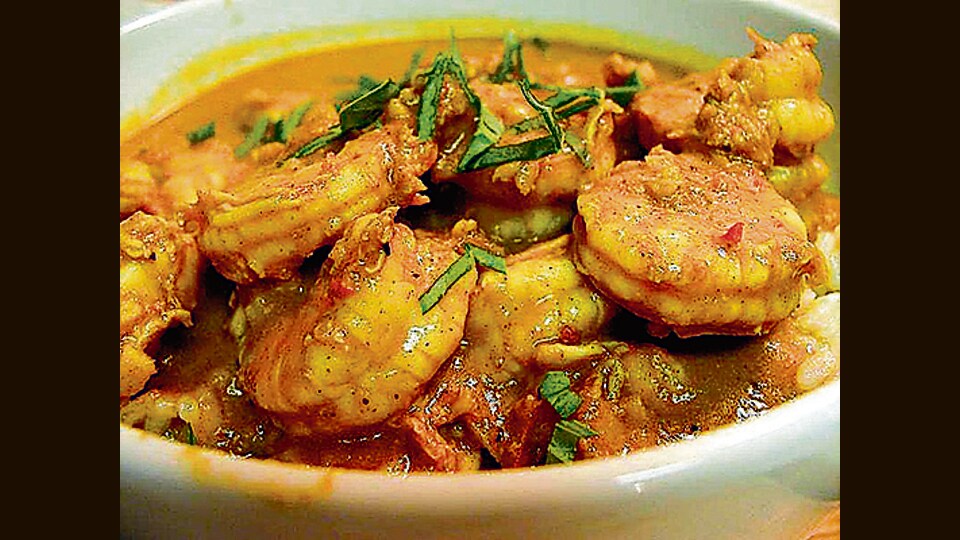
“Kolambiche bhujane” and “kolambicha patwada”, prawns wrapped in colocasia leaves, were cooked by some families to offer to the Goddess Gauri. (WIKI MEDIA/REPRESENTATIVE PHOTO)
A few months later, she showed me one of her prized possessions – a yellowed notebook containing recipes she had painstakingly collected- a testimony to the friendships she had forged over the years. I mentioned one of the recipes, that of “Rushichi bhaaji” in this column last year.
Mutton curry cooked in coconut milk was another recipe in Gupte’s notebook. She had borrowed it from one of her friends, Mrs Desai. The Desais came to Poona in the early 1940s from a small coastal village near Bombay. The family tried desperately to find accommodation in the “Peth” area of the city for almost a year before moving to their own two-room house in the Navi Peth on the outskirts of the city. The Desais ate fish and meat.
Gupte told me how the Desai household would have two Gauri idols for the Gauri Poojan, where one was offered vegetarian “naivedya” (offering to God), while the other was offered mutton curry and several varieties of fish. The mutton curry was cooked with coconut milk and a special “CKP masala”. Surmai and Pomfret fish would be sourced from trusted fishermen from Bombay during the festival. The women of the household grumbled about how difficult it was to procure medium-sized prawns in the city.
The women from the Desai family would also cook “aluchya gaathichi amti”, a spicy dish where colocasia leaves were stuffed with Bengal gram, coconut, and peanuts, rolled and tied into knots. These knots were cooked in gravy with prawns, coconut milk, tamarind, and jaggery. The dish cooked in the “Pachkalshi” way had found its way to the Chandraseniya Kayastha Prabhu (CKP) Desai kitchen.
Gupte’s notebook also had a recipe for “kolambiche bhujane”, a rustic, spicy prawn curry to be eaten with steamed rice. The recipe was given to her by one Mrs Champutai Vaidya, a Pathare Prabhu, whom she had met during a women’s meet in the city. Vaidya’s husband worked with the then-University of Pune.
While Bombay was where the Pathare Prabhu community thrived and prospered, a few families lived in Poona in the nineteenth century. The Gazetteer of the Bombay Presidency, published in 1885, mentions how “Gauri Poojan” was celebrated in a Pathare Prabhu household in Poona.
“On Bhadrapad bright-eighth or ninth, the third or fourth day after Ganesh’s birthday, women hold a feast in honour of his mother Párvati or Gauri. In the morning, ten or twelve balsam or “terda” plants are bought for an anna or so and hung on the eaves. About two in the afternoon, over the whole of the house, women draw rangoli lines six inches apart and between them trace with sandal powder footsteps two in a line and four or five inches apart. An elderly married woman takes one or two of the balsam plants, wash their roots and fold them in a silk waistcloth. This represents the goddess Gauri lying in a girl’s arms, carrying a metal plate with a lighted lamp, a few rice grains, a vermillion box, and some round pieces of plantains, and taking with her a boy with a bell, starting through the house, the boy ringing the bell as they go.
In each room the woman seats the girl who carries the goddess on a raised stool, waves a lighted lamp round the faces of the girl and of the goddess, and, giving the girl and the boy a bit of plantain, calls ‘Lakshmi, Lakshmi, have you come?’ The girl says, ‘I have come.’ The woman asks, ‘What have you brought?’ The girl says, ‘Horses, elephants, armies, and heaps of treasure enough to fill your house and the city.’ Thus, they go from one room to another, filling the house with treasure and bringing good luck. When they have been through the whole house, the goddess is seated on a high stool in the women’s hall leaning against a wall, on which has been painted Prabhu’s house and all it holds.
At lamplight, the goddess is offered plantains, cake, and milk, and at night she is richly dressed, decked with jewels, and with lamps lighted before her is offered milk and sugar. The next day is a time of great rejoicing, when many dishes of sweetmeats, fish, and mutton are cooked, offered to the goddess and eaten.”
Vaidya would cook “kolambiche bhujane” and “kolambicha patwada”, prawns wrapped in colocasia leaves, to offer to the goddess Gauri. Gauri and Ganpati sat beside each other, but their “naivedya” differed.
Ganpati was offered only vegetarian fare like “modak” (sweet dumplings); Gauri was served meat and fish dishes too. She is the daughter visiting her parents’ house, and she must be treated with the choicest dishes.
The dishes offered to the goddess varied in different families. Some offered vegetables, some fish, some goat’s flesh, and some a cock and liquor. In some households offering meat and fish “naivedya” to goddess Gauri, the idols of Ganpati and Gauri would be kept in separate rooms. Some simply put a curtain between the two idols while they were offered “naivedya”. Some Pathare Prabhu and CKP families turned vegetarian during the festival.
The Chitpawan Kokanastha and the Deshastha Brahmin communities were predominantly vegetarian. Chitpawan Kokanastha Brahmin households performed Gauri Poojan by worshipping pebbles which represented the goddess. Two or five pebbles were placed beside the Ganpati idol on rice and were worshipped over three days.
On the second day of the Gauri Poojan, “ghavan-ghatle” was offered to the goddess. The “ghavan” is a pancake made from rice flour, while the “ghatla” is a concoction of coconut milk, jaggery, poppy seeds, cardamom, and nutmeg. “Ghavan-ghatle” would sometimes be accompanied by coconut chutney and “masale bhaat” (spiced rice).
Food in India serves both as a commodity and as an expression of cultural and caste constructs. Caste defines what to eat and what not to eat. The food hierarchy where vegetarians are placed at the top of the pyramid is a function of the caste structure. The neologism “non-vegetarian” reinforces the normative status of vegetarianism by rendering meat nameless.
While discussing the recipes and her friends, Gupte casually mentioned that many CKP families turned vegetarian during festivals after relocating to cities like Poona and Vadodara from the coastal region. The reason was not always the unavailability of fish and meat. It is noteworthy that the Pathare Prabhu and the CKP are considered one of the so-called “elite” castes in India.
Offering food to Gods is a way to express reverence and devotion to divine beings. The food offered to Gods is often the food we eat. The Desais and the Vaidyas were happy feeding their Goddess, the daughter of the house, what they ate and considered worthy of her divine status. They enjoyed the food and hoped the goddess would too, and that is what mattered the most.

 E-Paper