
 E-Paper



The era of linear globalisation is behind us: S Jaishankar
Economic choices are now increasingly driven by strategic compulsions. Reindustrialisation, he said, is now seen as a ‘compelling strategic requirement’ and technologies and resources are being deployed with national objectives in mind

 Prefer HTon Google


The seventh edition of the Asia Economic Dialogue (AED), jointly organised by the ministry of external affairs and the Pune International Centre, began in Pune on Thursday with a strong message that “the era of linear globalisation is over, and that technology and strategic resources have become instruments of national power”.
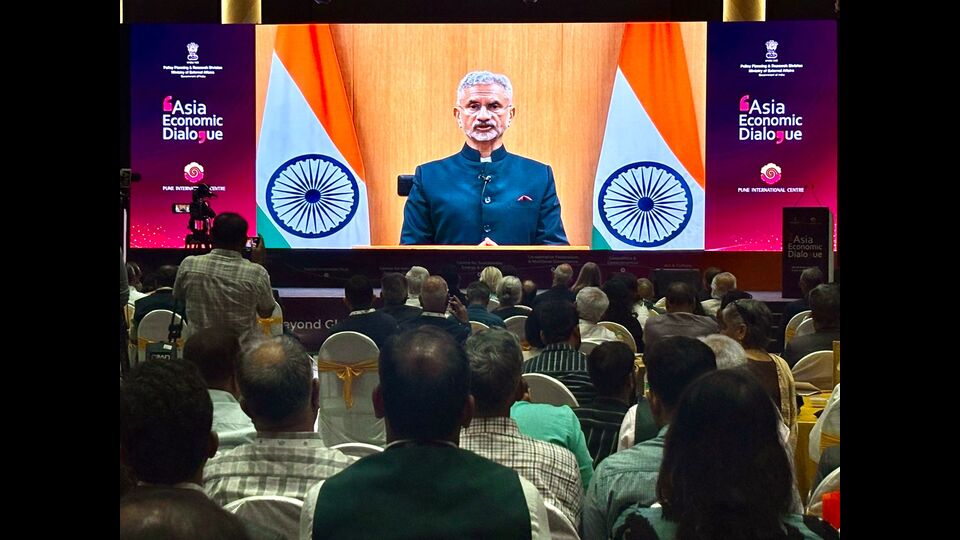
The three-day international conference, themed ‘Geoeconomics beyond globalisation: Tariffs, technologies and strategic alignments’ will witness 45 speakers from nine countries, including policymakers, diplomats, academics and industry leaders.
In his inaugural address delivered via video message, external affairs minister S Jaishankar said, “AED has over the years established a strong reputation for discussing geoeconomics and contemporary developments shaping it,” noting that this year’s focus on tariffs, technology and strategic alignments reflects the ‘churn’ in international relations.
Declaring that “the era of linear globalisation is behind us,” Jaishankar said that economic choices are now increasingly driven by strategic compulsions. Reindustrialisation, he said, is now seen as a ‘compelling strategic requirement’ and technologies and resources are being deployed with national objectives in mind.
“Artificial intelligence, semiconductors, data and critical minerals are no longer viewed only as drivers of growth. They are also instruments of national power,” he asserted.
“Our interest lies in fostering trade, mobility, production, services, technology, skills and talent partnerships,” Jaishankar said, highlighting collaborations in critical minerals, supply chains, migration and mobility agreements, and advanced manufacturing.
Referring to the recently held AI Impact Summit 2026, he said that India’s digital capabilities and talent base position it well to diffuse AI technologies widely and responsibly.
The inaugural session also featured a panel discussion on “Geoeconomics beyond globalisation,” chaired by ambassador Gautam Bambawale, convener of AED. Arguing that the turbulence in global politics stems from the collapse of the liberal international order, Kumar described the present moment as an “interregnum” or transitional phase without a settled order leading states to jostle for influence. Deborah Elms of the Hinrich Foundation pointed to renewed trade volatility, particularly in the wake of the policy shifts under US president Donald Trump. “Companies are in a panic because they don’t know what tariff rate their goods will face when they dock,” she said, describing the situation as unprecedented in modern trade history.
Whereas author and market expert Rama Bijapurkar turned the focus to how Indian businesses are responding to global uncertainty. She argued that Indian firms, accustomed to volatility, may be better prepared than many global counterparts.


