
 E-Paper



Weaponisation of trade, tech makes India’s sovereign strategy crucial: Nirupama Rao
Retired Indian diplomat and former foreign secretary of India Nirupama Rao said that the guiding principle for India should be reform, not abandonment of multilateralism

 Prefer HTon Google


Pune: Retired Indian diplomat and former foreign secretary of India Nirupama Rao said the current global landscape is marked by uncertainty, with the first principles of politics and economics being questioned and the certainties of the post–Cold War world order no longer standing unchallenged.
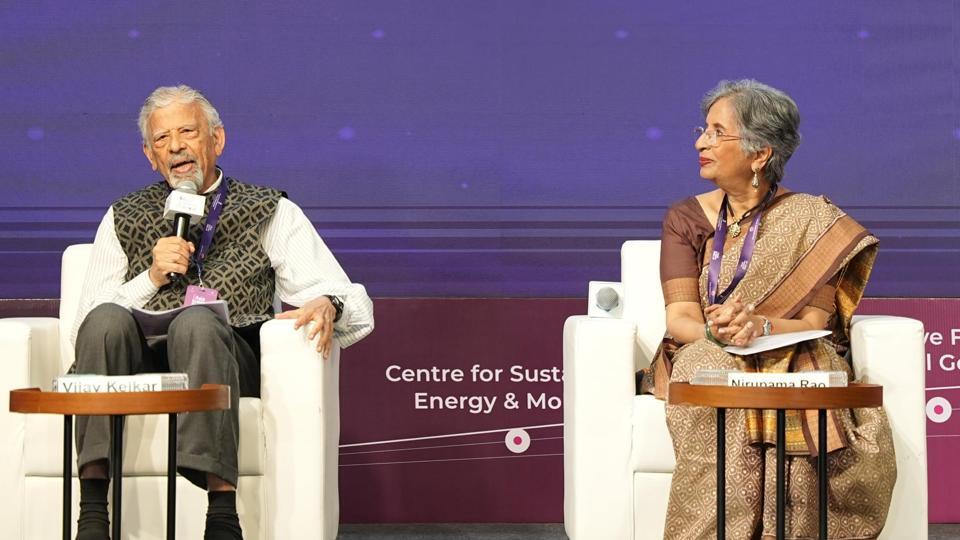
Speaking at the valedictory session of the Asia Economic Dialogue (AED) 2026 chaired by Vijay Kelkar, vice-president, Pune International Centre (PIC), on Saturday, Rao underlined India’s role in shaping the emerging global order.
“Trade has become a form of strategic leverage, technology is now sovereign territory, finance serves as an instrument of coercion, and supply chains have emerged as potential battlegrounds,” she said, terming the current system “asynchronous multipolarity”, where power is unevenly distributed across military, economic, technological, and financial domains, rather than classical multipolarity.
The former ambassador to the US said that the guiding principle for India should be reform, not abandonment of multilateralism.
Calling India more than a middle power, she outlined several imperatives for the country: like preserving strategic autonomy in foreign policy and global engagement, and building economic resilience through diversified international partnerships, achieve technological sovereignty in critical areas such as Artificial Intelligence (AI) and semiconductors, reform the defence doctrine to meet emerging security challenges, invest in societal cohesion and the intellectual retooling of citizens to meet future challenges.
According to Rao, renewed great-power rivalries, weaponisation of interdependence, erosion of institutional guardrails such as the World Trade Organisation (WTO) and arms control regimes, transnational threats like climate change and pandemics, and domestic political pressures that reinforce nationalism are key drivers of global turbulence.
While multilateralism faces strain, Rao said that it is not dead. Instead, global cooperation is being reconfigured through pragmatic, mini-lateral, and plurilateral platforms, such as the G20. According to her, the future of multilateralism and geo-economics will be shaped by policy choices, institutional reforms, and leadership decisions, starting in forums like the AED itself.
Rao described the present phase as one of “strategic globalisation”, characterised by managed interdependence that balances resilience with exposure. She said the most plausible trajectory ahead is managed fragmentation, steered through diplomacy, with technological leadership playing a decisive role.
Rao highlighted the civilisational impact of the AI revolution, stressing that its implications go beyond technology to affect the very structure of societies. She urged that India must globalise from a position of sovereignty, acting with clarity and strategic confidence to actively shape the emerging global order rather than passively reacting to it.


