
 E-Paper



Police opt for awareness campaign as opium trade continues to flourish in Chatra
The awareness campaign is largely aimed at reaching out to people explaining them about the health hazards, environmental impact as well as stringent legal provisions

 Prefer HTon Google


With opium cultivation and smuggling of cannabis and other drugs having grown into a menace in Jharkhand’s Chatra, the district police are set to launch an awareness campaign against opium trade with special focus on highlighting its health hazards, even for those involved in its cultivation, besides stringent penal provisions that can lead up to death penalty.
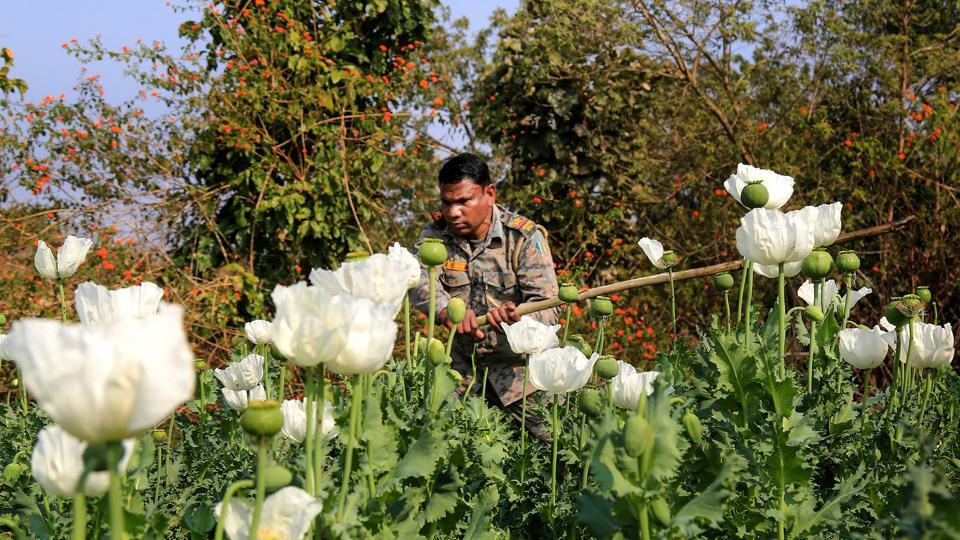
The heavily forested and Maoist-infested Chatra district in the coal-bearing North Chhotangpur division has been a den of opium cultivation in the state, with several small and marginal farmers being involved in it allegedly having support of outlawed CPI (Maoists) and their splinter groups.
Till recent pasts, the district administration would deny that it was an organized crime and their action and would be limited to occasional raiding in the interior forest areas and destroying the standing crop. However, the district administration has now decided to launch an awareness campaign to educate people about the practice, besides continuing to crackdown against the syndicate involved in the crime.
“We can’t deny the fact that we have a problem at hand and we need to solve it. The police has been cracking down against those involved in the crime and have done several seizures of opium and drugs and have made several arrests. While the crackdown continues, we also want to educate people about the different dynamics of the illegal trade,” said Chatra superintendent of police, Rakesh Ranjan.
As per data provided by the district police, from January 1, 2021 to October 6, 2021, the police have registered 123 cases related to the trade and arrested 129 persons. In this period, the police seized 605.77kg opium, 61.65 quintal of Doda (dried opium stem), 2.621 kg brown sugar, 120kg of Posta (poppy seeds), besides vehicles ranging from two-wheelers to trucks, arms and ammunition and cash.
Most forested areas in the district,including Pratapur, Lawalong, Rajpur and Hunterganj--which also share border with Bihar--are some of the areas where opium cultivation is done, sources said.
The awareness campaign of the police is largely aimed at reaching out to people explaining them about the health hazards, environmental impact as well as stringent legal provisions. Banners and posters having messages on those counts are being installed at several locations in the state, said the SP.
Symbolically, one of the banners was unveiled by chief minister Hemant Soren during his visit to Chatra last week for an inaugural function.
The banners spread the message about impact of opium cultivation on forest and soil degradation, impact on health of pregnant woman and the growth of unborn babies, and legal provisions such as capital punishment.
“We have planned to target the family as a unit to create awareness because most of the members are involved in it. Also, most of them are not aware of many of these things. For example, law even provides for capital punishment under Section 31 (A) of the Narcotic Drugs and Psychotropic Substances Act, 1985. Those involved will ultimately be chased down even if they are practising in deep forests, as we are using drones to detect such fields,” said Ranjan.
The officer said the police, in association with the district civil administration, is also educating and encouraging people to take up alternative agricultural practices and grow other cash crops.
“Some farmers have started saffron cultivation in the district. We are encouraging farmers, in association with the department concerned, that they grow such produce which are equally rewarding. We are also engaging the Indian Council of Agricultural Research in our efforts,” said Ranjan.


