
 E-Paper



Spirits soar as families celebrate of Navratri, Durga Puja and Dussehra in Pune
While we are in the midst of Navratri and Durga Puja fervour, and waiting for Dusshera, communities and families living in the city talk about their traditions during the festive period


Spirit and devotion across communities remain the same, what changes is the method and approach. Here’s a look at what they have to say...
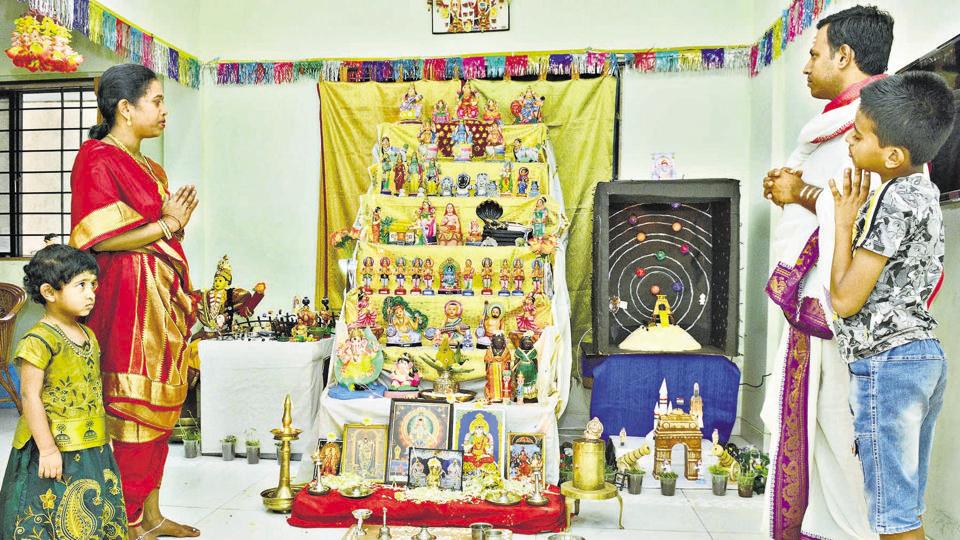
Navratri, South Indian style with Golu – an assembly of dolls
In the household of Saranya (34) and Nellaiappa Subramanian (35), working with Infosys, visitors are welcomed with the Kolam (rice) design, and an aroma of burning incense sticks greets you. Golu’, which means an assembly or darbar of dolls in Tamil, is celebrated during Navratri among Tamil Nadu. It is also a part of the festivities in Andhra Pradesh and Karnataka.
“In Tamil Nadu, it is called as Bommai Golu and in Telugu it is known as Bommala Koluvu,” said Saranya, dressed in the traditional Madisaarai, while her husband Nellaiappa is wearing a Panchagacham. For past 11 years, the Subramanian family has been celebrating Golu and besides the dolls, they always have a theme to encourage the participation of their children. “It is an age-old practice in my home. We still have our great grandmother’s 80-year-old dolls (small Krishna and brass dolls),” said Saranya.
As Sharanya sets up the steps to place the dolls, she talks about the idea of Golu. “The number of steps should be an odd number. The dolls are arranged on the steps. There are miniature dolls of gods, goddesses, animal and people. The dolls of shopkeepers are kept on the bottom most step. Acharyas and gurus are placed on the middle step, other gods in the top 3 steps and Devi in the topmost step,” said Saranya.
“My eight-year-old son Hari Shankar was excited about the Chandrayaan 2 launch and was following the updates regularly. Hence, he selected the Chandrayaan theme this year,” she added.
Neighbours and friends are invited to their homes and gifts are exchanged among women. The gifts contain clothes, coconut and sweets. Married women also exchange small bags which has items like comb, turmeric, mirror and beetle leaves. Women also engage in singing hymns and praising the three major forms of the goddess - Saraswati, Lakshmi and Durga. “The women wear mogras in their hair on these days, and also give it to other women who visit their house. However, the options for purchasing the Golu is less in Pune. On the 10th day, the dolls are taken out from the stand and packed carefully to be kept safe for the next year,” added Saranya.
This family brings West Bengal to Pune for Durga Puja
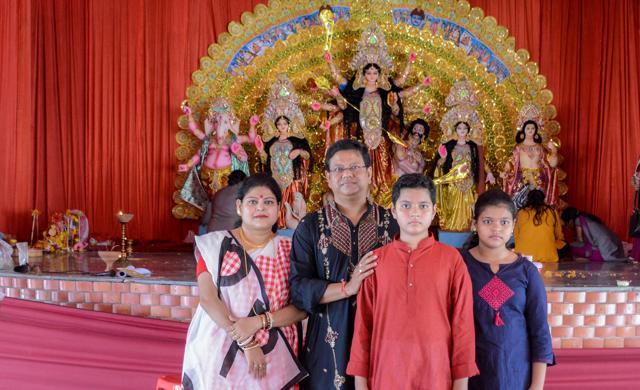
For the Mahato family, the 10-day festival of Durga Puja brings with it the excitement of buying new clothes, savouring delicious food, dancing to the rhythm of the dhak or just admiring the powerful idols of Durga.It has been only two years since Rajib Mahato (44) and Sanjukta Banerjee Mahato (40) shifted to Pune from Kolkata. According to Sanjukta, the difference between Durgostav celebration in Kolkata and Pune is the pace. She says, “Elaborate pandals are the highlight in Kolkata and we go pandal hopping with family and friends. However, in Pune the celebrations start in the evening and we enjoy being a part of Punya Nagari Banga Samaj.”
Sanjukta says that the festival begins with Mahalaya, which, according to Bengali tradition, is the day when goddess Durga, along with her children, Goddess Lakshmi, Goddess Saraswati, Ganesha and Shri Kartikeya, begin their journey to Durga’s maternal home.
“The last five days of the festival involve rituals and offerings, and the streets of Pune are filled with devotees out and about in the Puja spirit.” said Sanjukta.
Being accepted in the Bengali club in Pune
“The people in Pune are friendly and accepted us as a part of the group. One thing that we like about Durgotsav in Pune is that there is no rush. You actually get to be involved in the aarti and take part in cultural events,” said the couple. “I did not get a chance to sing for 30 years, and I got an opportunity in Pune and performed a Rabindra Sangeet here,” said Rajib.“In Kolkata, members of a particular club get to perform aarti or participate in events, while public is lost in the crowd,” said the couple.
Aye Halo! Let’s play Garba: Rathod family steeped in tradition with a hint of fusion
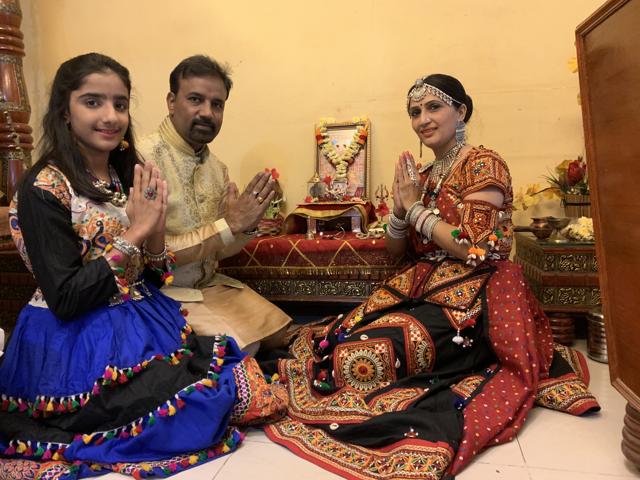
For Taruna (42), Santosh Rathod (44) and their two children, the nine days of Navratri is an occasion to come together and celebrate. Being a part of the Kutch Gujarati community, the family follows all the traditional rituals laid down by their family heads, despite living in Pune for the past 20 years.
“Over the years, there have been a lot of changes in the way Navratri is celebrated. We do not live in a joint family, however, we try to follow as many rituals as we can,” said Taruna as she gets ready in the traditional chaniya choli.
“Garba is not just the dance as it is known, but it is also the earthen pot that is placed for ghatastaphana along with Jowar seeds which has been sowed in a flat thaal (plate). Initially, we used to keep an akhand diya (continuously burning candle), but nowadays, it is not possible to maintain it. It is easy when there are other members of the family in the house to keep the flame burning,” she added.
The Rathods fast for nine days and also dance around the garba (pot) that is placed in their house. “This is not just a dance as it is made to be, but it is our traditional way to invoke the Goddess’ blessings and rejoice her homecoming. Even after fasting, we get immense energy and strength to dance on the traditional aarti at ‘Chachar no Chok’, the place where you dance around the Garba where the Goddess is said to join you in dance,” she added.
On the ninth day, the Rathod family prepares nine dishes for nevaidya (offering) which includes lapsi (porridge), boiled moong (green lentils), bhaat (rice), ved, vadka (various shallow fried wheat flour shapes), muthiya tari ne ladva (wheat and jaggery sweet), talwat (a dish with sesame), roti and lavani no Bhooku (crush of jaggery and broken wheat). The family breaks their fast and then immerses the idol and the jowar.
Passing on traditions to next generation
Every year, during Dussehra (Vijayadashami), the Kannada Sangha in Pune celebrates with a variety of cultural events. Ramadas Acharya from the Kannada Sangha, Pune, shares, “At individual homes, we do the puja, prepare special prasad and pray to deities. However, most importantly on the day of Dussehra, we come together as a community. We organise cultural events through the week, such as dramas and other dance forms from Karnataka. We also have special authentic food festivals. On the last day, we get together, have a doll exhibition and a special spread for Vijayadashami.”
“The idea is to replicate our tradition and customs for the next generation. We mix contemporary and traditional ideas to help them understand better. The main focus is to help them get a feel of the actual festivities,” added Acharya.Acharya adds, “Dussehra or Nadahabba as it called in Karnataka is one of the major events in Karnataka as well as Kannadigas all over the world.Events by Kannada SanghaThis year’s highlight of the Dussehra is a rural play “Yakshagana” curated by Kannada Sangha’s members. Yakshagana is a music (Gana) of Yakshas (God). It is a play with music, lyrics, dance and eye-catching costumes, depicting the story of the Puranas.”
Dressed in a traditional red and white saree though with a modern applique motif, Sanjukta and her husband, dressed in a crisp kantha work kurta, paid obeisance to Goddess Durga by offering flowers and enjoyed dhak played by an artist from Bengal.
“We are very excited to be part of the Durgostav where we follow a traditional dress code for the Sindoor Khela on the last day, that is navami where we open it to all; transgenders, widows, and young girls and not just to married women.
My children have taken holiday from school for the next five days to enjoy Durgostav,” added Sanjukta.


