
 E-Paper



Stage is a banyan tree: Bori’s play to create cultural hub for Pune
Nachiket Patwardhan, a senior architect, has designed the theatre, which is expected to be inaugurated by March 2021

 Prefer HTon Google


The construction work of an open-air theatre at the Bhandarkar Oriental Research Institute (Bori) in Pune is in its last phase.
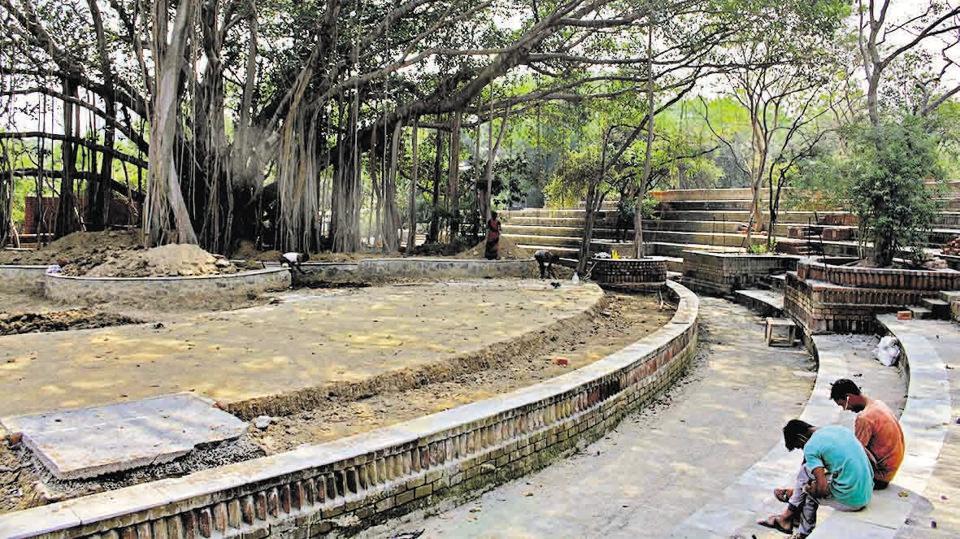
The speciality of this open-air theatre, is that an 83-year-old banyan tree will be at its centre.
In 1937, this tree was planted by Vaijnath Kashinath Rajwade, the then executive chairman of the institute. Just like the work of the institute, the tree has grown and expanded over the years.
Approximately two years ago, the construction of the open-air theatre around this iconic tree started and now it is to be completed.
The institute hoped this theatre, which will be able to accommodate 2,000 people, will be a cultural centre in Pune and also a revenue source.
Nachiket Patwardhan, a senior architect, has designed the theatre, which is expected to be inaugurated by March 2021.
“That such a theatre can be constructed was the idea of Abhay Firodia. The funds required to construct the theatre are provided by the Firodia Trust. It will be a one-of-its kind theatres, as its ‘stage’ will be a tree. This tree was planted by Vaijnath Kashinath Rajwade brother of Vishwanath Kashinath Rajwade, a famous historian, in 1937. The idea was inspired by the open-air theatres at Shantiniketan. We aim for it to be a cultural centre in Pune,” said Bhupal Patwardhan, executive chairman, Bori.
The institute hopes it would be a revenue source for research projects.
“We do not get any help from the government. We hope to get a source of funds for our research projects from this theatre. The historic banyan tree is so big, that it covers almost the entire area of the theatre,” said Bhupal Patwardhan.
Nachiket Patwardhan said, “The design consists of two overlapping circles, 70M and 52M in diameter; the common area of both circles is the stage (around the banyan tree). The 50M wide stage is large enough to provide four different performance spaces for 35, 250, 400 and 800 people. The budget is substantial but I’ve focused solely on design and execution without the burden and responsibility of any budget making and control.” When asked about his inspiration behind the design, he said, “Inspiration was the tree and the frustration of seeing such amazing spaces destroyed by FSI hungry buildings.”
The green rooms, washrooms and stores are yet to be built, but work is expected to be over soon.


