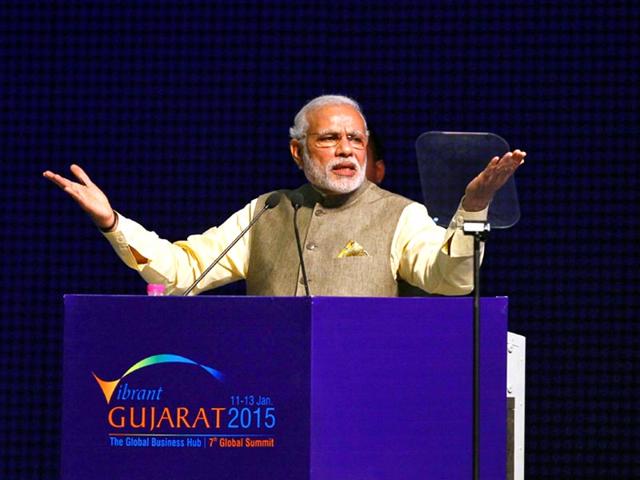
Prime Minister Narendra Modi made the right pitch when he told delegates at the Vibrant Gujarat Summit that the government was determined to make India the easiest place in the world to do business in. India’s ranking in the World Bank’s Ease of Doing Business report has slipped eight rungs to 142. Getting a power connection for a new business takes 105 days, more than three times the Singapore average of 31 days.
It takes 47 days to register a property in India compared to 4.5 days in Singapore. Resolving insolvency can take 4.3 years in India in comparison to 0.8 in Singapore. The latest rankings, updated till May 2014, do not factor in the string of initiatives that the Modi-led government has unveiled including the signature ‘Make in India’ campaign. The new government has set a target of leapfrogging to a rank of above 50 in the ease of doing business index over the next two years. If recent announcements are any indication, there is a sense of urgency to achieve this target.
That said, the government cannot lose sight of random occurrences that can influence policy-making. Like in a cricket match where the toss, weather and pitch play a significant role in determining the eventual outcome, the world of business and economy too is influenced by a host of random events. This was particularly true for 2014 and more so for India. The Lok Sabha elections, monsoon, political uncertainties in West Asia, oil prices, the rupee’s movements, and the US’ monetary policy stance: All were events of chance that left their mark on Asia’s third-largest economy. The trends and patterns in these events, in turn, guided policy moves and boardroom decisions.
In an atmosphere dominated by many known and unknown unknowns, ushering in the promised ‘achhe din’ is more complex than catchy alliterations. Even landslide poll victories don’t make things easier. Modi and his government soon realised this truism. Seven months into its term, the government eventually decided to push through reforms through executive decree — ordinances. The jury is still out on whether ordinances are the best option, but it does demonstrate the government’s intent to walk the talk on critical reforms in insurance, coal block allocation and easing of land rules. What has also stood out is the new government’s decision-making speed and the willingness to question the status quo.
{{/usCountry}}In an atmosphere dominated by many known and unknown unknowns, ushering in the promised ‘achhe din’ is more complex than catchy alliterations. Even landslide poll victories don’t make things easier. Modi and his government soon realised this truism. Seven months into its term, the government eventually decided to push through reforms through executive decree — ordinances. The jury is still out on whether ordinances are the best option, but it does demonstrate the government’s intent to walk the talk on critical reforms in insurance, coal block allocation and easing of land rules. What has also stood out is the new government’s decision-making speed and the willingness to question the status quo.
{{/usCountry}}The decision to scrap the Planning Commission and replace it with more contemporary Niti Aayog, the launch of the Jan Dhan scheme for financial inclusion and the ‘Make in India’ programme to turn the country into a manufacturing powerhouse could be signs of this line of thinking. Having played out the early part of its innings relatively well, one would expect the government to consolidate its policy moves in 2015 by demonstrating speed, alacrity and consistency in decision-making.