Few would have bet as recently as December that India’s ties with Sri Lanka would be suffused with warm atmospherics as they are now.
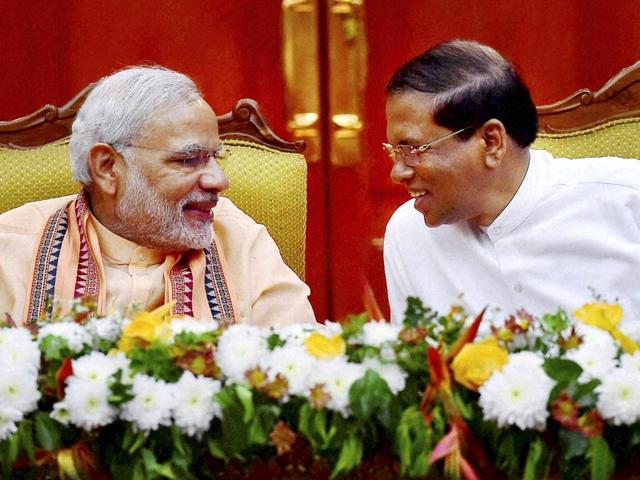
Bilateral relations under the regime of Mahinda Rajapaksa had a pronounced chill as both sides differed strongly on rehabilitating minority Tamils and restoring their political rights.
That’s apparently changing.
India was the first port of call for Sri Lanka President Maithripala Sirisena and Prime Minister Narendra Modi was received at the airport in the wee hours of the morning by Sri Lanka’s Prime Minister Ranil Wickremesinghe during a visit marked by customary fanfare.
Mr Modi’s visit, also to the island nations of Seychelles and Mauritius, arguably had three objectives.
One was to indicate that India will hereon take its responsibilities as a significant maritime power seriously, particularly since China is making known its ambitions plainly. Second was to repair frayed ties with Colombo and, third, to gesture to Sri Lankan Tamils that India was not about to let up on lobbying for their rights.
The PM has helpfully advanced India’s agenda on these fronts. In a remarkable speech to the Sri Lankan parliament, befitting a prime minister’s visit to the country after 28 years, Mr Modi reassured his hosts while reiterating India’s concerns with noticeable sensitivity and tact.
He pointed to the “bond of familiarity”, the shared history, myths, inter-woven religiosity, intellectual exchange and the recent political experience of battling terrorism. The PM underlined Sri Lanka’s ‘great significance’ for India, its importance for South Asia and the Indian Ocean region — but pointed out that the success of countries depends on how they define themselves as nations.
{{/usCountry}}He pointed to the “bond of familiarity”, the shared history, myths, inter-woven religiosity, intellectual exchange and the recent political experience of battling terrorism. The PM underlined Sri Lanka’s ‘great significance’ for India, its importance for South Asia and the Indian Ocean region — but pointed out that the success of countries depends on how they define themselves as nations.
{{/usCountry}}Mr Modi rightly pointed out that “diversity can be a source of strength”, and — in a barely oblique reference to the Tamil minority — called for accommodating aspirations of all sections of society and empowering states, districts and villages. He reaffirmed his own belief in “cooperative federalism” while asserting that the unity of Sri Lanka was paramount.
Mr Modi made a landmark visit to Jaffna and in discussions with Tamil leaders is believed to have asked them to be patient in view of the political transition in the country.
Mr Modi is walking the tightrope well. Sinhala politics has long had a majoritarian flavour; it is currently in flux, anticipating constitutional reform, which may restore power to the legislature — a development that can see the return of Mr Rajapaksa after parliamentary polls. India has strong interests in Sri Lanka and wants to limit Chinese influence to the extent it can but is equally wary of becoming the dominant story in the island’s domestic politics. That will neither be in New Delhi’s interests nor those of Sri Lankan Tamils.