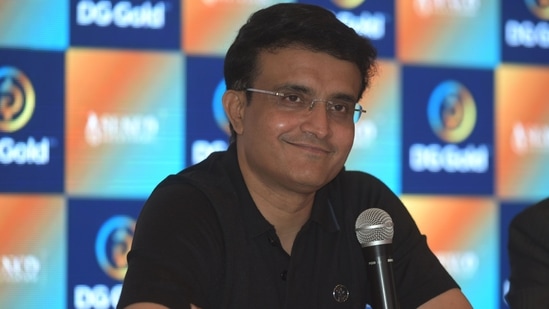
“This ground (Wankhede stadium) has never let me down, so hopefully in my next role in a different capacity, I'll be able to get the administration and Indian cricket stronger.” These were Sourav Ganguly’s words from a 25-minute press meet on becoming BCCI president in 2019. He had come wearing his oversized India blazer and found himself surrounded by TV cameras, a life he was all too familiar with. Three years later, sporting a stylish beard he has grown for an ad campaign, he made a quiet exit after completing nomination formalities for next week’s AGM, which signalled an end to his BCCI innings.
Ganguly began with a bang, announcing a pink-ball Test on home turf at Eden Gardens against Bangladesh (Hindustan Times)
In his administrative avatar, Ganguly made regular trips to his new workplace in the vicinity of the stadium where he scored his first India hundred, playing U-19s. Whether he was able to make a credible difference isn’t a straightforward question to answer.
On the face of it, BCCI’s marquee property—the Indian Premier League—is $6 billion strong. It has a dedicated playing window and attracts the best T20 talent in the world. The Indian cricket team didn’t win an ICC trophy during his tenure but judging a board chief with competition success wouldn’t be a very scientific exercise. If the World Test Championship final at Southampton had more sunny days, and not cloudy skies, the result could well have been different. On the field, Indian cricket is in a healthy space, with its second string giving competitors a run for its money. Just as Ganguly isn’t to be blamed for the losses, he cannot be credited for the wins. The structures in Indian cricket have been in place, and the riches of IPL have been slowly trickling down to junior cricket for many years now.
But, it's easy to surmise that Ganguly’s administrative innings paled in comparison to his tenure as captain. Ironically, it ended much the same way as his final few days as India captain—unceremoniously.
He had to live up to the 'Ganguly cult'. But the weight of expectations aside, making BCCI's rich coffers richer was never going to be all that challenging. Whether India's first player-president of this generation was able to do enough for the players—junior, past and present, men and women was what he should be judged by.
Ganguly began with a bang, announcing a pink-ball Test on home turf at Eden Gardens against Bangladesh, when the Indian dressing room wasn't all that keen. They played and won within three days. Since then, pink-ball Tests have become a regular feature in the home calendar.
As Ganguly held player contract discussions with chief selector MSK Prasad, he would be seen as a hands-on president for lending his expertise to player matters. He had a say in picking the next chief selector with Prasad replaced by former India spinner Sunil Joshi.
Six months into the job, Covid struck. Cricket came to a standstill. Somewhere during that gloomy phase, Ganguly appeared to lose his hold. His personal brand continued to rise. His advertising contracts with BCCI's competing brands gave rise to the question of moral propriety. Ganguly never fully endorsed the definition of conflict of interest. He wanted people to trust his integrity.
Introducing contracts in domestic cricket was his very first promise. The best-performing domestic cricketers are better compensated than earlier through graded match-fee revision but a uniform-gradation-across-associations formula has not been charted out.
The Ganguly-led BCCI failed to offer Covid compensation to affected cricketers on time. Even as reports of administrative apathy at Uttarakhand cricket with players given pittance as allowances came to light, there were no comments forthcoming from the player-president.
Then came the Virat Kohli episode. By the time Kohli lost his ODI captaincy, he wasn't the most popular man in the Indian dressing room. Many in BCCI had also begun to sense this. But when Kohli publicly disapproved Ganguly asking him to stay on as T20 captain, it brought to the fore a total breakdown in captain-board president relationship. When Ganguly took charge, he had called Kohli ‘the most important man in Indian cricket as captain of India’. The incident sullied Ganguly’s image more than Kohli’s.
During Ganguly’s tenure, MS Dhoni became India’s mentor for the 2021 T20 World Cup. But Ganguly wasn't at the forefront of this decision. The former India captain who led from the front during his playing days failed to do so in his innings in the boardroom, and that is how many will remember his three years in BCCI.
Rasesh Mandani loves a straight drive. He has been covering cricket, the governance and business side of sport for close to two decades. He writes and video blogs for HT.


 Live Score
 Cricket Teams
 Cricket Players