


 Live Score
 Cricket Teams
 Cricket Players
India's blind cricketers have no dearth of vision
The game is played across the same 22 yards, but the regulations are tailored to the needs of visually impaired cricketers. The ball is made of plastic and filled with ball bearings. Bowling is always underarm, and the moving ball produces a jangling sound to alert the batter of the ball's line.

 Prefer HTon Google


It's been 18 years but Deepak Malik's memory is crystal clear. Sachin Tendulkar's Sydney classic. Indian summer in Pakistan. A cricket lover's delight. Deepak, then eight, would regularly scurry to his terrace in Sonepat's Bhainswal village to fix the antenna for better transmission. Life was simple, cricket was lovely. That Diwali, as he merrily stood outside his house waiting for a rocket to soar into the night sky, his life plunged into permanent darkness.
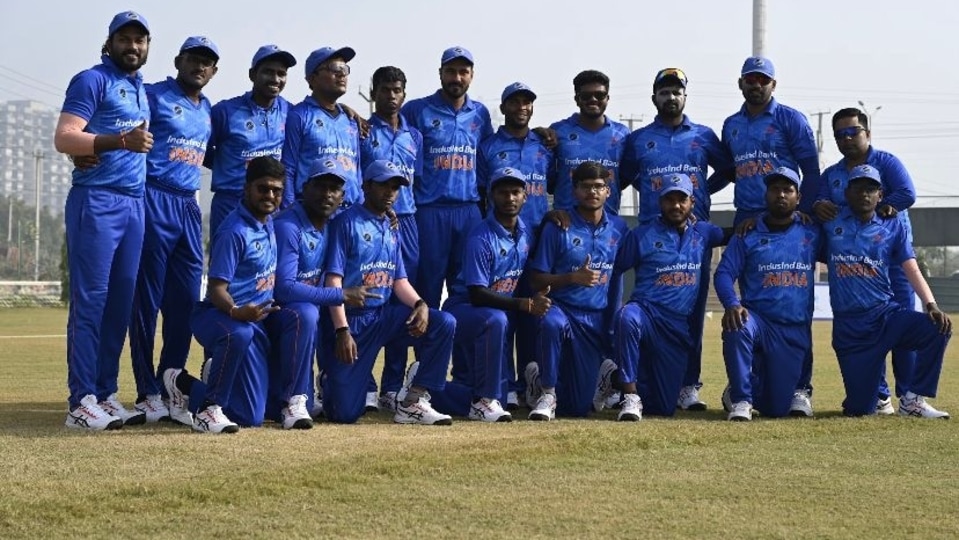
The bottle holding the cracker toppled, turning the rocket in Deepak's direction, and before anyone could realise, the burning rocket flew into Deepak's right eye. "There was darkness all around. That darkness has still not left me," he said.
It took Deepak four years to move on from that night. He refused to speak to his friends and parents, went into a shell, and struggled to find his sense of worth. From that to becoming an all-rounder in India's blind cricket team, it has been a journey of grit and fortitude.
"I grew up on cricket. Coming from a region that produces world-class wrestlers and kabaddi players, cricket was an odd choice, but I was crazy about Sachin Tendulkar. Like any kid my age, I wanted to play cricket for India," said the 27-year-old.
"But that Diwali changed everything for me. I wept inconsolably. The right eye was covered in blood. The left eye got damaged by sparks. I eventually found succour in cricket. I went completely silent. I refused to speak to my parents, friends, and teachers. My friends would force me to play with them but I could barely see anything. That made me feel all the more terrible. Eventually, I stopped stepping out of the house."
In 2008, his family moved him to a blind school in Delhi which is where he was introduced to blind cricket. He made it to the school team in 2011 and made it to the Indian team three years later.
Last week, he cracked a 34-ball 113 against Nepal at the ongoing T20 World Cup for the blind. The in-form batter will look to extend his good run with two-time defending champions India, who defeated Sri Lanka by seven wickets on Wednesday to sail into the semis.
"I have toured Pakistan, Bangladesh, South Africa, England, Jamaica, and Sri Lanka. Cricket has taken me around the world. The sense of dejection that I felt before I was introduced to blind cricket is long gone. I am living a dream," he said.
For someone who played conventional cricket as a kid, albeit for recreation, getting his senses and instinct attuned to blind cricket was a challenge. The game is played across the same 22 yards, but the regulations are tailored to the needs of visually impaired cricketers. The ball is made of plastic and filled with ball bearings. Bowling is always underarm, and the moving ball produces a jangling sound to alert the batter of the ball's line.
"Some of the bowlers can be quite fast. We have bowlers who can clock speeds of up to 120 kmph. For a partially or fully blind cricketer, it is a challenge to deal with that pace," said Deepak, who was all at sea when he first faced an underarm delivery.
"I couldn't put bat to ball when I first batted at the blind school. It's tougher than what most think," said Deepak, who belongs to B2 category of blind, meaning his vision is restricted to three metres. Those with a complete lack of vision are categorised under B1, while a B3 person can see up to six metres.
The ball ought to reach the batter in a minimum of two bounces, with the first bounce landing mid-pitch and the second bounce landing outside the batting crease. A B1 batter can't be deemed bowled if the ball hits the stumps above eight inches. The ground dimensions are shorter too — boundaries are 45-50 metres away and the traditional 30-yard circle is brought down to 20 yards.
The B1 category players have to bowl 40 percent of the team's overs, and the batting order needs to group the three categories together.
"We call it a circle. A circle of B1, B2, and B3 batters need to be maintained through the batting order. If B1 and B2 are opening, B3 should be the next man in. If B2 and B3 are batting, B1 should come in next and so forth," explained national coach Asif Basha.
"Most bowlers roll the ball on the ground, which makes hitting sixes a tough task, but we have batters who have devised techniques to hit long sixes. B1 batters usually sweep and reverse sweep, but you'll find B2 and B3 players hitting decent cover drives," said the coach.
"It's a humbling experience to train these boys. Earlier people would tell me there is no future with them, and even I was apprehensive about my ability to coach the blind. But their dedication and commitment are second to none," added the 27-year-old who played two seasons of the Karnataka Premier League in 2017 and 2018 for Bijapur Bulls. He was also an RCB net bowler in 2012 and 2013.
For Nilesh Yadav, one of India's bowling all-rounders, cricket helped him deal with dual losses — of his vision and his mother. Born "almost blind" in Uttar Pradesh's Jaunpur, Nilesh was casually standing by the boundary one afternoon when the rubber ball bounced off the ropes and smashed his glasses.
A few pieces injured his right eye, taking away whatever little vision he had. Eight months later, his mother met with an accident and passed away. "It was a double blow. I was barely eight, and everything was too tough to process," Nilesh, now 19, said.
"Some doctors tell me there is still a faint chance of retrieving some vision with some surgery, but I am fine the way I am. Playing cricket for the country has given me the confidence to take on the world," Nilesh, currently pursuing his graduation from Delhi's Ramjas College, said.
Nilesh's father is a steel welder in Mumbai, and he has six children to feed — three of his late elder brother's. "He can't help me financially, but he is proud of me. That's all that matters," he said.
Nilesh follows cricket on radio and TV commentary and lists veteran Hindi commentator Vineet Garg as his favourite. "I also like Aakash Chopra, Vivek Razdan, and Vijay Dahiya. I also liked the late Suresh Saraiya," he added.
"I want to meet Virat Kohli and Sachin once, but only if they are interested. I don't want anyone to pity me."


