The evolution of T20s has brought with it a greater emphasis on data, planning and match-ups, but the ability to think on your feet remains non-negotiable.
By consensus, MS Dhoni is the greatest white-ball captain India has had. He won every trophy there’s to be won for the country and has had enormous success as Chennai Super Kings skipper in IPL and the now-defunct Champions League T20. As his teammates will tell you, he’s calmness personified on the field and tactically so astute that he seldom misses a beat. But just for the sake of argument, what if that last over by Joginder Sharma all those years ago hadn’t gone as per plan?
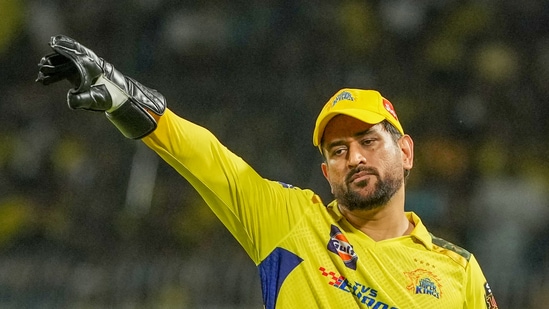
Chennai Super Kings skipper M S Dhoni during the IPL 2023 cricket match between Kolkata Knight Riders and Chennai Super Kings (PTI)
If you rewind to that September evening in 2007 when the Wanderers in Johannesburg was heaving with Indian and Pakistani fans, Dhoni had two options going into the final over with 12 runs to defend for the inaugural World T20 title. He could have either given the ball to Harbhajan Singh – the off-spinner had been hit for three sixes by Misbah-ul-Haq towards the shorter boundary in the 17th over of the innings – or the lesser-experienced Joginder who had taken a wicket and given away 13 runs in his first three overs. Dhoni’s decision is widely hailed as a masterstroke when he was perhaps merely being pragmatic in the belief that a seam bowler would be more difficult to target, but the lens with which we view him may have been a bit different if India had ended up on the losing side.
While Dhoni’s credentials were apparent over time, this is to simply illustrate the fine margins at play when it comes to captaincy. As the late Richie Benaud once said: “Captaincy is 90 percent luck and 10 percent skill. But don’t try it without that 10 percent.”
Particularly in a fickle format like T20, where the game moves at breakneck speed and close matches are a frequent occurrence, a captain’s mind has to constantly keep ticking. In leagues like IPL, there’s also the challenge of dealing with players from different backgrounds and impatient owners striving for instant glory. How does one go about handling this complex world of captaincy?
“Captaincy in T20s comes down to having a good gut instinct for the game,” said former Australia captain Aaron Finch, who led his team to the 2021 T20 World Cup title. “It could be something as simple as a different angle in the field or a bowling change at the right time. It may go against what all the numbers say, but that’s a really important aspect.”
The evolution of T20s has brought with it a greater emphasis on data, planning and match-ups, but the ability to think on your feet remains non-negotiable.
“A lot of the times, you would love to have a rough idea of how you want the 20 overs to go if it went perfectly to plan. But sometimes, all that goes out of the window after the first over. You might assess the conditions really quickly and decide that you need to change your tactics totally. You do a lot of planning and preparation to find that 1% edge over the opposition. But you have got to have a good gut feel and instinct for the game,” reiterated Finch, who is in India as an expert for Star Sports (the official TV broadcaster of IPL).
Man-management, according to the 36-year-old, is another critical aspect, more so in the IPL where there’s limited time to get together before a season. “The ability to get the best out of people... it’s an incredibly difficult format to be really consistent at. The ability to get everyone to buy into what you are trying to achieve so quickly is very important.”
Dhoni, of course, has these attributes in abundance. “Dhoni’s calmness on the field is one of his great strengths. Tactically, he is superior to almost anybody else who has played the game. The way he reads the game is extraordinary. His control of his team on the field is brilliant. He empowers everyone. That's all you can ask for from a captain,” Finch said.
Who among the younger IPL captains impresses Finch? “Hardik has been very good again. He has got a very good team. But seeing him lead India in that first ODI against Australia in Mumbai where they won, tactically he was very good. He seems to be really calm under pressure. Samson is the other one who has impressed me. He’s a relatively inexperienced captain. For him to be wicketkeeping and having the connection with his bowlers is a really good trait.”
Where captains face the biggest test of their acumen is in the death overs of an innings. There may be those who believe in constantly going up to the bowler for advice and those who let the bowler take over after setting a particular field.
“Different bowlers want different things. I don't think there is a right or wrong way to go about it,” said Finch. “Over the last couple of years with the Australian team, we had a really experienced bowling group. So, they were very clear with plans against a particular batter. The only time I would disagree is if I don't think it's the right ball to bowl at that point of time. If you have got a less experienced bowling attack, you might want to bounce off a few more ideas and get a little bit more collaborative. It comes down to the individual you are leading.”
Vivek Krishnan is a sports journalist who enjoys covering cricket and football among other disciplines. He wanted to be a cricketer himself but has gladly settled for watching and writing on different sports.Read More


 Live Score
 Cricket Teams
 Cricket Players