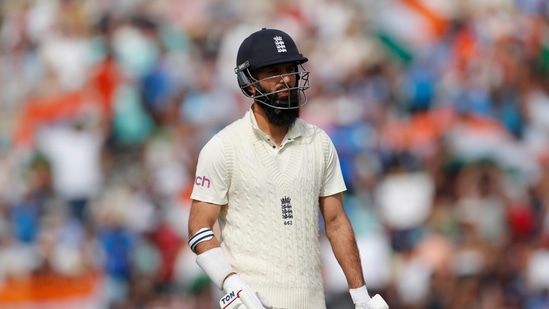
Moeen Ali calling time on his Test career, though not entirely unexpected, was somewhat of a surprise, coming as it did with the Ashes series on the horizon. Given the paucity of quality Test players in England currently, he would have been a certainty to travel Down Under. It couldn’t have been an easy decision.
File image of Moeen Ali. (Action Images via Reuters)
Moeen is only 34, hardly old by today’s fitness standards. His England teammate James Anderson is pushing 40, and he’s a fast bowler. Anderson, however, is an exception these days. Increasingly, players in their mid-30s are opting out of Test cricket, looking to spend a few years in white-ball cricket before hanging up their boots.
But Moeen is only symptomatic of a trend that seems to be growing across the cricket world in the past decade-odd. MS Dhoni, Chris Gayle, AB de Vllliers and Faf du Plessis are a few major players who took similar decisions. What does this augur for the longest format?
In the old days when cricket was an off-season sport and most cricketers had regular jobs, retiring in the early 30s would suggest serious injury, physical and mental fatigue, loss of form. Or, that a player has decided to focus on advancing in his primary vocation, maybe looking to find a new job/business while he’s still got age on his side.
In the modern game, professionally run with players making handsome money, and especially after the advent of T20 league cricket, their fitness cared for, this has come to mean disregard for the pristine tradition and legacy of cricket, and unmasked hubris in the pursuit of mammon.
The first scenario has become part of cricket romance, the second, closer to these times, seems true on the face of it, but is substantially flawed. It is based on the premise that everything in the past was perfect, which as we know from every other aspect of life, is delusional.
Transition from the old to the new is always jumpy, uneven, at times painful as sensibilities, ambitions, practices and mindsets get churned. Lament at how some of this happens or its consequences is not misplaced, but ascribing greed to players opting out of Test cricket ignores how socio-eco-political developments influence desires, ambitions and lifestyle.
For instance, in the `old’ days, cricket was also a means to a corporate or government job for most in the sub-continent, but the biggest lament of players then was that they were paid farthings. Today, top players earn in crores. The game is fundamentally still the same, what’s changed is the economics and demands.
Getting selected by a T20 franchise, for instance, is like a campus hiring with stock ops and a fancy car. Something the previous generation of cricketers could never have even dreamt of. With this also comes greater insecurity, more playing days in a year, massive lifestyle changes to remain fit, etc. Why should the money players earn today be scoffed at?
So how does one save or salvage Test cricket?
Fact is players will opt out—early, late, whenever—because of multiple choices available. Moreover, switching from one format to the other can be challenging for me. Few do it with a high degree of excellence. Some players will find Test cricket mentally draining.
These are not trifling considerations. What’s crucial is how many youngsters grow up coveting the five-day format so much that they want to be a part of it. If more youngsters want to play Tests vis-a-vis other formats, it’s not a bad equation.
Remember, though, the role models of budding cricketers may largely be located in T20 or ODI heroes. To win over the current generation, it’s not enough to just talk of the glory of Test cricket in the past sense, rather make it `sexy’ for the present. This can come through adroit marketing, enlightened mentoring, tutoring and what have you that put Tests on a pedestal impossible to ignore, or surrender easily.
Better planning of fixtures will be a boon too. Imagine losing the fifth Test between India and England in the last series! What’s also needed is greater involvement of all Test-playing countries. Currently, most action is centered on three, which is limiting development and growth of the format globally.


 Live Score
 Cricket Teams
 Cricket Players