


 Live Score
 Cricket Teams
 Cricket Players
Ravi Bishnoi's numbers moving backwards; Asian Games final exposes how far his bowling has stalled
Ravi Bishnoi's Asian Games final nightmare underlined a deeper issue: five years into his India career, his bowling numbers and evolution are moving backwards.

 Prefer HTon Google


India posted 211 on a difficult pitch and then had the game in control till the seventh over of the chase, having reduced Pakistan to 42/3 in the Asian Games 2026 gold-medal match. Shreyas Iyer turned to his wrist spinner, Ravi Bishnoi, for the next over, and he conceded 10 runs, allowing the momentum to gradually shift towards Pakistan.
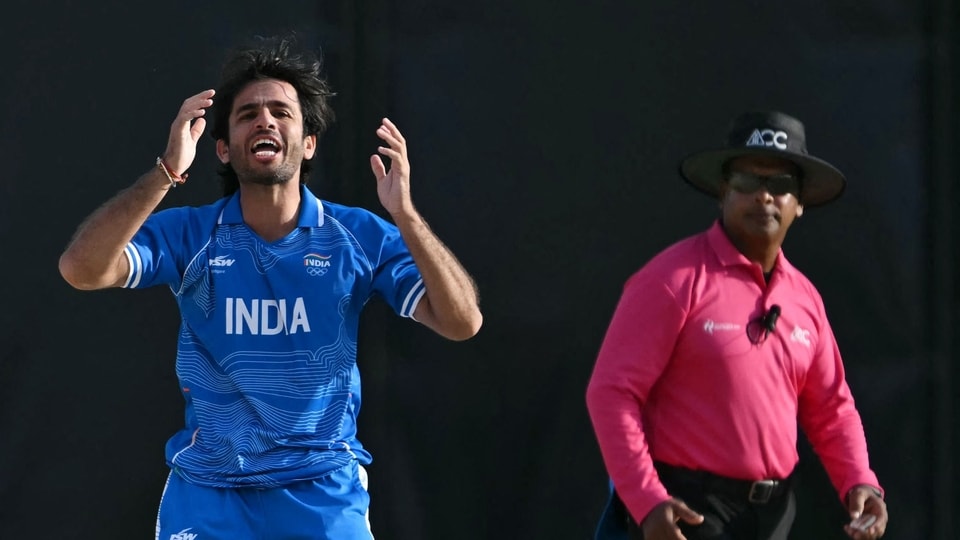
Bishnoi bowled three overs in the match, conceded 44 runs and allowed Pakistan to come back into the match, while causing a headache for his captain as one of the main bowlers was taken to the cleaners. The thing is, there are bad days for bowlers, even for the biggest names. But in his case, this is no longer an aberration detached from the larger arc of his career. Instead, it is another reminder of a bowler whose repertoire has not expanded, while batters have read and decoded him over the last few seasons.
Bishnoi’s first year as an international T20 bowler was 2022. In that season, he took 17 wickets at an average of 17.13, while conceding 7.09 runs per over. In the next season, Bishnoi picked up 18 wickets at an average of 17.61 with an economy of 7.20. By December 2023, he became the number one T20I bowler. This should have been the first step in a remarkable career; instead, it increasingly looks like the statistical summit of his career.
The numbers have moved backwards
In 2024, Ravi Bishnoi did pick up more wickets, but it cost him more. His average was 20.86, while the economy was 7.52. The next year, Bishnoi’s average further climbed, and he now conceded 26.40 runs before taking a wicket while giving away 7.76 runs per over. After conceding 44 runs in the final against Pakistan, Bishnoi’s 2026 average stands at 31, while his economy is around 8.5, and he strikes every 22 balls now.
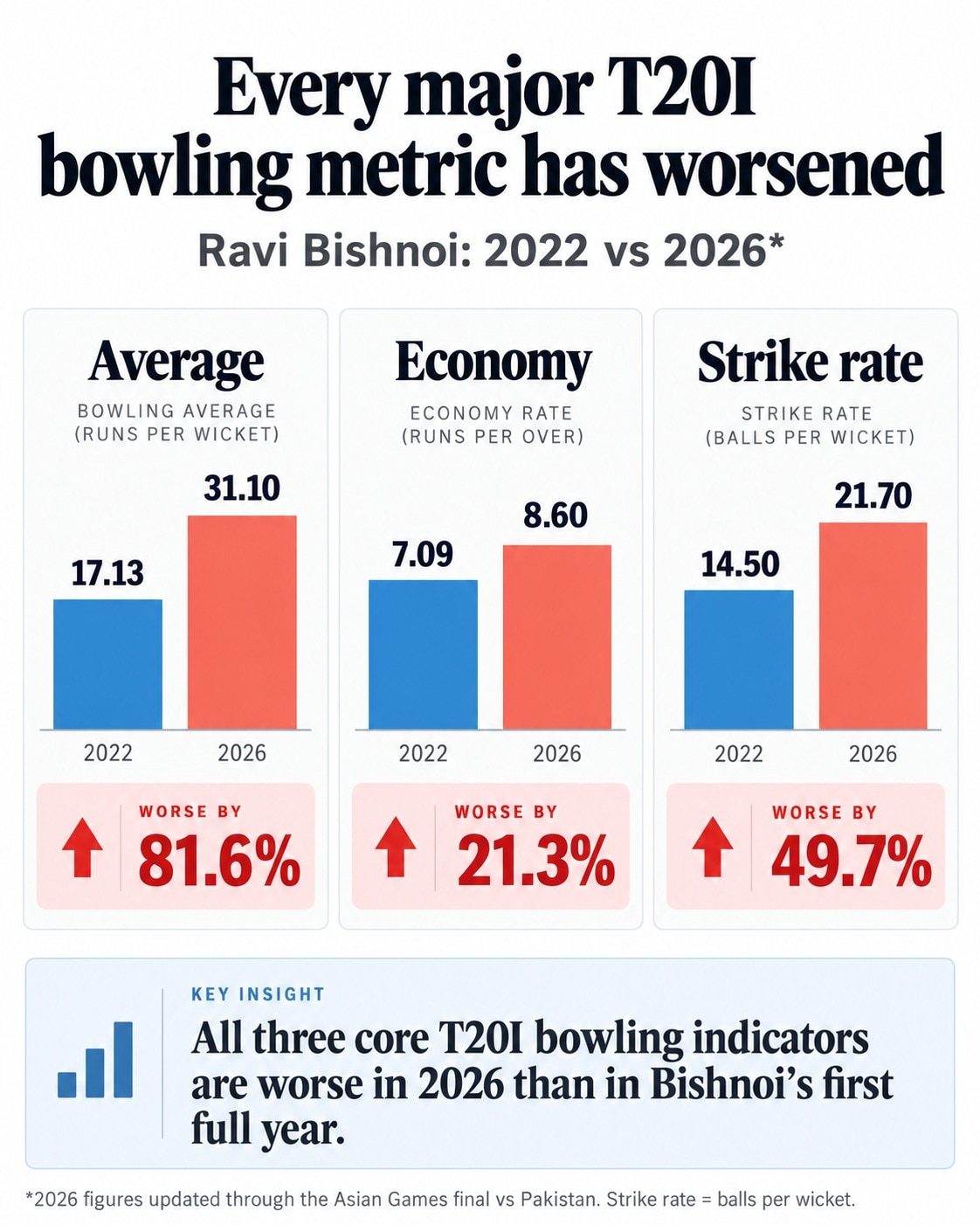
Now compare this with his first year at the biggest stage. His average has ballooned from 17.13 to 31. That means each wicket now costs him fourteen runs more than it used to. There is more to it, Bishnoi in 2026 concedes nearly 1.5 runs more each over while taking about eight deliveries more to take a wicket. For a bowler who is apparently entering his prime, every crucial indicator points to his decline from where he started.
And this is not just in international cricket, IPL points to the same fact. In 2021, Bishnoi conceded only 6.39 runs per over; by 2024, that number had become 8.77, and it ballooned to 10.84 in 2025. It improved slightly in 2026, when his economy was 9.88.
His striking abilities have shown some inconsistent improvements. Actually, in IPL 2026, Bishnoi’s strike rate was excellent, but the control has never returned. This means that Bishnoi can still beat batters and deceive them, but over time, he is paying a larger price for each wicket.
Also Read: Rescue team from collapse, revive stalled innings: Why Tilak Varma does India’s most thankless job
The key to Bishnoi’s rise was deception, but it is gradually getting eroded by predictability. Unlike other right-arm wrist spinners, Bishnoi depends a bit too much on his googlies. In the early days, this was what distinguished him from other bowlers and made him a difficult read for batters. But over time, the batters have understood the secret to his trade, and Bishnoi has not been able to add new weapons to his repertoire.
The lack of reinvention
The telling fact is that Bishnoi spoke about adding a much more potent leg-spinner to his arsenal back in 2022. Yet, after four years, the discussion around Bishnoi is the googly being his stock delivery.
Compare this with someone like Varun Chakaravarthy. His international career nearly collapsed after his first stint in the Blue. But he went back, increased his repertoire, became more deceptive, and, besides working on his action and alignment, came back as a much more lethal bowler. In his second stint, Chakarvarthy developed as one of India’s prime weapons.
On the other hand, Bishnoi has worked on his action and alignment, tried to tinker with his delivery point, yet is suffering from a lack of sufficient weapons. For most elite bowlers, time in the international arena teaches them what to use, when to use it, and how to use it. For Bishnoi, it seems, time at the highest level is forcing him to remain unidimensional, predictable, and increasingly clueless.


