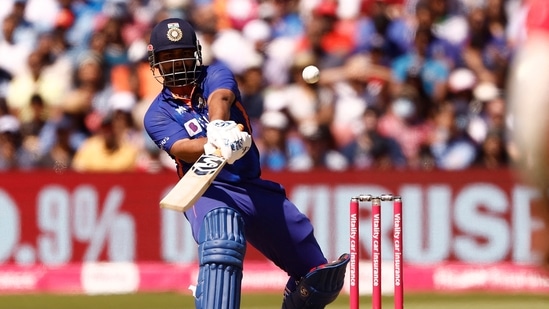
If attributes of an archetypal limited-overs batter are jotted down, Rishabh Pant would have them all—big-hitting ability, ingenuity to manufacture shots and find unusual areas on the field and bat with ease against pace and spin. His India record in limited-overs cricket though has been underwhelming. The third T20I against England on Sunday was Pant’s 50th in the format, but he’s only scored 768 runs at an average of 22.58 and strike rate of 124.27. In ODIs too, he hasn’t set the stage alight, aggregating 715 runs in 24 matches at an average of 32.5 with five half-centuries.
Rishabh Pant (Action Images via Reuters)
These numbers might have made his place shaky if not for the impact he has had in whites. Since his Test debut in 2018, he has hit centuries in England and South Africa and played a starring role in the series win in Australia in 2020/21 with scores of 97 and 89* in the fourth innings at Sydney and Brisbane respectively. He has done all this with an endearing nonchalance reflective of his nature. It shouldn’t surprise given the skill the left-handed batter from Delhi possesses.
What is surprising though is that he hasn’t been able to translate it in the shorter versions. The Indian team management is keen for Pant to click in the shorter versions and has tried him in different batting positions.
In the last two T20Is between India and England, Pant was given the chance to open with skipper Rohit Sharma. The move shows the team management’s thinking although it was also by KL Rahul’s injury. Pant has the game to exploit the fielding restrictions and provide impetus that the Indian top order sometimes lacks. While succeeding in Tests, he has showed a sound defence too, to negotiate any seam movement.
His Test record also suggests that Pant is perhaps at his best when he has a bit more time to settle in. That is not always available while batting in the middle-order in limited-overs cricket, and having to tee off instantly often leaves him with the risk of holing out.
He could not capitalise on the opportunity to open in the two T20Is, dismissed for 26 and 1 at Edgbaston and Trent Bridge. He made a promising start in the second T20I, finding the boundary easily a few times until a thick inside edge to the wicketkeeper as soon as the powerplay ended cut short his stay. Pant has opened once in ODIs too, against West Indies in Ahmedabad in February, making 18 off 34 balls.
Pant’s destructive ability means it’s difficult to look past him for the wicketkeeping slot, though Dinesh Karthik has made a case to be considered in T20Is with his recent resurgence as a finisher. It is why head coach Rahul Dravid reassured after the T20 series against South Africa last month that Pant was “an integral part of our batting line-up” heading into the T20 World Cup.
“We know what he does with the power he has. The fact that he is a left-hander is very important to us as well in the middle overs. And he has played some good knocks. Of course, he would have liked to have scored a few more runs but it’s not that concerning. For us, he is certainly a very big part of our plans going ahead in the next few months,” Dravid said.
As an attacking batter, Pant’s quest to find his footing in white-ball cricket vaguely resembles Virender Sehwag’s career trajectory. Sehwag too had his struggles and didn’t do total justice to his calibre, ending his ODI career with an average of 35.05 in 251 matches. Pant’s career is in its early stages, and he will hope to course correct soon.
Vivek Krishnan is a sports journalist who enjoys covering cricket and football among other disciplines. He wanted to be a cricketer himself but has gladly settled for watching and writing on different sports.Read More


 Live Score
 Cricket Teams
 Cricket Players