


 Live Score
 Teams
Teams Players
Marsh, Warner ease Australia to maiden T20 World Cup title
The pair dominate the New Zealand bowling for an eight-wicket win after Josh Hazlewood's strikes in an eventually one-sided final in Dubai on Sunday

 Prefer HTon Google


As the Dubai sky lit up with fireworks, the Australians soaked in the atmosphere, emotional and ecstatic in their team huddle. Kane Williamson and his men waited to shake hands, third time unlucky in a World Cup final.
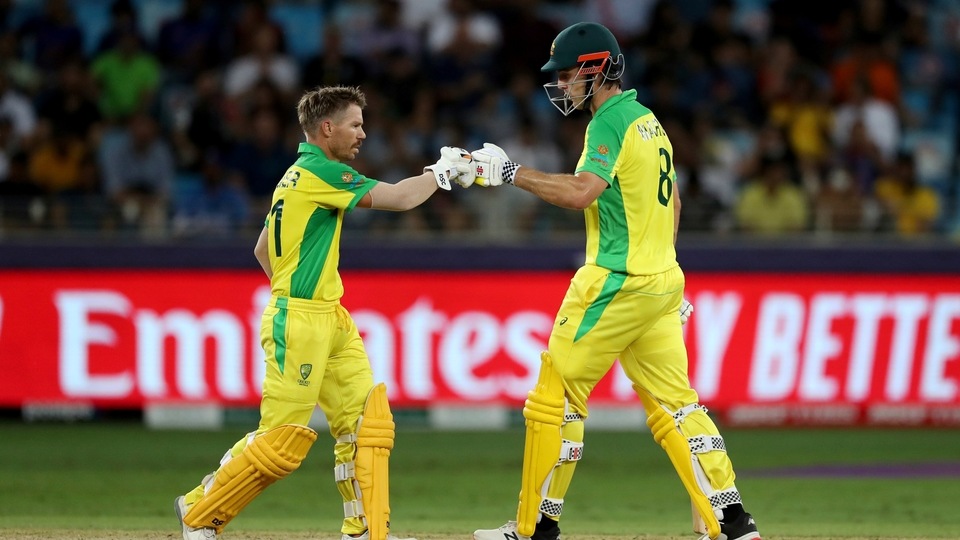
Glenn Maxwell, whose reverse-sweep off Tim Southee in the 19th over saw Australia go past New Zealand’s 172 to win the 2021 T20 World Cup final in front of a largely indifferent crowd at the Dubai international stadium, was swamped by his teammates.
Australia simply added to their phenomenal record in knockout matches against their Trans-Tasman rivals--they have now won 16 of 17 matches--as they pulled off an 8-wicket win against New Zealand that looked almost inevitable.
Both the teams had made the finals beating more fancied Asian sides. Yet this wasn’t the Australian side that would go into a final carrying the favourites tag. They had been written off before the tournament. Partly because of their modest T20 returns recently and some of it a hangover of the controversies that have plagued them in the last few years. The Sandpapergate scandal, the "culture review" that followed and team disharmony around coach Justin Langer’s coaching ways. They put all that aside to pull off a spectacular run chase powered by Dave Warner 53 (38) and Mitchell Marsh’s (77*) efforts against a New Zealand side that had far superior all-format returns of late.
So many of the Aussie players rose to the occasion in the big games: Marcus Stoinis and Matthew Wade stole the semi-final from Pakistan. Warner and Adam Zampa have been outstanding throughout the tournament and they, along with Marsh and Josh Hazlewood againt delivered.
In the end, none of the trends that had been seen in the tournament changed in the final. No team had won an evening game at Dubai in the tournament. Australia made sure that didn’t change. 172 was a good total to post in a final. But not enough on a pitch that made batting easier in the second innings, not with Australian batters in belligerent mood.
Aaron Finch’s was the only wicket Australia lost in the powerplay as they coasted to 43/1. Warner wasn’t taking as many risks to stay on to face the Kiwi spinners, Mitchell Santner and Ish Sodhi. He could do that as Marsh at the other end had taken it on himself to chance his arms.
New Zealand were high on match-ups. But Australia reversed the effectiveness of each one of them. Marsh went after the 4th over bowled by Adam Milne, twice pulling and once cutting to gather a 15-run over. Marsh was also the first one to go after Santner in the 8th over. Warner went after Sodhi in the 9th. The ball wasn’t gripping off the surface for the Kiwi spinners. Sodhi tried a slider, went shorter, tried the fuller one but Warner’s nimble footwork and powerful swipes resulted in another very productive 17-run over. At the half way stage Australia was comfortably placed at 82/1.
New Zealand had to switch to seam, but Warner was unfazed. He first swatted James Neesham away over fine leg, then deep mid-wicket to bring his 50, punching the air and screaming in delight. He was coming after New Zealand. He had corked up all the hurt of being benched in the IPL, slammed for his Cape Town misdemeanour. This was not a bad occasion to let it go.
Boult bowled Warner in the 13th over but Marsh continued to attack, bringing up his 50 in a Sodhi over, the 16th of the innings, that leaked 16 runs. The leg-spinner had given away 40 runs in his three overs. Australia were singling him out like Williamson had done to Starc. Australia had given New Zealand a hiding in the 2015 World Cup final. The script, unfortunately for the Black Caps, looked eerily similar.
It wasn’t the rock concert-like atmosphere Justin Langer experienced in the semi-finals. Some Pakistani spectators who had tickets for the final had turned up. Many didn’t. The Dubai stadium that was one third full at the start and gradually became half full. But they were still chanting for Pakistan and India. Wickets or runs. It was up to the two teams to lift the mood. Williamson was the only Kiwi who entertained. Australia turned up as a collective.
Australia’s efforts spoiled what was a spectacular innings from Williamson. He had scored 131 runs at run-a-ball before the final. But the manner in which he was able to switch gears to produce a 85 (48, 10 x 4, 3 x 6) run innings was admirable.
Williamson was finding a single difficult to come by in that final over of the powerplay bowled by Hazlewood. Two runs is all he got. 32 runs are all New Zealand managed from the powerplay. Most teams tried to go big with the field in. New Zealand didn’t throw their bats around. They were data believers. They should have known better.
Three overs later Williamson helped a Marsh half tracker over mid-off. 11 runs came from the 9th over to give some momentum to the innings. Then a dropped catch. Starc, brought back in search of a wicket, went for a 19-run over. New Zealand took 79 runs in overs 11-16. Williamson took Starc for special treatment. 60 came off his 4 overs, mostly from the captain’s blade. But Hazlewood (4-16-3) was spectacular at the other end, never deviating from his plans. Zampa had another good outing (4-26-1), finishing with 13 wickets in the tournament.


