There were clear indications of India’s white-ball shortcomings
Constant chopping and changing, Kohli announcing he will relinquish T20I captaincy, persisting with a half-fit Hardik Pandya and MS Dhoni thrust into the role of mentor all contributed to the instability in the team.
The World Cup is the last place you would want to see your worst nightmare come true. For India, it hasn’t abated since the high of 2011. Okay, 2013 if you want to believe a five-match winning streak is fitting appraisal of a team in an eight-team Champions Trophy. It’s still a considerable gap that fails to justify India’s growing repute as the hub of T20 cricket.
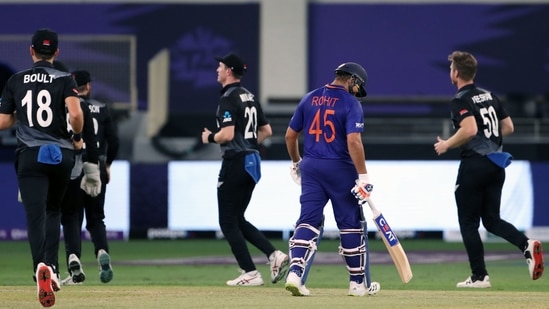
Dubai, Oct 31 (ANI): India's Rohit Sharma during the ICC Men's T20 World Cup match between India and New Zealand at Dubai International Stadium in Dubai on Sunday. (ANI Photo) (ANI)
A fresh approach to India’s white-ball cricket aspirations was desirable somewhere down the line, if not a complete shakeup. But the concept of accountability in Indian cricket has devolved in recent times. It generally worked in four-year cycles till Mahendra Singh Dhoni obtained a no-questions-asked extension with the 2007 T20 World Cup win. But the lines were deliberately blurred when N Srinivasan vetoed the selectors’ move to find a new captain after India were blanked in England and Australia, just months after the 2011 World Cup win. The reasoning was perfectly acceptable: How can you remove someone as ODI captain based on India’s performance in Tests?
Okay. How about adapting then? Why not relieve Dhoni of his Test duties (he had an impeccable home record, just like his predecessors but ultimately won just six of 30 Tests he led India overseas, losing 15 and drawing nine) and find a proper replacement? That didn’t happen as well. First to pounce on the opportunity to make money out of cricket, the BCCI was late in coming to terms with the concept of split captaincy. The wound was allowed to fester in the meantime as the BCCI created a make-believe world comprising rank turners for home series and sweeping massive overseas defeats under the carpet with the IPL. India made the last-four in the 2015 and 2019 50-over World Cups and the 2016 T20 World Cup but their latest capitulation necessitates this chronicling. India didn’t become a bad white-ball team overnight. The signs were always there but we chose to ignore it. Out of 32 T20Is India batted second since the 2016 World Cup, they have won 23. Within the same time frame though, India have won just 22 out of 41 matches batting first. Add to it the incessant chopping and changing and the general sense of indecision that always looms large over this post-Dhoni Indian team and it’s not surprising they are where they are.
Let’s understand how the India team has changed since Virat Kohli took over. Not fielding the same eleven in successive Tests (38 games on the bounce, ultimately) had already started to project Kohli in a different light a few months into his captaincy. More was coming though. Since Kohli became all-format captain in January 2017, India handed debuts to 25 cricketers in ODIs and 26 in T20Is. Only six among those 26 T20I debutants—including seven during July’s series against Sri Lanka—made it to the squad (without the standbys) but not wrist-spinners Kuldeep Yadav or Yuzvendra Chahal who in 2017 were hailed as assets in white-ball cricket. Varun Chakaravarthy was fielded against Pakistan and New Zealand with an overall international experience of just three games in Sri Lanka while Ravichandran Ashwin, who was picked ahead of Chahal, continues to be on the bench. So does Axar Patel—now a standby after a last-day change of heart saw Shardul Thakur supplant him in the squad—because Ravindra Jadeja was supposed to add depth to the batting but so far hasn’t.
T20 is an unforgiving format that demands clarity of thought. But India have been far from it, demoting Rohit Sharma to No 3 after one failure against Pakistan, a match they played one bowler short because Hardik Pandya is being given the longest rope possible to become an allrounder again from being just a No 7 bat now. Kohli’s indecision over his spot too is mind boggling. Before the IPL, Kohli had said he would open for Royal Challengers Bangalore in preparation for the World Cup. Just before the tournament began, he said KL Rahul opening the batting was a “no-brainer”. When a Pakistani journalist asked Kohli if he would open with Ishan Kishan the next match instead of Sharma, he gasped saying the word “unbelievable” before doing exactly that against New Zealand. India’s edginess in batting was for the world to see, be it in their hesitation to attack or resilience to graft something out of hopeless situations.
Most of this mess can be pinned on India’s chaotic buildup. Living in a bio-bubble for four months on the trot and Kohli announcing he will relinquish T20I captain—possibly to Sharma—but holding on to ODI captaincy was bound to have a rippling effect. Dhoni joining the team as mentor, as it’s turning out, isn’t conjuring any magic. Fresh from an IPL win, Dhoni’s wish is bound to be interpreted as command, further complicating the power dynamic within the team. The result has been nothing short of a rude awakening to the truth that India are far from the world beaters they were perceived to be. Not all’s the team’s fault though. Defeats are inevitable if you don’t play together for long. And this Indian T20I team doesn’t know how to play together. Between January 1 and October 15—the day of the IPL final—India had played just eight T20Is, three of them without almost 90% of the current T20 World Cup squad against Sri Lanka in July. During the same time, South Africa played 18 T20Is, Pakistan and West Indies 17 each, Bangladesh 16, Australia 15, New Zealand 13, Sri Lanka 12 and England 11 matches.
It wasn’t supposed to transpire this way though. India, if you remember, had to cancel a home ODI series against South Africa in March when the coronavirus was on the verge of becoming a pandemic. The Proteas were to come again in September for a full white-ball series comprising those three ODIs and three T20Is but the second leg of the IPL took up that window. And since it was to be hosted by the UAE, the IPL was quietly deemed adequate preparation for the World Cup. It isn’t. Jasprit Bumrah isn’t as much under the pump at Mumbai Indians where Trent Boult opens the bowling and everyone has defined roles with backup and contingency plans readied. Chakaravarthy was effective at KKR partly because Sunil Narine was already plugging the runs from another end. Kohli was keen on exploiting his mystery delivery but an India-Pakistan match is not the match to try a new bowling attack for the first time. It hurt India badly but they at least put up a good score then. Sunday though was a whole new low India weren’t prepared for at all.
Somshuvra Laha is a sports journalist with over 11 years' experience writing on cricket, football and other sports. He has covered the 2019 ICC Cricket World Cup, the 2016 ICC World Twenty20, cricket tours of South Africa, West Indies and Bangladesh and the 2010 Commonwealth Games for Hindustan Times.Read More


 Live Score
 Cricket Teams
 Cricket Players