E-Paper



Is load prescribed for pack and draught animals reasonable, HC asks govt
Uttarakhand high court directs GB Pant University to constitute a committee to study it within 12 weeks and suggest changes in rules


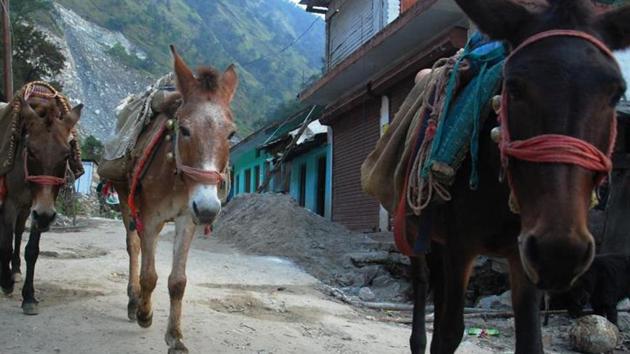
The Uttarakhand High Court has directed vice-chancellor of GB Pant University of Agriculture and Technology to constitute a committee to undertake a research within 12 weeks to find out whether the maximum weight prescribed under Prevention of Cruelty to Draught and Pack Animals Rules, 1965 is reasonable or not.
The committee will submit the report to the vice-chancellor, who will then send it to the chief secretary for making suitable amendments in the said Rules. The HC ruled that the committee be presided by the head of the department, veterinary sciences, while two senior most professors will undertake the research/ study.
The directions are a part of the 57-page order that a division bench of Justices Rajiv Sharma and Lok Pal Singh gave on Wednesday while according the status of “legal person or entity” to the entire animal kingdom, saying “they have a distinct persona with corresponding rights, duties and liabilities of a living person.” While disposing a public interest litigation (PIL) filed by Champawat-based social worker Narayan Dutt Bhatt in 2014, the court also declared all Uttarakhand natives as the guardians of animals and endowed them with the duty to ensure their welfare and protection.
The Prevention of Cruelty to Draught and Pack Animals Rules, 1965, defines pack animals as those who carry load on their back, and draught animals are those that are made to pull load through wheeled vehicles like a cart or a plow. It also categories maximum weight limits have been prescribed for pack and draught animals.
The high court said that till the study is completed and amendments are done, the state government will ensure that draught and pack animals do not carry load more than what is prescribed in the rules. HC also said that “where the route by which a vehicle is to be drawn involves an ascent for not less than one kilometer and the gradient is more than three meters in a distance of 30 metres, the weight shall be half of what is specified by this court. It is also made clear by way of abundant precaution that the weight specified in the direction made hereinabove, shall be inclusive of the weight of the vehicle.”
Veterinary experts and animals rights activists have welcomed the decision.
Dr GK Singh, dean, veterinary and animal sciences at GB Pant University said such studies have already been conducted for bulls and buffaloes. “We only have dairy animals here. For conducting study on draught and pack animals such as camels, donkeys, horses and mules, we will have to get them from outside. The HC order is a welcome step,” he said.
Animal rights activist Gauri Maulekhi, who is also executive member of Society for the Prevention of Cruelty to Animals (SPCA), Dehradun, said the decision was a step in the right direction for building a more sustainable society .“The abuse of working animals is most unfortunate. Overworked, diseased, injured animals pulling unreasonable loads cannot benefit the owners for long. It is a good step to revise and implement the law to protect such livestock,” said Maulekhi, who is also a member of state cow protection commission
Other major directions by HC to state government:
Ensure that in any area where the temperature exceeds 37°C during the period between 11.00 am and 4.00 pm in summers and when the temperature is below 5°C between 5 am to 7 am and between 10 pm to 5 am in winter season, no person is permitted to keep in harness any animal used for the purpose of drawing vehicles.
Since the carts driven by animals have no mechanical devices, they should be given the “Right of Way”. All the police officers throughout Uttarakhand are directed to ensure compliance of this direction to avoid inconvenience to the animals.
All the municipal bodies must issue certificates of unladen weight of vehicles to avoid cruelty to animals.
All the municipal bodies in Uttarakhand have been directed to provide shelter of suitable size to horses, bullocks and camels driving vehicles.
Appoint veterinary officers as per Section 3 of the Prevention and Control of Infectious and Contagious Diseases in Animals Act, 2009 and declare controlled areas and free areas to prevent, control or eradicate any scheduled disease by notification.