E-Paper



Limited space, unchecked construction create problems for Nainital
Lack of plain land in Nainital has led to constructions on slopes, which in turn, leads to traffic snarls during rains, hailstorm and snowfall.

 Prefer HTon Google


Nainital may be one of the most famous Himalayan hill stations, but its fame doesn’t match up with its area. It is quite small, nearly 11 sq km, clustered around the Nainital lake. Barring a small plain ground near the lake, there is almost no plain land in Nainital. This creates its own set of problems, especially with regard to space usage and building new structures, be it private or that of the government.
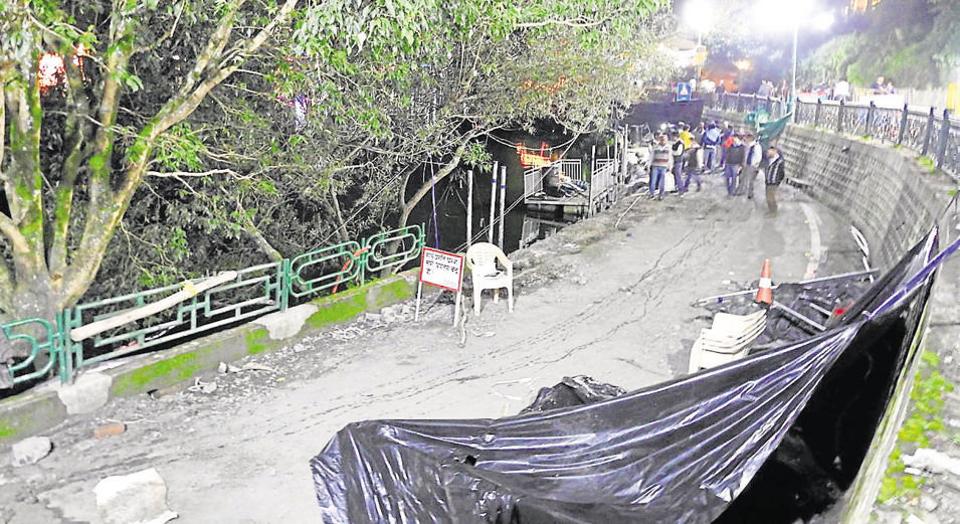
The lack of enough plain land has prompted locals to construct their houses and other structures on the slopes around the lake. And this concretisation, with over 7,000 structures perched on the steep slopes, has reached its saturation point. Most of the lanes on the slopes are narrow and steep, which makes driving and commuting difficult during the rainy season, hailstorms and snowfall.
This limitation in space coupled with the growing population and daily tourist influx, especially in summer months, creates a lot of problems like traffic mismanagement, overcrowding in the city markets, traffic jams and difficulty in finding a spot for parking.
The encroachments on the lanes further aggravates the problem. The space constraint in Nainital often leads to traffic chaos, forcing the authorities to take unprecedented measures. Last year, police put ‘Nainital Houseful’ flexi-banners on the roads to Nainital. Some locals also believe ground vibrations due to traffic movement led to the caving in of a part of the 172-year-old road stretch of Mall Road.
During peak summer months, up to 2,000 vehicles arrive in Nainital daily. On weekends, up to 6,000 vehicles make a beeline for Nainital, which has parking capacity for 2,000 vehicles.
Taking cognisance of this issue, in April last year, the HC directed the state to ensure that “those coming to Nainital with their own vehicles should first make advance arrangements for parking their vehicles”. After HC’s tough stand, administration started stopping tourist vehicles without advance parking arrangements from entering the city. When the chaos worsens, traffic cops also stop tourist vehicles temporarily in the outskirts of the hill station.
Last year on HC’s directions in a PIL filed by Nainital-based activist Ajay Singh Rawat, IIT Delhi submitted a report for making proper parking arrangements in Nainital. The IIT report had made many recommendations like the road in front of the Malital mosque be widened among others.
Also Read | Over-exploitation of water resources threatening Nainital’s ecology
Noted environmental activist Ajay Singh Rawat, who has been instrumental in filing several PILs in Supreme Court and state high court to protect the ecology of Nainital said most hill stations are small.
“But how we deal with the development and use of space makes all the difference. The source of Nainital lake, Sukhatal, is a Himalayan wetland, but the state government is yet to notify it. Give this situation, many people are taking advantage of this fact, building constructions on the lake beds and the lake shore. Also, despite the ban on group housing and over two-storey buildings in Nainital, they are still being constructed in many areas,” he said.
Rawat said there are reports by Lake Development Authority Nainital and Uttarakhand Academy of Administrative Training Institute that had declared way back in 2006 that Nainital had reached its carrying capacity. “The solution is that the authorities should develop satellite townships away from the lake region. This will lessen stress on Nainital,” he said.
The strictness by local authorities even put the traders, hoteliers, tour and travel operators on warpath with the local authorities last year. They even threatened of indefinite strike, arguing that strict measures were discouraging tourists from coming to Nainital, affecting their businesses.
Neeraj Joshi, president Taxi Travel association Nainital, said due to regular traffic chaos in Nainital, many tourists are now going to other nearby places like Ranikhet, Bhimtal and Sattal. “For over a decade, the authorities didn’t come up with any comprehensive and long-term plan for traffic management here. But following HC’s strictness, the administration has started taking some measures,” he said.
Dinesh Lal Sah from Nainital Hotels and Restaurants Association said lack of proper parking space has been affecting the tourist influx in Nainital, especially following the high court’s strict directions.
Also Read | Fragile geology of landslide-prone Nainital a recipe for major tragedy
Harbeer Singh, additional district magistrate Nainital admitted that parking was a major issue in the city due to lack of enough space. “We have plans to set up a multi-level parking at the site of Ashok Cinema here with a capacity of 284 vehicles. We have moved the process by seeking various No Objection Certificates from different departments,” he said.
Singh said they also want to create a proper parking space at Rusi Bypass nearly 2km from the city where all visitors can park their vehicles. “An expression of interest has been already floated for the interesting companies and agencies who want to run the setup and create this parking space,” he said.
Mahesh Chandra, inspector in-charge, traffic police Nainital, said, during tourist season, up to 2000 tourist vehicles enter Nainital on a daily basis, while on weekends this number can go up to 6000.
“But the total parking available including those with hotels is around 1500 to 2000. This creates problems and we are forced to stop vehicles outside Nainital,” he said.