The Uttarakhand high court on Monday directed the Central and state governments to file a reply by August 27 on whether Badrinath shrine could be declared as a national heritage.
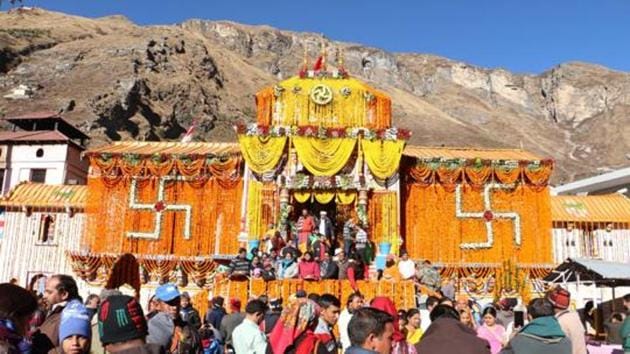
One of the most visited pilgrimage centres of India, Badrinath shrine is one of the Chardham (four main pilgrimage centres of Hindus) located in Garhwal hills along the banks of the Alaknanda River in Chamoli district at a height of over 10,000 feet.
MC Pant, a counsel of the petitioner, said the court has directed that replies be filed as affidavits by the Central and state governments by August 27 -- the next date of hearing.
The directions were issued by a division bench of justices VK Bisht and Manoj Kumar Tiwari while hearing a public interest litigation filed by Nainital-based Chetna Bhargav in June.
Bhargav in her PIL had highlighted unhygienic conditions around Badrinath shrine especially the construction of a sewerage treatment plant near the shrine.
DS Mehta, another counsel of the petitioner, said the court also asked the advocate general to speak to the secretary urban development that why Badrinath area should not be developed as a special area.
{{/usCountry}}DS Mehta, another counsel of the petitioner, said the court also asked the advocate general to speak to the secretary urban development that why Badrinath area should not be developed as a special area.
{{/usCountry}}The HC also issued directions that secretary urban development also be made a party in the case.
Mehta said the high court also directed the counsel representing the Jal Nigam to visit the shrine area and present a status report before the court.
In June, while admitting the PIL, the court directed the state and central governments on to explain why sewerage treatment plant was constructed near the Badrinath shrine, which is creating unhygienic conditions there, in violation of the laid down norms.
The petitioner had urged the court to take immediate steps for shifting of the open sewage treatment plant to an alternate location.
According to Bhargava, she went on a pilgrimage to Badrinath shrine, Narad Kund, Anna Kshetra, Khap Kshetra and Baba Balaknath Ashram in the first week of June and was aghast to see the unhygienic condition there.
She said an Open Sewage Treatment Plant (STP) less than 500 metres from Badrinath shrine had been constructed on the bank of river Alaknanda.
“The construction of the STP is causing great inconvenience due to the pungent smell emitted from it causing hazardous atmospheric conditions which is also causing harm to the ecosystem of the surrounding areas and polluting the waters of Alaknanda,” she said.
Earlier this month, the high court also asked the state government whether a memorial could be built for victims of the 2013 Kedarnath tragedy where pilgrims could offer prayers for the departed souls, especially on the anniversary of the tragedy in mid-June.
The court posed this question while hearing a public interest litigation in 2014 by Delhi-based Ajay Gautam, who had alleged in his petition that the government was not coming clear on the actual casualties in the tragedy.