
 E-Paper



Indian Muslims don’t fare well at all, says US report
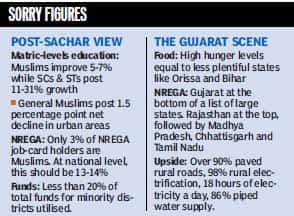
Two India reports by the US-India Policy Institute, a Washington-based think-tank, has noted a steady decline in key human development indicators of Muslims, apart from high hunger levels in Gujarat, one of India’s fastest growing states. Zia Haq reports. Sorry figures


Two India reports by the US-India Policy Institute, a Washington-based think-tank, has noted a steady decline in key human development indicators of Muslims, apart from high hunger levels in Gujarat, one of India’s fastest growing states.

The UPA government had rolled out multiple welfare programmes after the 2006 Sachar Committee report on disadvantages faced by Muslims.
The research, which takes a post-Sachar look, suggests that the government’s minority welfare agenda could be floundering due to inadequate outreach and exclusion, the very drawbacks it aims to plug. The research was anchored by Abusaleh Shariff, lead economist of the Sachar Committee report, and is due out in December.
University of California, Riverside economist Anil B Deolalikar, the lead author of the International Food Policy Research Institute’s India Hunger Index, is also on the US-India Policy Institute’s panel.
The institute’s Gujarat paper, titled Relative Development of Gujarat and Socio-Religious Differentials, says the state had high levels of hunger, while “simultaneously boasting” high per capita income. It also is among the lowest beneficiaries from a national rural jobs programme.
Shariff said new evidence indicates that despite funneling over Rs 7,000 crore for multi-pronged plans in the past five years, exclusion could still be holding back socio-economic recovery of over 150 million Muslims.
The main philosophy behind the Sachar report, according to Shariff, was to enable minorities to gain social and economic access in line with their population share. “However, some of the initiatives... are aimed at providing immediate benefit. Such policies will have little if at all priority in the bureaucratic scheme of things,” Shariff said.
The current approach, whereby government creates specific schemes for minorities, could create a wedge between competing communities, he added.

Stay updated with all top Cities including, Bengaluru, Delhi, Mumbai and more across India. Stay informed on the latest happenings in World News along with Delhi Election 2025 and Delhi Election Result 2025 Live, New Delhi Election Result Live, Kalkaji Election Result Live at Hindustan Times.


