E-Paper



Weak family bonds push juveniles to a life of crime
A little more time from parents might help prevent juveniles from committing crimes.

 Prefer HTon Google


A little more time from parents might help prevent juveniles from committing crimes.

A study by the Delhi Commission for Protection of Child Rights (DCPCR) has described parental neglect as the main factor which forces juveniles into the world of crime.
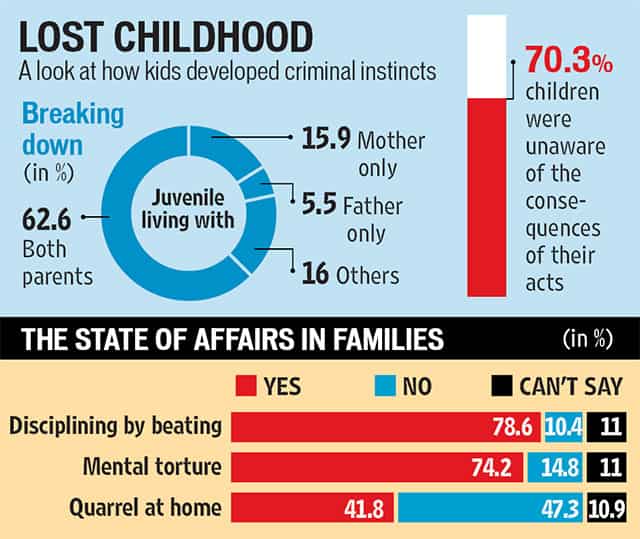
The study has found that only 29% of the children’s parents spend quality time with them.
Only 15% of those in special homes and 36% of those in observation homes reported some kind of sharing between them and the parents and less than two-fourths of their families dined together.
“Weak bonding between family members resulted in subsequent weak supervision, guidance and involvement that led to possible drift to unlawful acts. Families that spend time together, show warm relationships and open communication are likely to desist deviance as these factors act as virtual supervision mechanism. Most of the children in detention centres were deprived of many of the above factors in their families,” the report stated.
For some children, who stated that their parents spent time with them, it only meant that they were assisting the parents in their work.
The study further revealed that 41.8% of the homes of the children reported quarrels at varying frequency. About 18.1% on the other hand witnessed beating of one parent by the other. Nearly 74.2% reported mental and psychological torture.
The personal accounts of children in various detention centres revealed that 50.3% of these children were deprived of adequate housing conditions. Similarly, 48% of the murder accused and 70% of the rape accused were deprived of proper
housing.
“They were living either in jhuggis/streets or in rented accommodations. Absence of houses of their own was reported by 39.5%. Deprivation of land and a house threw many of the children and their families on the streets making them vulnerable to various risks,” the report further stated.
Lack of education among parents also played a crucial role as most parents of the children in various detention centres had received lower level of education.
“About 54.9% fathers and 70.9% mothers of the children in detention did not have any formal schooling. Among those who had formal education, a substantial number (19.8% father and 11.5% mothers) were with either primary or upper primary level of education,” the report said.