The earth’s protective ozone layer is recovering! In a UN-backed report released last week titled Scientific Assessment of Ozone Depletion: 2018, authored by an expert panel working with the World Meteorological Organisation and the United Nations Environment Programme, has stated that the collaborative efforts of signatory countries of the Montreal Protocol have helped heal the ozone layer, providing a ray of hope. These reports are carried out once every four years under the aforementioned protocol. While the Northern Hemisphere leads the race and expects its ozone layer to be completely healed by the 2030s, the Southern Hemisphere lags behind, and expects to reach complete closure by mid-century. In bigger news, if countries continue to keep this commitment, the gaping hole in the ozone layer over the Antarctic should disappear by the 2060s.
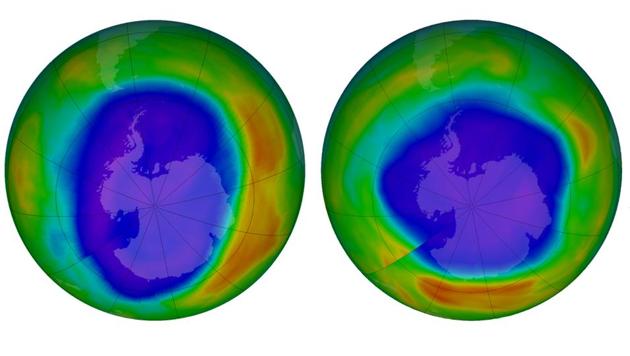
The biggest cause of the depletion was the presence of various ozone-depleting substances (ODS) such as chlorofluorocarbons (CFCs) and halons, which constitute CFC-11 emissions, and were ultimately banned in 2010. Between then and now, efforts to replace these chemicals with less harmful ones such as hydrofluorocarbons (HFCs) have begun to pay off. India and China are big users of HFCs due to their population. They are coolants used in refrigerators and air conditioners.
Finalised in 1987, the Montreal Protocol has been hailed as the one of the most successful and effective environmental treaties ever negotiated and implemented, aimed solely at preventing the depletion of the ozone layer and protecting humans from the ultraviolet rays of the sun. The treaty also gives developing and underdeveloped signatory countries a buffer period to completely stop the use of HFCs, which do not directly affect ozone depletion but are global warmers. In 2015, when Prime Minister Narendra Modi met then US President Barack Obama, India vowed to stop using HFCs and look for more environment friendly options for coolants.
While countries continue to work towards this goal independently, earlier this year, rogue CFC-11 emissions were detected in East Asia, which could mean that there is a violation of the international treaty. Some believe that these were just accidental emissions. The beauty of treaties such as this one is that the onus of compliance remains on the country while the environmental effects remain global, pushing countries to do their best . We must ensure that our development goals are sustainable and do not hinder this movement. Our future depends on it.
{{/usCountry}}While countries continue to work towards this goal independently, earlier this year, rogue CFC-11 emissions were detected in East Asia, which could mean that there is a violation of the international treaty. Some believe that these were just accidental emissions. The beauty of treaties such as this one is that the onus of compliance remains on the country while the environmental effects remain global, pushing countries to do their best . We must ensure that our development goals are sustainable and do not hinder this movement. Our future depends on it.
{{/usCountry}}