
 E-Paper



A layered relationship
The India-US dialogue focussed on taking stock of where each stands on global issues and finding common ground on shared ideas

 Prefer HTon Google


The India-US 2+2 dialogue of defence and foreign ministers last week was an opportunity to take stock of a partnership that is growing closer and stronger amid serious geopolitical challenges arising from the Ukraine war and the Israel-Hamas conflict. This year has been a landmark one for the India-US relationship as high-profile visits from both sides have driven the ties underpinned by the glue of shared challenges and rapidly expanding collaboration in defence and technology. There is no doubt that the growing assertiveness of China is the most important factor that has brought the two sides closer together, and the ministers discussed the threat posed by Beijing ahead of a planned meeting between US President Joe Biden and his Chinese counterpart Xi Jinping on the margins of the Asia-Pacific Economic Cooperation (APEC) Summit this week. China’s aggressive behaviour in boundary disputes, ranging from the Line of Actual Control with India to the South and East China Seas with South East Asian countries, has only increased wariness about Beijing’s actions in recent months.
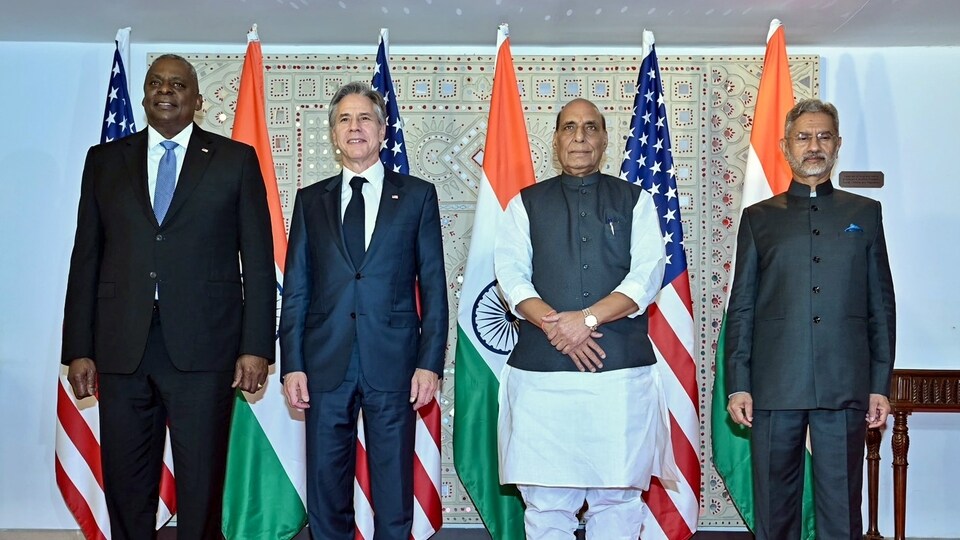
But the India-US relationship has also grown beyond a union aimed at combating China, and witnessed a remarkable enlargement of joint work in defence and technology under the initiative for Critical and Emerging Technology (iCET) and other frameworks. There has been progress on plans to manufacture the GE F414 engine in India to power the next generation of home-grown jets and to supply MQ-9B Reaper drones, and the two sides also agreed on a new move to jointly develop and make an infantry combat vehicle.
The India-US defence and security partnership has now acquired a momentum of its own. The two sides are backing several initiatives to ensure the Indo-Pacific remains free and open, and these are not limited to the security domain. There is, for example, the work being done to create transparent telecom networks, prepare for future health emergencies and put in place resilient supply chains. However, both sides will have to do more to reduce their economic dependence on China, which remains India’s largest source of imports and the biggest trade partner for the US. There are differences between Delhi and Washington on matters such as Ukraine and Canada, but the message from the dialogue was clear -- these are unlikely to halt the forward movement in the relationship.


