
 E-Paper



The communal turn in Dhaka
The arrest of a Hindu monk and the demand for banning Iskcon turns the spotlight on India-Bangladesh relations

 Prefer HTon Google


The polarisation in Bangladesh since the arrest of Chinmoy Krishna Das, a Hindu monk associated with the International Society for Krishna Consciousness (Iskcon), suggests that the so-called second revolution in that country seems to have taken a decisive communal turn. Das, a vocal spokesperson and mobiliser for the rights of minorities in Bangladesh, was booked on sedition charges and his arrest triggered clashes in which one person was killed. Sheikh Hasina, the deposed Bangladesh prime minister (PM) currently residing in India, described the arrest as unjust and demanded Das’s immediate release. Against this backdrop, the Dhaka High Court’s rejection Thursday of a petition seeking a ban on Iskcon comes as a welcome relief: Iskcon claims the legacy of the 16th-century Bengali Vaishnavite saint and preacher, Chaitanya Mahaprabhu, and is more of a transnational counterculture organisation.
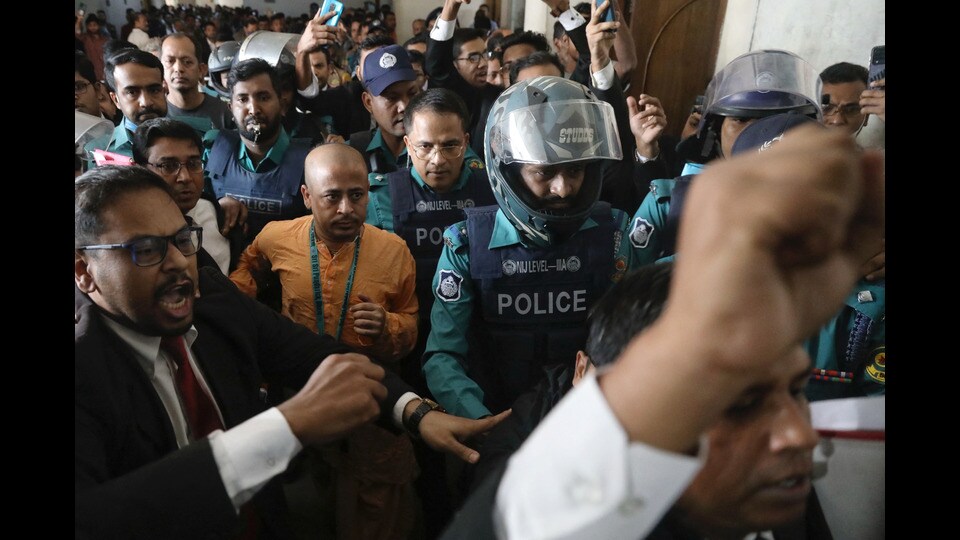
The arrest of Das, the slapping of sedition charges on him, the demand for banning Iskcon, and continuing communal clashes raise questions about the interim government’s capabilities in enforcing law and order and communal peace. Since August when a mass uprising led to the ouster of the elected Awami League government and forced PM Hasina to flee to India, Bangladesh has been in a state of chaos. The internal contradiction in the interim government, a mishmash of representatives drawn from political outfits such as Bangladesh Nationalist Party, and student and even religious groups, is now coming to the fore with various interests pulling it in different directions. The attacks on the Hindu community, considered a political constituency of Awami League, have expectedly raised hackles in India: Geography and a shared political history ensure that the rise in majoritarianism in Dhaka immediately reflects on its relations with New Delhi. New Delhi’s “deep concern” about Das’s arrest and its call to Bangladesh “to ensure the safety of Hindus and all minorities” comes against this backdrop. Dhaka has expressed “utter dismay” at the arrest being “misconstrued by certain quarters”.
The outrage seems misplaced, for it is the illiberal and communal turn in Bangladesh that must worry Dhaka. The face of the interim government, Muhammad Yunus, may want to dismiss the anti-minority violence as exceptional: There have been reports that highlight Muslims safeguarding shrines, homes and other property of Hindus. However, physical violence has been the leitmotif of the public mobilisations that caused the regime change in Dhaka; Islamist groups that were a part of these mobilisations have been open about their intention to subvert the idea of a secular and democratic Bangladesh State. The release of activists such as Jashimuddin Rahmani, the chief of the Ansarullah Bangla Team, points to the complicity of the new administration in fuelling communalism; Rahmani was in prison in connection with the murder of an atheist blogger.
Two aspects of the current situation deserve special attention.
One, the character of the interim government in Dhaka. The hatred of the Sheikh Hasina regime seems to be the only glue that holds the disparate groups together. This is reflected in the interim government’s stance on its relations with Delhi. While Yunus has also sought the extradition of Sheikh Hasina, he has been more reconciliatory in his approach to Delhi, beseeching India to look beyond Awami League and firewall India-Bangladesh relations from domestic politics. Meanwhile, the Islamist groups, historically seen as pro-Pakistan voices, seek to discredit the legacy of the language movement and deny agency to the people who fought for the creation of Bangladesh.
Two, how should India articulate its concerns about Bangladesh’s Hindus? Delhi, surely, is not the guardian of Bangladeshi Hindus, but as a liberal democracy, it is entitled to flag its concerns about the rights of minorities. Besides, history, geography, and national security make it impossible for Delhi to ignore the chaos at its border, but it must nuance its position so that the concern for Bangladeshi Hindus does not further imperil their situation in that country.


