
 E-Paper



2026 polls: A watershed in Assam's politics | Number Theory
The implications of the 2026 verdict, however, go beyond the fortunes of these two parties. Here are four data points which capture this
Updated on: May 8, 2026, 08:40:26 IST

 Prefer HTon Google
Share via


Copy link

The Bharatiya Janata Party (BJP) has won its biggest ever victory in the 2026 Assam elections. The Congress, on the other hand, recorded its worst ever performance in the state. The implications of the 2026 verdict, however, go beyond the fortunes of these two parties. Here are four data points which capture this.
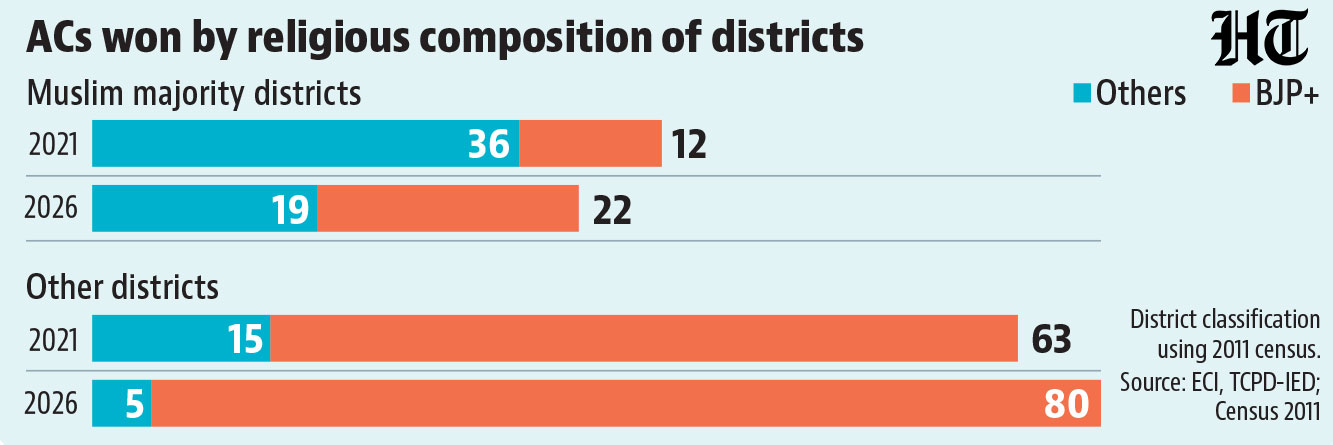
 Did gerrymandering win Assam for the BJP?This was the first assembly election in Assam after the 2023 delimitation, the first in the state after 1976. Allegations of gerrymandering – political favourable redrawing of constituency boundaries – have been made vis-à-vis the process. How true are they? One data-point makes it clear. Nine out of Assam’s 27 districts (as per the 2011 census) have a Muslim population share of 50% or more. The parties not aligned with the BJP won 36 assembly constituencies (ACs) in these districts in 2021. This time they have won just 19. The number of Muslim MLAs from these nine districts have fallen from 28 in 2021 to 19 in 2026. This strongly suggests that AC boundaries were redrawn in a way that Muslims became less important in at least some of the ACs in these districts. But is gerrymandering the only reason for the BJP’s spectacular showing this time? Another statistic cautions against jumping to such conclusions. In the districts with less than 50% Muslim population, the seat count of non-BJP aligned parties fell from 15 to just five. The number of ACs in the nine Muslim majority districts in Assam fell from 48 to 41 after delimitation. In 2021, the non-BJP alliance parties had won 36 out of the 48 (75%). This time they have won just 19 out of the 41 (46%). But it is their performance in the non-Muslim majority part of the state that has sunk even further: from 15 out of 78 (19%) in 2021 to just five out of 85 (5.9%). Delimitation is the icing on the cake for the BJP rather than the cake itself.
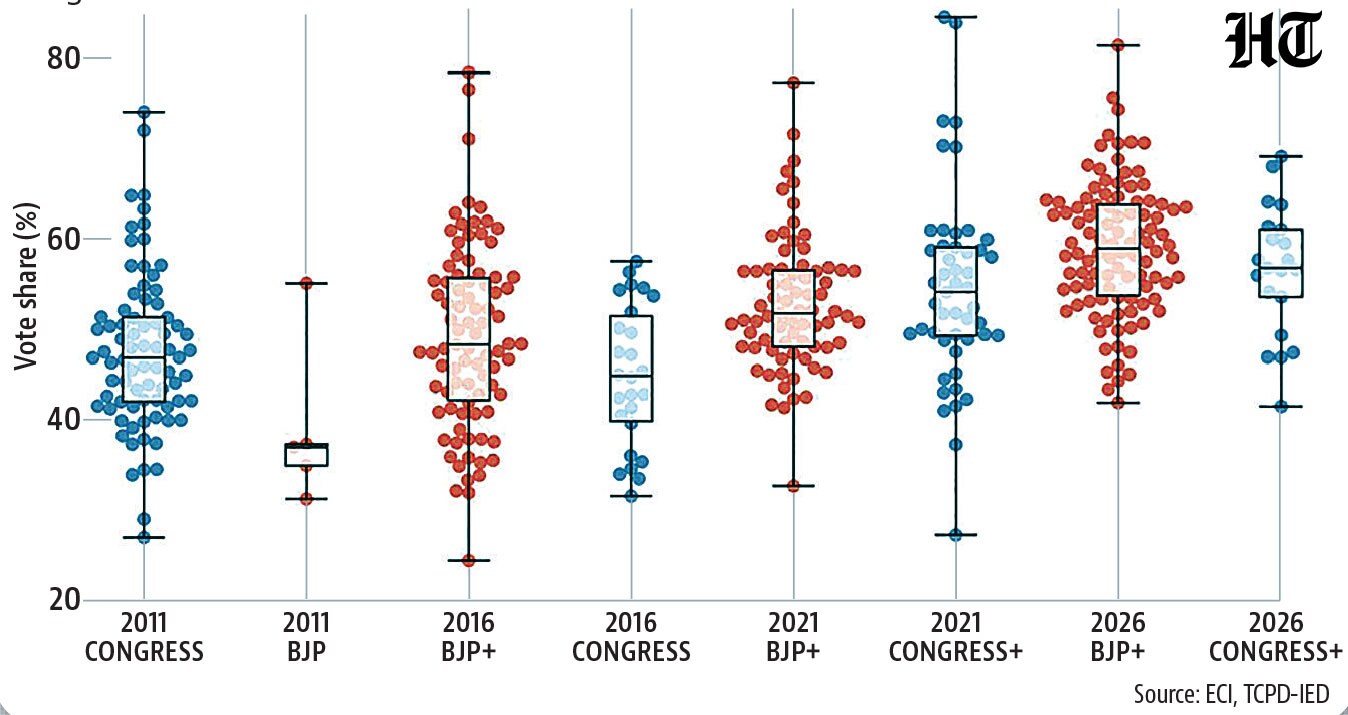
- Assam’s polity is extremely polarised at the momentThere is a 12-percentage point difference between the vote shares of the BJP and the Congress alliances in the state. This number does not do justice to the extent of polarisation in Assam at the moment. HT has looked at the median vote share of winning candidates in Assam from the BJP and the Congress alliances from 2011 onwards. The numbers have increased by 22 percentage points for the BJP and nine percentage points for the Congress. They are close to the 60% mark for both these parties in 2026. The average winning candidate is winning with a brutal majority, and the losing candidate does not even stand a chance. When read with the district-wise religious demography discussed above, it is impossible to not see this as communal polarisation.
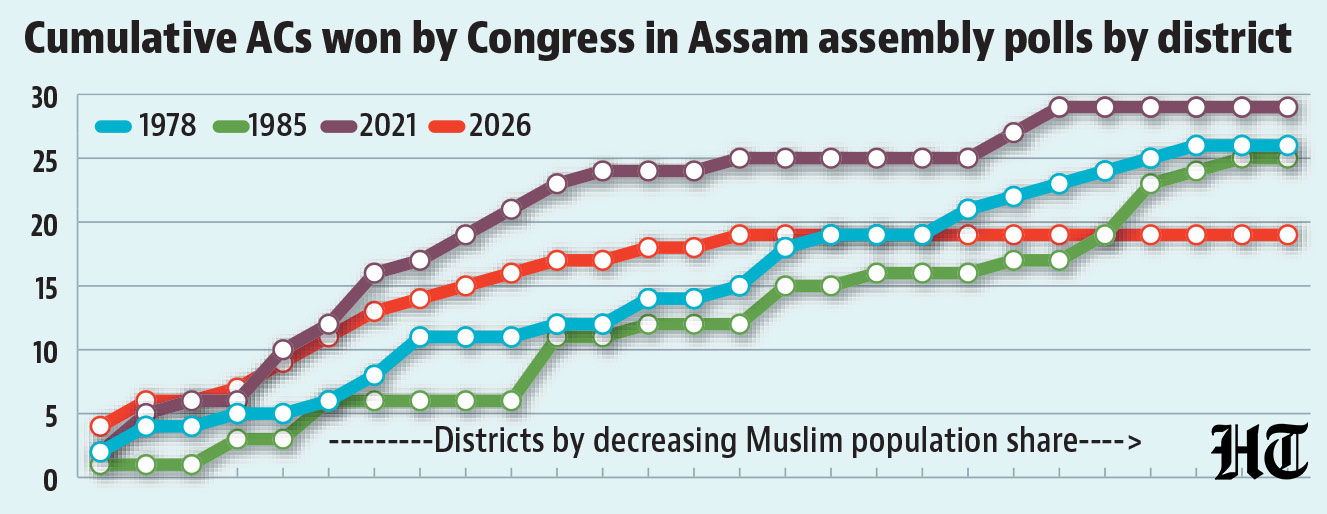
- The current communal discord is different from politics at the time of Assam accordTo be sure, electoral routs are not new for the Congress in Assam. It fared very badly in two state elections much before the current dominance of the BJP. In 1978 elections, the Congress lost badly to the Janata Party and in 1985 it was humbled by young rebels leading the AASU agitation. However, what differentiates the Congress’s current predicament form these past upsets is the Congress’s complete rout from non-Muslim majority parts of the state in the 2021 and 2026 elections. Comparing Congress’s MLA count as one goes from high to low Muslim population share districts in 1978 and 1985 with 2021 and 2026 numbers shows this clearly.
- Can the Congress resurrect itself from this crisis in Assam? Any such effort must begin with acknowledging the harsh reality of state’s politics today. What the Congress did in the past to reinvent its politics after the reverses of the 1980s is not going to be enough today. Assam’s political and social rupture has mutated into a communal rather than just a linguistic rupture.



Unlock a world of Benefits with HT! From insightful newsletters to real-time news alerts and a personalized news feed – it's all here, just a click away! -Login Now!


