
 E-Paper



8 years of GST, India's key indirect tax reform | Number Theory
.
Updated on: Jul 1, 2025, 08:56:27 IST

 Prefer HTon Google
Share via


Copy link

The Goods and Services Tax (GST) is eight years old today. Many years in the making, GST has been the most important indirect tax reform in India till date. It did away with state-wise differences in indirect tax rates and created a unified indirect tax regime for trade in goods and services in India. This was expected to facilitate ease of doing business and also help prevent tax evasion. Because the reform entailed doing away with state-wise differences in taxes it also required a significant erosion of fiscal autonomy available to state governments, making it a politically delicate exercise. How has the GST performed in the last eight years? Here are three charts which try to answer this question.
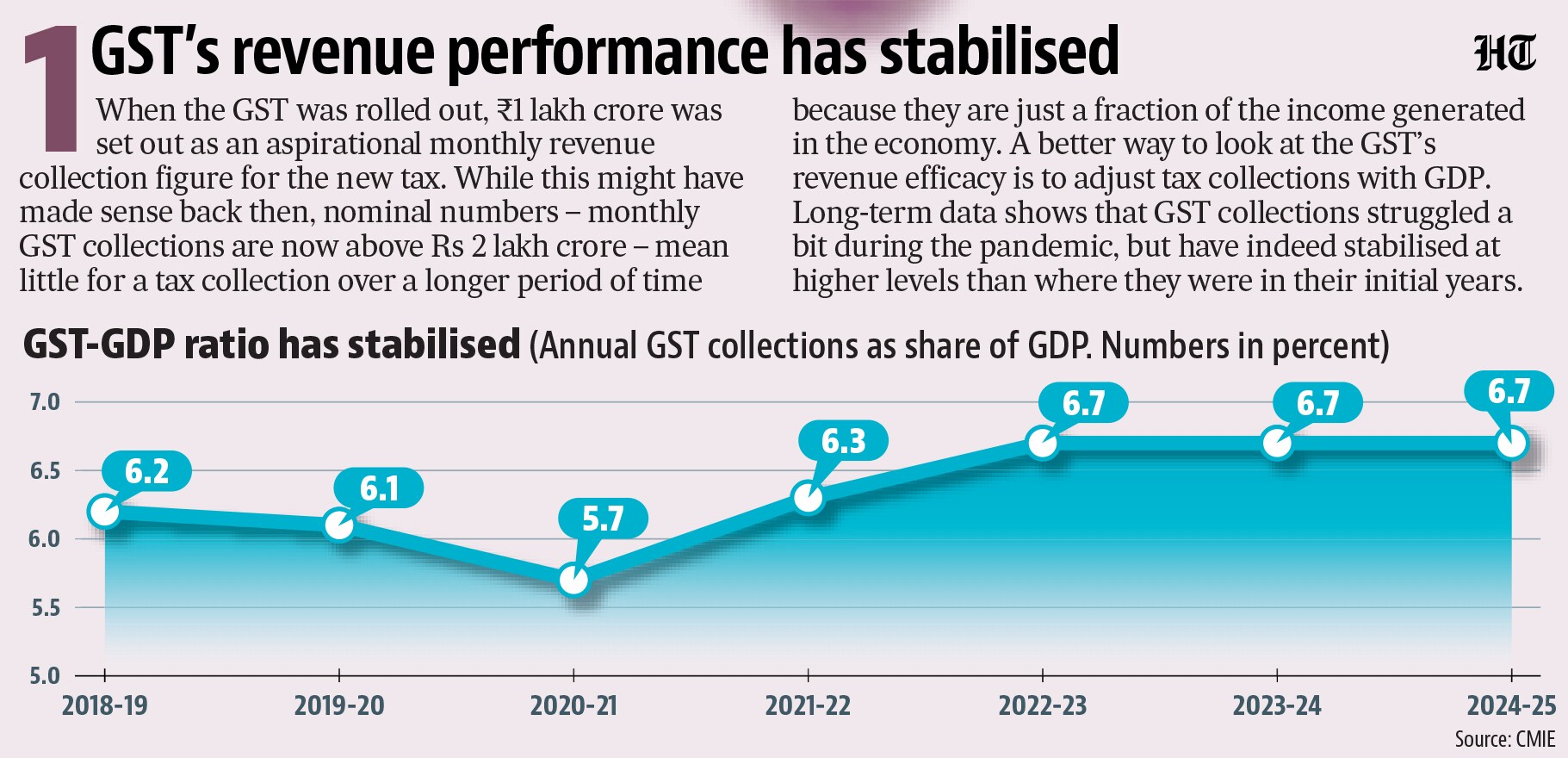
 GST’s revenue performance has stabilisedWhen the GST was rolled out, ₹1 lakh crore was set out as an aspirational monthly revenue collection figure for the new tax. While this might have made sense back then, nominal numbers – monthly GST collections are now above ₹2 lakh crore – mean little for a tax collection over a longer period of time because they are just a fraction of the income generated in the economy. A better way to look at the GST’s revenue efficacy is to adjust tax collections with GDP. Long-term data shows that GST collections struggled a bit during the pandemic, but have indeed stabilised at higher levels than where they were in their initial years.
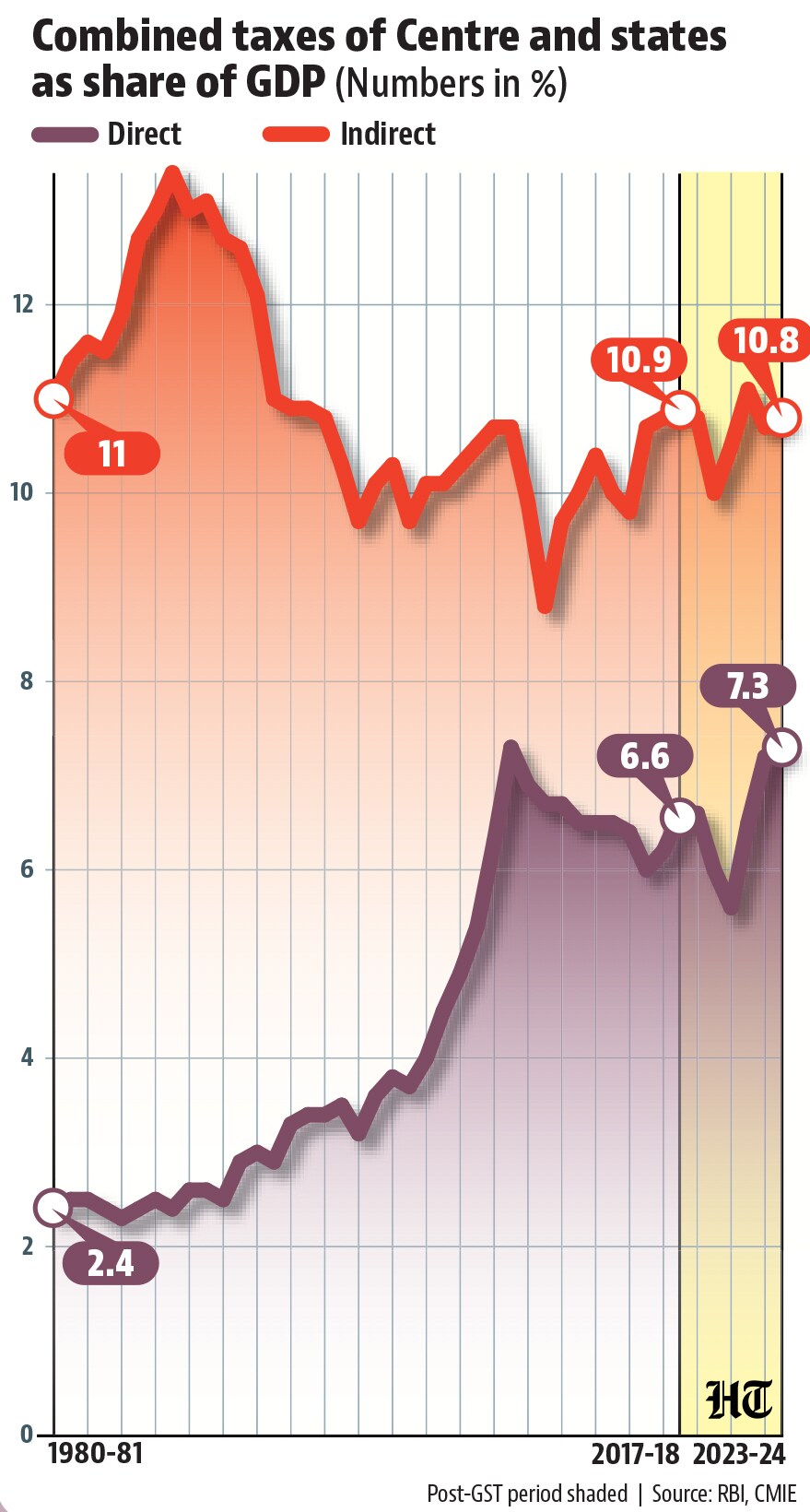
- However, in terms of overall tax-GDP ratio, direct rather than indirect taxes show a rise in post-GST periodThe rise in GST-GDP ratio notwithstanding, the overall revenue impact of GST should be judged in terms of overall tax-GDP ratio of the Centre and the states. RBI has data on combined direct and indirect taxes of the Centre and states till 2024-25. A look at the direct and indirect tax to GDP ratio shows that it is the direct tax to GDP ratio which has shown a larger rise in the post-GST period. This shows that overall indirect tax collections have not received a significant boost from GST’s implementation, although some of the jump in direct tax collections could well be a result of the formalisation thanks to GST.
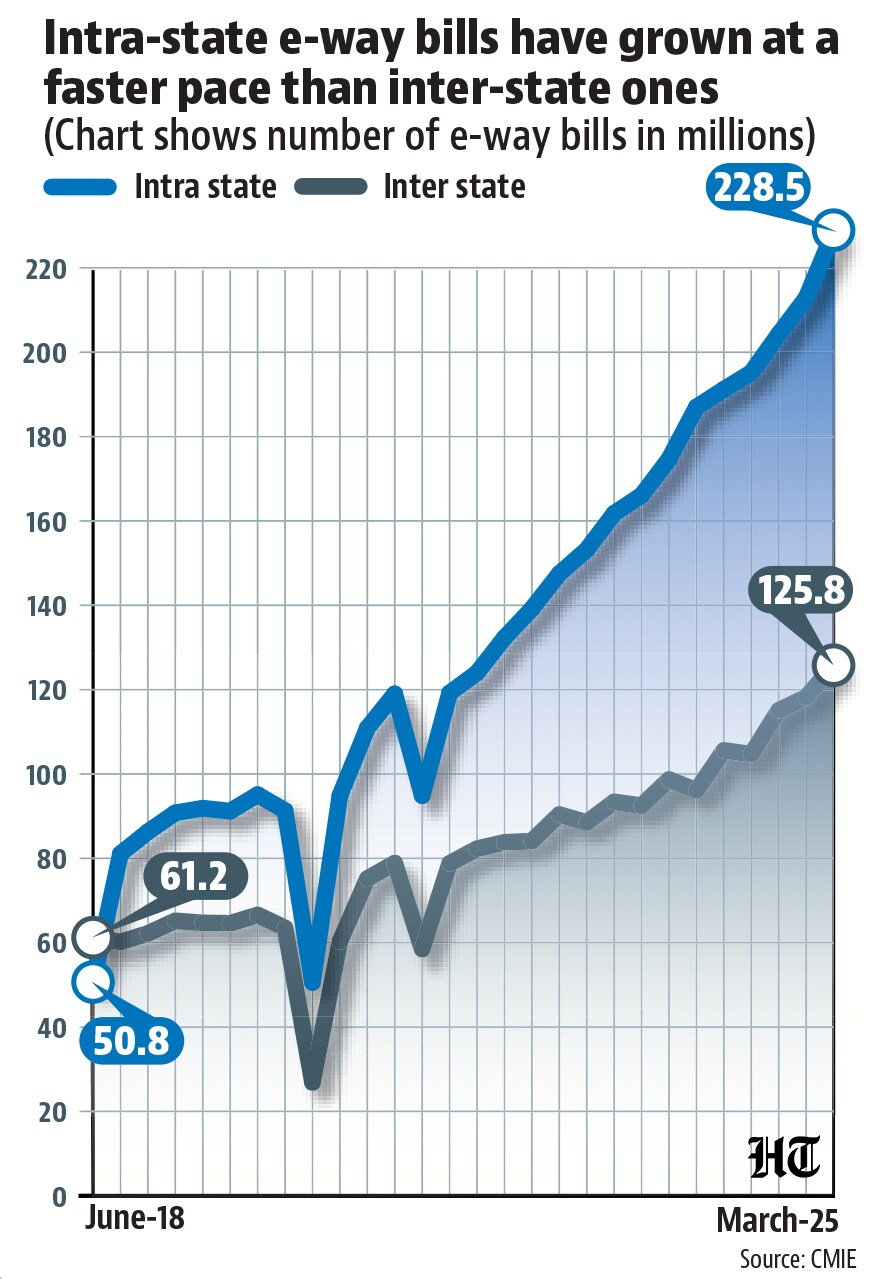
- GST E-Way bill data suggests that it has likely led to a greater formalisation of local transactionsOne of the things GST was expected to achieve in India was a greater formalisation of the economy because of its chain effect of businesses having to claim input tax credits. Eight years after its roll-out what is the trend on this front? Because numbers of E-Way bills (required for transport of goods) generated by GST – each transaction leads to a unique E-Way bill – are available for intra-state and inter-state transactions separately, it is possible to make a comparison of these two kinds of GST transactions. The number of inter-state E-Way bills was higher than intra-state in June 2018, the earliest period for which this data is available in the Centre for Monitoring Indian Economy (CMIE) database. However, this trend has gradually reversed and intra-state E-Way bills are now more than 1.8 times the number of inter-state E-Way bills. This suggests that GST’s expanding footprint is a result of its growing coverage in transactions within states which could well be a result of growing formalisation of the local, even hyperlocal economy.
- But fiscal federalism fissures remainGST was rolled out after a grand bargain between the Centre and the states where the former promised guaranteed revenue growth to the states for the first five years. The pandemic’s disruption complicated this arrangement because the compensation cess which was supposed to cover the revenue shortfall to states proved inadequate necessitating borrowing. There is now a fresh twist in the tale. Last week, HT reported that the GST compensation cess might be sitting on a surplus of ₹95000 crore even after settling all the dues which were pending because of the debt taken earlier. Who gets to keep this cess and whether the cess will continue in a new form (also reported by HT) are questions which are likely to create animated discussions in the GST Council whenever it meets next. When read with the fact that these discussions are happening at a time when more states, including those ruled by BJP governments, are demanding a greater share in central government revenues, it suggests that India’s fiscal federalism contract might be on the cusp of yet another churn.


Unlock a world of Benefits with HT! From insightful newsletters to real-time news alerts and a personalized news feed – it's all here, just a click away! -Login Now!


