E-Paper



A database of India’s Muslim MLAs and MPs - Part 1 | Number Theory
This is the 1st of a 2-part series based on an HT database of all-Muslim MPs and MLAs. The 2nd part will look at party-wise changes in representation of Muslims

 Prefer HTon Google


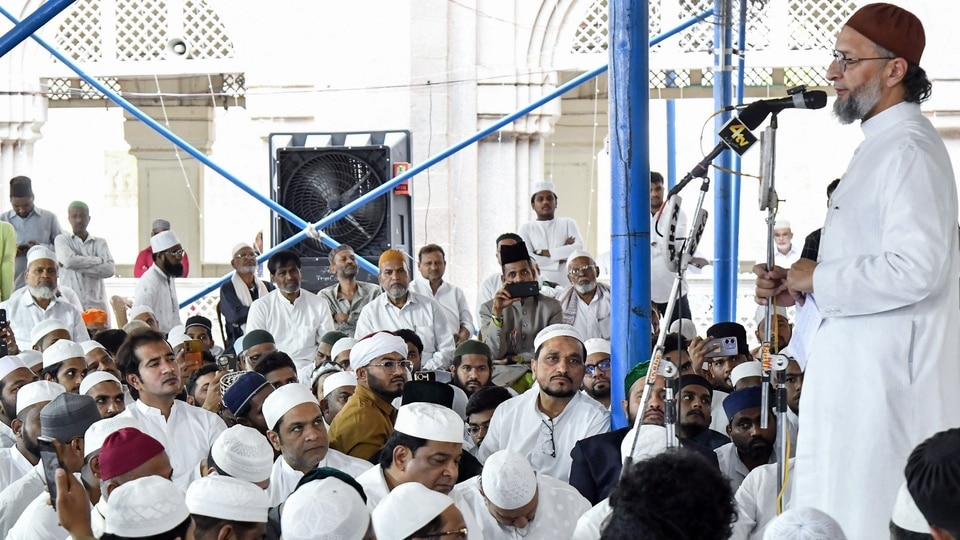
Muslims comprised 14.2% of India’s population in 2011, according to the latest published census data. In absolute terms, India likely has the third largest population of Muslims in the world. How are Muslims represented in Indian politics? What has happened to this share over time?
The first author of this story has prepared a database of all Muslim MLAs and MPs from 1952 onwards to answer this question. This is the sixth original all-India database prepared by HT ; the other databases are on the council of ministers, chief ministers, deputy chief ministers, Supreme Court judges, and governors.
This two-part data journalism series will use this database to analyse the representation of Muslims in Indian parliament and assemblies. The first part will look at these trends over time and across geographies. The second part will look at Muslim representation from the perspective of political parties.
 Muslim representation has varied, but their underrepresentation has been permanentMuslims have a share of 5.7% and 6.7% in the 9533 Lok Sabha MPs and 64009 MLAs elected in India since 1952. Both these numbers are significantly lower than their population share in India which has increased from 9.8% to 14.2% between the 1951 and 2011 census. Share of Muslim MPs reached a peak in 1980 elections when it was 9.3%. It fell to an all-time low of 4.2% in 2014, the first election in which the BJP achieved a parliamentary majority of its own. It has recovered marginally from that trough in the subsequent elections. The share of Muslim MLAs shows lower volatility than MPs and reached its decadal peak in the 2000s when it was 7.3%. While the period from 2021 until now shows the share to be the highest, the number will likely come down when more states go to poll in what remains of the decade as the high Muslim share states have already had two elections.
- More than half of India’s Muslim MPs and MLAs have come from just three and four statesIndia has had 539 Muslim Lok Sabha MPs and 4,288 Muslim MLAs so far. 52% of India’s all Muslim MPs have come from just three states: Uttar Pradesh, West Bengal and Bihar. Among Muslim MLAs, 57% come from West Bengal, Uttar Pradesh, Jammu and Kashmir and Kerala. These numbers need to be read with the fact that state-wise MP numbers have not factored in division of states but MLA numbers have. This is because parliamentary constituencies cannot be neatly separated for pre- and post-division states.
- What explains the regional skew in Muslim representation?The real cause of skewed Muslim representation lies in demography within states. Just three 2011 Census districts—Murshidabad in West Bengal, Malappuram in Kerala and Dhubri in Assam—have contributed 10.7% of India’s total Muslim MLAs. These districts had a share of 5.3% in the country’s total Muslim population in 2011. 67.5% of India’s all Muslim MLAs have come from just 75 districts which have a share of 45.5% in the total Muslim population of the country. At the other extreme, India’s 565 districts, where 55% of Muslims live, have a share of just 32.5% among all Muslim MLAs. 308 districts, which have 11% of India’s Muslim population have not had even one Muslim MLA since independence. One cannot replicate this analysis for Muslims MPs because, unlike assembly constituencies, parliamentary constituencies need not be confined to a district boundary and therefore cannot be mapped to Muslim population.
- ConclusionThe crux of the analysis is that Muslims are underrepresented in Indian parliament and assemblies and largely get elected from areas where they are numerically dominant. Geography aside, what have been the political drivers of Muslim representation in India’s state assemblies and Lok Sabha? The second part of this series will look at this question in detail.