
 E-Paper



How consumer sentiment in rural, urban India differs | Number Theory
.
Updated on: May 29, 2025, 08:57:37 IST

 Prefer HTon Google
Share via


Copy link

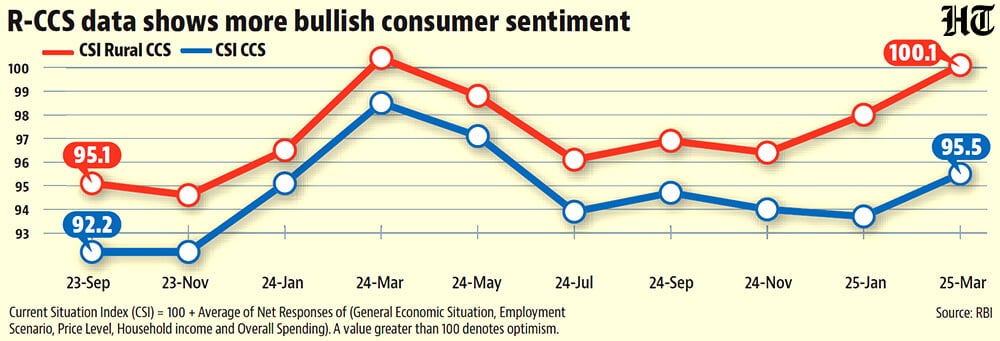
The Reserve Bank of India published data for its rural consumer confidence survey (R-CCS) for the first time in April 2025. R-CCS data has been published from September 2023 onwards in sync with the period for which we have the Consumer Confidence Survey (CCS) data. CCS is based on surveys in 19 major Indian cities. A comparison of R-CCS and CCS data shows that consumer sentiment is more bullish in rural areas than urban areas. What explains this difference ? A detailed examination of the data produces more questions than answers. The below charts explain this argument in detail.
How consumer sentiment in rural, urban India differs
 Rural consumer sentiment has been higher than urban consumer sentiment in every roundA comparison of current situation index (CSI) in the R-CCS and CCS data from September 2023 to March 2025 – the period for which we have data in both the series – shows that the former has been higher than the latter in every round. CSI is the average of net sentiment – difference between share of respondents who reported an improvement and worsening – on each of the metrics plus 100 so a value higher than 100 denotes optimism. What does this mean? Are rural India or farmers more bullish than their urban counterparts?
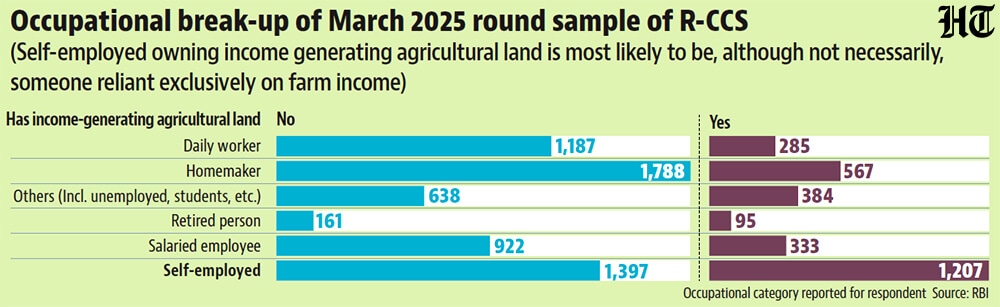
- But R-CCS does not cover rural India alone and not all rural respondents are farmersWhile the CCS in conducted in 19 major cities in India, the R-CCS is designed to cover “rural and semi urban households”. An analysis of unit-level data of the R-CCS throws more light on its composition. In the March 2025 round (latest data) of the R-CCS only about one-third of the respondents reported having income-generating agricultural land. The share of respondents who were self-employed and also owned income generating agriculture land – a farmer would display both these traits – was less than 14%. The larger point is, the R-CCS is likely to have a small minority of households who are completely dependent on farming income. To be sure, the R-CCS sample is in keeping with the evidence from NSS surveys, which shows that agricultural incomes are losing importance for a large majority of rural households in India.
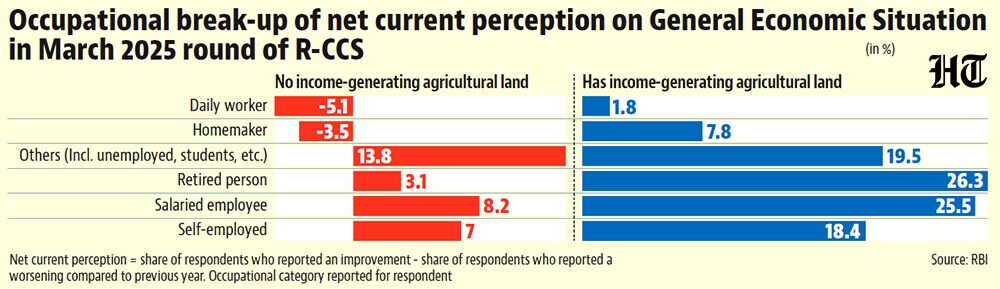
- Owning agricultural land leads to a better perception on general economic situation across occupational categoriesA break-down of the data by ownership of income generating agricultural land and occupational classification of the respondents for the March 205 round shows this clearly. General economic perception is higher across every occupational category for the group which has income generating agricultural land. Is this a reflection of land ownership and associated farm income bringing an additional sense of security? It is an interesting question to ask, especially in the context of salaried and retired (perhaps pensioners) reporting the highest net current sentiment among those owning agricultural land. Given the fact that economic sentiment among self-employed with agricultural land is lower than salaried or retired pensioners with agricultural land, it also begs the question whether farming is only useful as a complementary rather than stand-alone occupation.
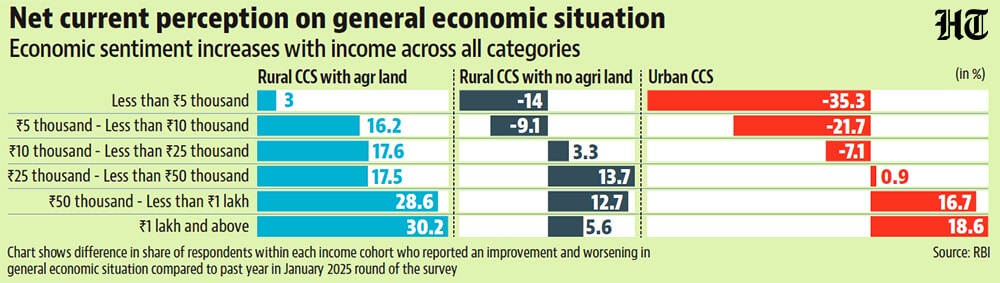
- The rich, however, are better off in all kinds of consumer cohortsThis is the most important takeaway from the unit-level data of the CCS and R-CCS. A comparison of net current sentiment by income categories in the CCS and R-CCS broken up by whether or not the respondents own income generating agricultural land shows that net current sentiment on general economic situation increases consistently with income for all three categories even though it is highest for the land-owning cohort in the R-CCS. Is this a refection of the fact that things are relatively better for a rich person in a small town or village than a bigger city where real incomes could be smaller? Once again, it is an interesting question to ask.


Unlock a world of Benefits with HT! From insightful newsletters to real-time news alerts and a personalized news feed – it's all here, just a click away! -Login Now!


