
 E-Paper



Non-metro cities take off in India's aviation boom | Number Theory
.
Updated on: Oct 6, 2025, 09:18:45 IST

 Prefer HTon Google
Share via


Copy link

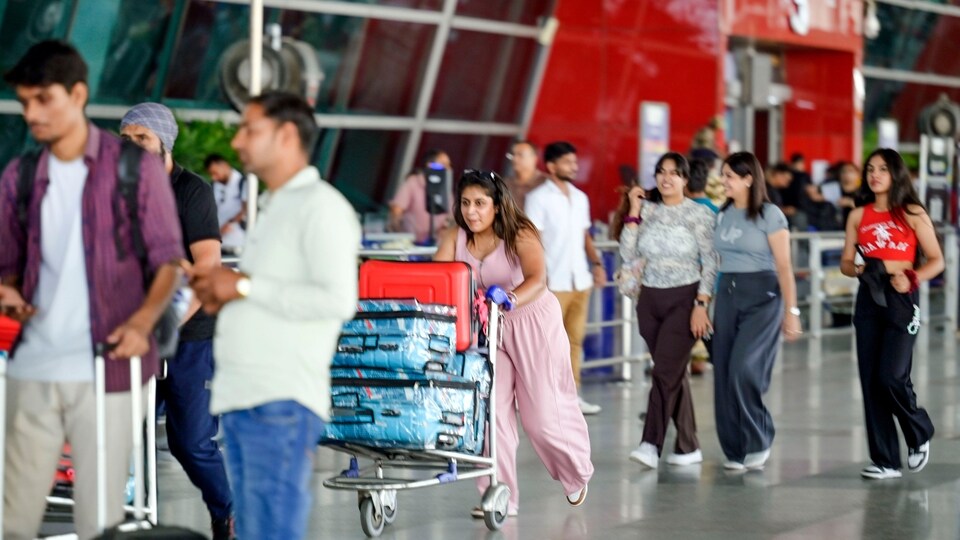
That India’s post-reform growth story has been an unequal one is a well accepted and commented upon fact. However, this inequality does not mean that growth has been the preserve of just a handful of places. In fact, there are enough signs that even as inequality persists, opulence is also spreading across India’s geography. Among the most important proofs of this is the growing share of non-metro towns in India’s aviation map. The numbers speak for themselves.
Non-metro cities take off in India's aviation boom
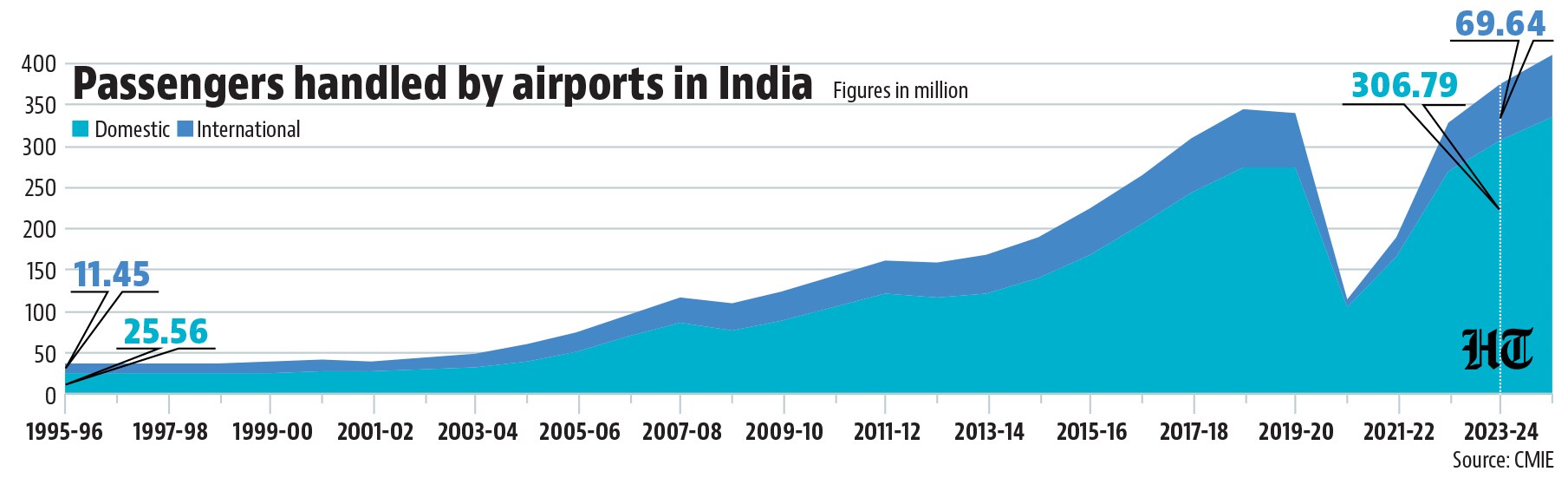
 Air travel has boomed in India in the last two decadesThe Centre for Monitoring Indian Economy (CMIE) database gives the number of domestic and international passengers handled by airports from 1995-96 onwards. This number was 25.6 and 11.4 million for domestic and international passengers in 1995-96 and increased by a multiple of 13 and 7 in the next three decades. Between 2005-06 and 2024-25 itself, the number of domestic and international air passengers in India has increased from around 51 and 22 million to 335 and 77 million respectively. The only dip in the long-term graph came during the pandemic, when flight operations were severely restricted. What is also noteworthy is the fact that the bulk of India’s aviation growth has come from domestic, not international, passengers. The ratio of domestic and international passengers has increased consistently if one were to ignore the pandemic year.
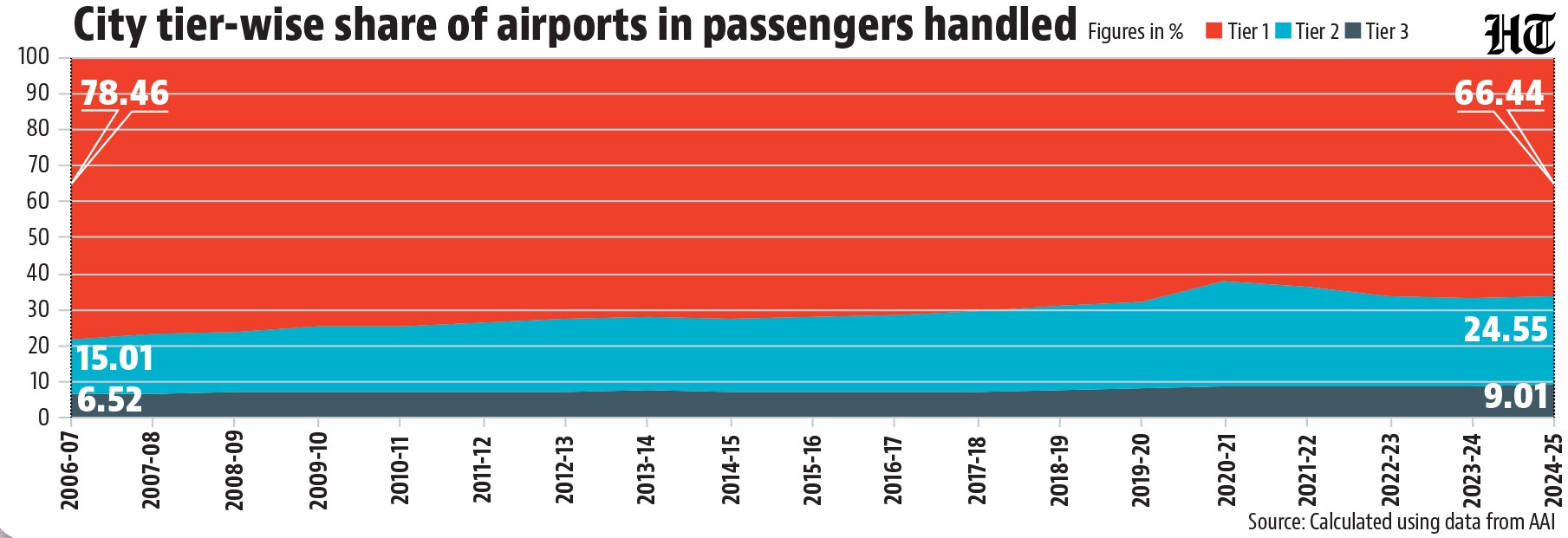
- Airports in metro regions still dominate, but their share has decreasedAs India’s skies have opened to millions of new fliers, the distribution of traffic across airports has shifted. Metro airports in the six largest cities (Delhi, Mumbai, Chennai, Kolkata, Bengaluru and Hyderabad) continue to handle the bulk of passengers, but their dominance is weakening. HT analysed this by drawing the fiscal year wise data from the airport-wise passenger traffic given in Airport Authority of India’s monthly traffic news reports. The airports were classified into metro and non-metro categories, and further into city tiers using the RBI’s official city tier framework. In 2006-07, these metros accounted for nearly three-fourths of all passengers handled by Indian airports. However, by 2024-25 their share had fallen to nearly 60%, with non-metro airports capturing around 40% of traffic. It is important to underline that both the embarking and disembarking airport count a passenger in their passenger handled numbers and therefore these numbers almost double the number of passengers flown by the airlines. A tier-wise view reinforces the shift: while Tier-1 cities still dominate, their share of passenger traffic has dipped from 78.5% in 2006-07 to around 66.4% in 2024-25, with Tier-2 cities gradually expanding their footprint from 15% to 24.6% and Tier-3 making small but notable gains to reach 9%.
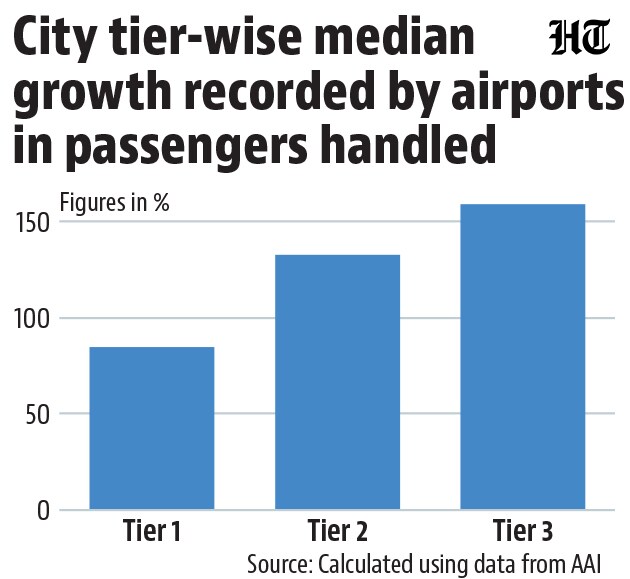
- Smaller cities are now driving India’s aviation boomHT analysed the city tier-wise growth numbers of 76 airports for which data is available from 2015-16 to 2024-25 from AAI’s reports. The results show that smaller cities have been driving India’s aviation boom: passenger traffic at Tier 1 airports grew a median 84.4% over the decade, while Tier 2 and Tier 3 airports saw far faster growth of 132% and 159% respectively. Kanpur Airport (Chakeri) in Uttar Pradesh and Mysore Airport in Karnataka—tier 2 and tier 3 respectively—stand out as airports that saw the most growth, recording extraordinary increases of 163480% and 7874%, albeit from a very low base. Both airports were long-established but highly underutilised with little or no scheduled service until the mid-2010s; their revival and subsequent surge were reinforced under the UDAN regional connectivity scheme. To illustrate, AAI data shows that the Kanpur airport handled just 197 passengers in 2015-16, and Mysore only 1190—by 2024-25, those figures had risen to 3,22,252 and 94,891, respectively.
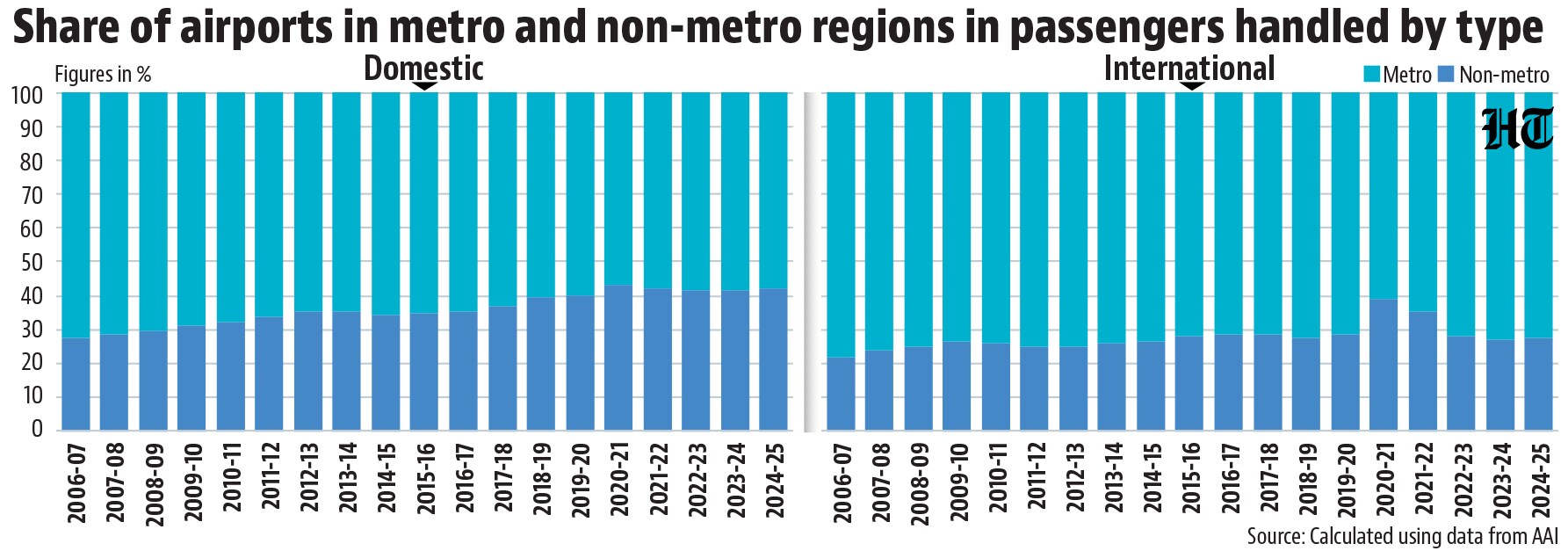
- Gap between metro, non-metro airports narrows more in domestic than international passengersThe narrowing of the metro and non-metro divide is most visible in domestic aviation. In 2006-07, nearly 73% of all domestic passengers in India passed through the airports in metro cities, while non-metro airports accounted for just over a quarter. By 2024-25, the metro share had dropped to around 58%, with non-metro airports handling four in every ten domestic passengers. Airports such as Lucknow, which expanded from barely 0.5 million domestic passengers in 2006-07 to nearly 5.3 million in 2024-25, and Jaipur, which grew from 0.6 million to more than 5.5 million domestic passengers in the same period, show how non-metro cities have emerged as major domestic hubs alongside the traditional metros. International travel, however, remains far more metro-centric. In 2006-07, they accounted for more than 78% of international passengers, and even by 2024-25 their share was only marginally lower at about 73%. For global carriers, scale and connectivity continue to concentrate traffic at the largest airports, limiting the extent of decentralisation seen in the domestic market.


Unlock a world of Benefits with HT! From insightful newsletters to real-time news alerts and a personalized news feed – it's all here, just a click away! -Login Now!


